
Family SUVs: Compare Jobs First, Badge Second
Chinese family SUVs can beat familiar badges on space, EV range, efficiency and towing. Compare BYD, GWM and MG on real family jobs first.
Most people assume they'd never buy a family SUV based on brand loyalty alone. Yet that's precisely what happens when the shortlist forms around badges first and daily household jobs second - and it's costing families real, measurable usefulness they could have had for the same money.
What if the SUV you dismissed actually does your family's jobs better?
Here's the counter-intuitive bit: several Chinese-branded SUVs aren't just cheaper alternatives to the vehicles you already know. They're now packaging together more of the practical outcomes families say they want - space, electrified range, efficiency, towing, safety tech - than some of the familiar names sitting higher on the consideration list [1][2][3][7][8].
Think of it like hiring a tradesperson. You could pick the one your neighbour used ten years ago, or you could compare the actual quotes, qualifications, and availability of everyone who tendered. The first approach feels safe. The second one gets the kitchen finished properly and on budget. Family SUV shopping works the same way, except the "tender documents" are spec sheets, independent reviews, and your own weekly routine.
So the better questions to ask aren't "Which badge feels right?" but rather: Which vehicle fits the most child seats with the least wrestling? Which one covers Monday-to-Friday trips on electricity and still handles the holiday drive without range anxiety? Which gives you boot space, towing, and driver-assist tech without blowing past your budget?
How much practical difference are we actually talking about?
The gap isn't abstract. Here's what current models show:
-
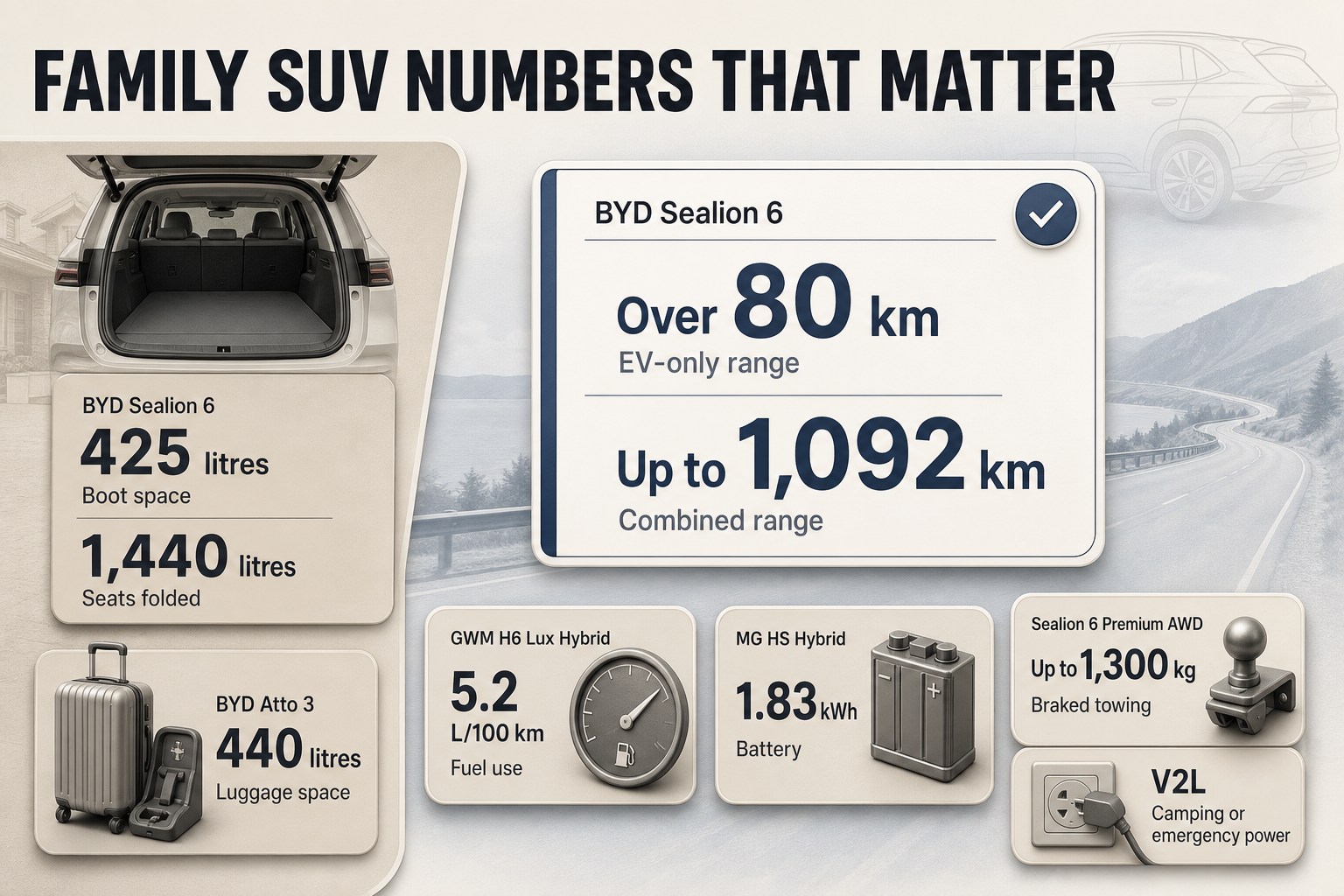
Boot space and family packaging: The BYD Sealion 6 offers 425 litres minimum, expanding to 1,440 litres with seats folded, plus flat-floor packaging and rear legroom designed around child-seat access and multi-passenger comfort [1][2][3]. The BYD Atto 3, despite compact exterior dimensions, delivers 440 litres of luggage space with ISOFIX on both outer rear seats - validated by the AA, not just manufacturer brochures [7].
-
Electrified range without the trade-off: The Sealion 6 lists over 80 km of EV-only range and up to 1,092 km combined range on one variant [1][2]. That means most weekday driving can happen on electricity, while long trips don't require charger-hunting or careful route planning.
-
Efficiency that's genuinely mainstream: The GWM H6 Lux Hybrid quotes 5.2 L/100 km on regular unleaded [4]. The MG HS Hybrid is tuned around a 1.83 kWh battery for smoother daily driving and improved fuel economy [6]. Neither is a compliance-car afterthought.
-
Towing and lifestyle flexibility: The Sealion 6 Premium AWD offers up to 1,300 kg braked towing, plus vehicle-to-load (V2L) capability for camping or emergency household power [1][2].
The AA's review of the Sealion 6 summed it up as balancing "safety, value, range, style and features" - the exact multi-variable bundle most family buyers say they're after [8].
What does getting this wrong actually feel like?
Say you're six months into owning a mid-spec SUV from a well-known brand. The badge felt reassuring on handover day. But now it's a Wednesday afternoon, and you're folding the rear seats flat to fit the kids' sports gear alongside the weekly shop - only the floor isn't flat, and the 380-litre boot means something always gets left behind. Your fuel bill hasn't dropped the way you hoped because the hybrid system is mild at best. The child seat still requires a minor contortion act every morning.
None of this is dramatic. It's just friction - the kind that repeats every school run, every supermarket trip, every long weekend away. Over five years of ownership, those small gaps in space, range, and efficiency compound into thousands of dollars in extra fuel, dozens of hours of packing frustration, and the quiet knowledge that your budget could have bought a vehicle that simply did more of your family's real jobs, better.
How should you actually build a family SUV shortlist?
The fix isn't complicated. It's a shift in sequence: assess the transport jobs first, then check which vehicles meet them, regardless of badge.
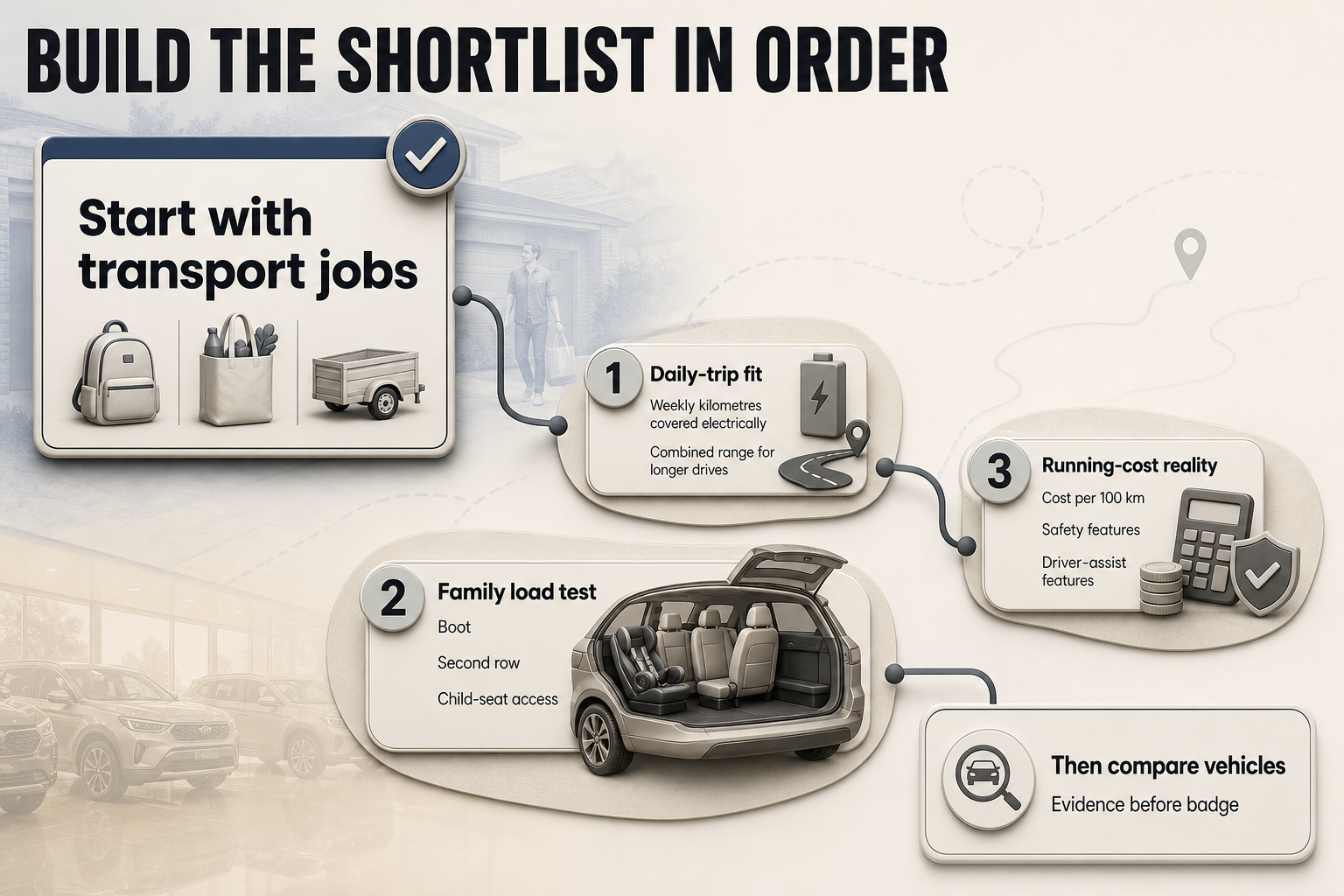
Three filters worth running before anything else:
- Daily-trip fit - How many of your weekly kilometres could be covered electrically? What's the combined range for longer drives?
- Family load test - Does the boot, second row, and child-seat access match your actual household, not a showroom walkthrough?
- Running-cost reality - What's the fuel or energy cost per 100 km, and does the vehicle include the safety and driver-assist features you'd otherwise pay extra for?
Skipping this step doesn't save time. It just means the shortlist gets shaped by habit instead of evidence.
Which SUV fits your family's next five years?
Start by writing down your household's top three vehicle jobs - the tasks the SUV will do most often. School drop-off and pickup. Weekly shopping. Holiday driving. Light towing. Whatever they are, put them on paper.
Then compare models side by side on those jobs. For families replacing a five-to-ten-year-old Japanese or Korean SUV, check whether a current BYD Sealion 6 or Atto 3 delivers more usable space, better electrified range, and stronger standard safety tech than the like-for-like replacement from your current brand [1][2][3][7][8]. For households chasing lower running costs without giving up practicality, put the GWM H6 Hybrid and MG HS Hybrid into the comparison on efficiency, refinement, and feature density [4][5][6].
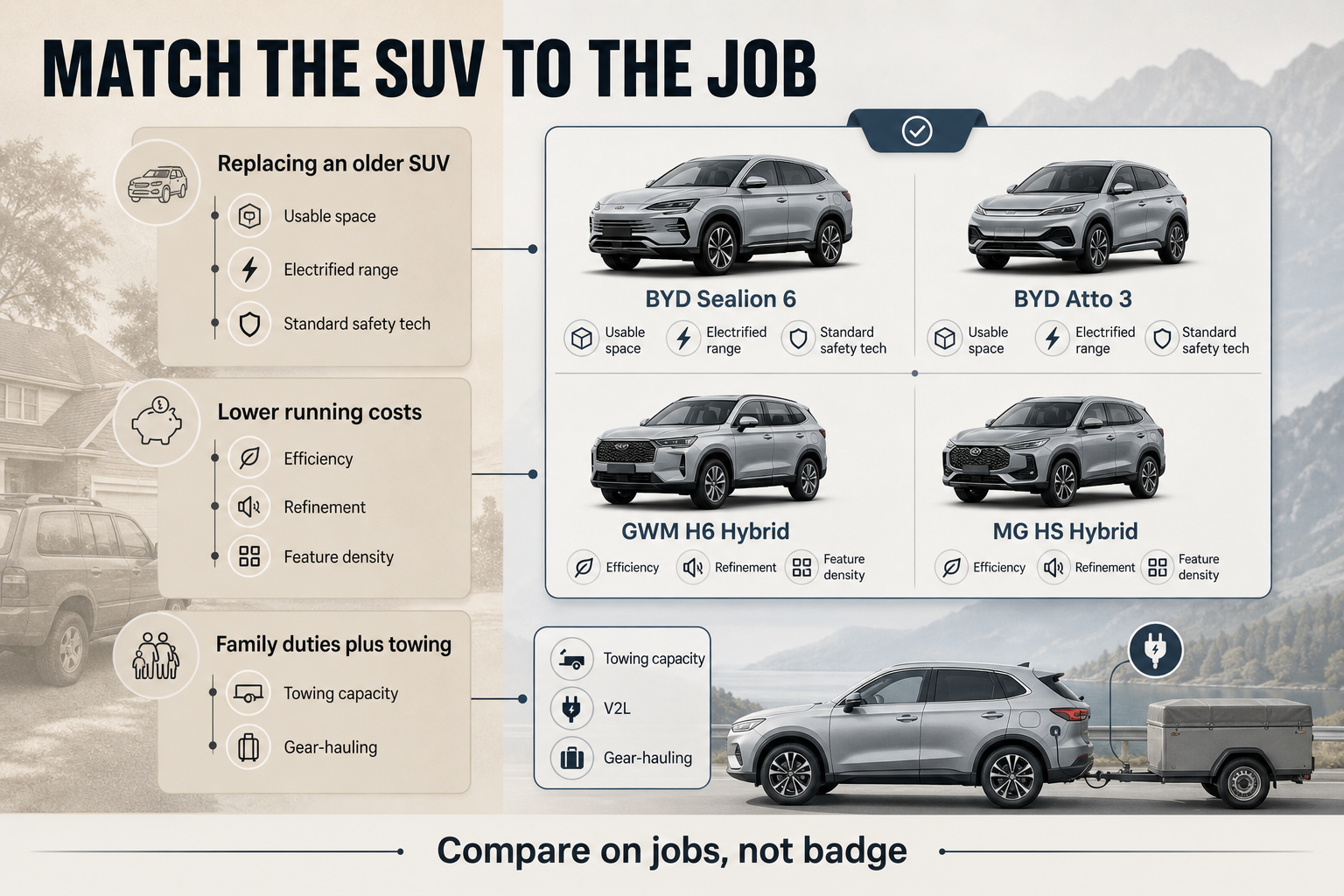
If you need one vehicle for weekday family duties and weekend towing or gear-hauling, check towing capacity and V2L alongside the usual comfort and space metrics [1][2].
The point isn't that any single model is automatically better. It's that filtering by badge first can screen out the vehicle that scores highest on the things your household actually lives with. Build the shortlist around your family's real jobs, compare on current evidence, and let the badge fall where it may.
What the brands say
These brands have chosen to respond directly to this independent research. We publish brand responses unedited because we believe transparency builds trust - and that brands willing to engage openly with independent analysis deserve to be heard.
You may also be interested in these independent articles
Sources
- [1]BYD Auto NZ - BYD Sealion 6 specification sheet, 2025
- [2]BYD Auto NZ - BYD Sealion 6 specification sheet, 2026
- [3]BYD Auto NZ - BYD Sealion 6 vehicle page, 2026
- [4]GWM New Zealand - The Arrival of Haval H6 Lux Hybrid, 2023
- [5]GWM New Zealand - 2025 Haval H6 model page, 2026
- [6]MG Motor New Zealand - All-new MG HS Hybrid range, 2026
- [7]New Zealand Automobile Association - BYD ATTO 3 car review, 2023
- [8]New Zealand Automobile Association - 2024 BYD Sealion 6 Super Hybrid SUV review, 2024
© 2026 pyfoi. All rights reserved.