

Is Keeping Your Old Car Costing You More?
Old car running costs can beat a new payment in NZ. Compare petrol, hybrid and EV costs over 12 to 24 months before another costly year slips by.
What if keeping the old car is actually the expensive choice?
Most people assume that holding onto a paid-off car is the thrifty move. Counter-intuitive as it sounds, your old car running costs may actually be higher than the monthly outlay on a newer, more efficient replacement. The absence of a car payment doesn't mean the absence of cost - it just means the cost is hiding in a different line of your household budget. And for many New Zealand households, that hidden line is growing.
This is a story about what happens over the next 12 to 24 months when you decide to keep the old petrol car versus switching to something newer and more efficient.
Does "paid off" really mean "low cost"?
Think of your car like a home heating system. Nobody would celebrate keeping a 15-year-old uninsulated electric heater just because it was paid off - you'd look at what it costs to run each winter. Yet with cars, we fixate on the purchase price and ignore the operating bill.
The real question isn't "Can I avoid a new payment?" It's "What operating model am I choosing to fund for another year?" Your 2010 to 2013 petrol car isn't just older. It runs on a fundamentally different cost structure than a 2026 hybrid or EV. The weekly fuel fill feels manageable because it's broken into small doses, but those doses add up to a much larger annual number than most households realise.
Better questions to ask yourself: What does my car actually cost me per 100 km? How does that compare with what's available now? And what am I giving up each month I wait?
What does the maths look like over a year?
Here's where the numbers get uncomfortable.
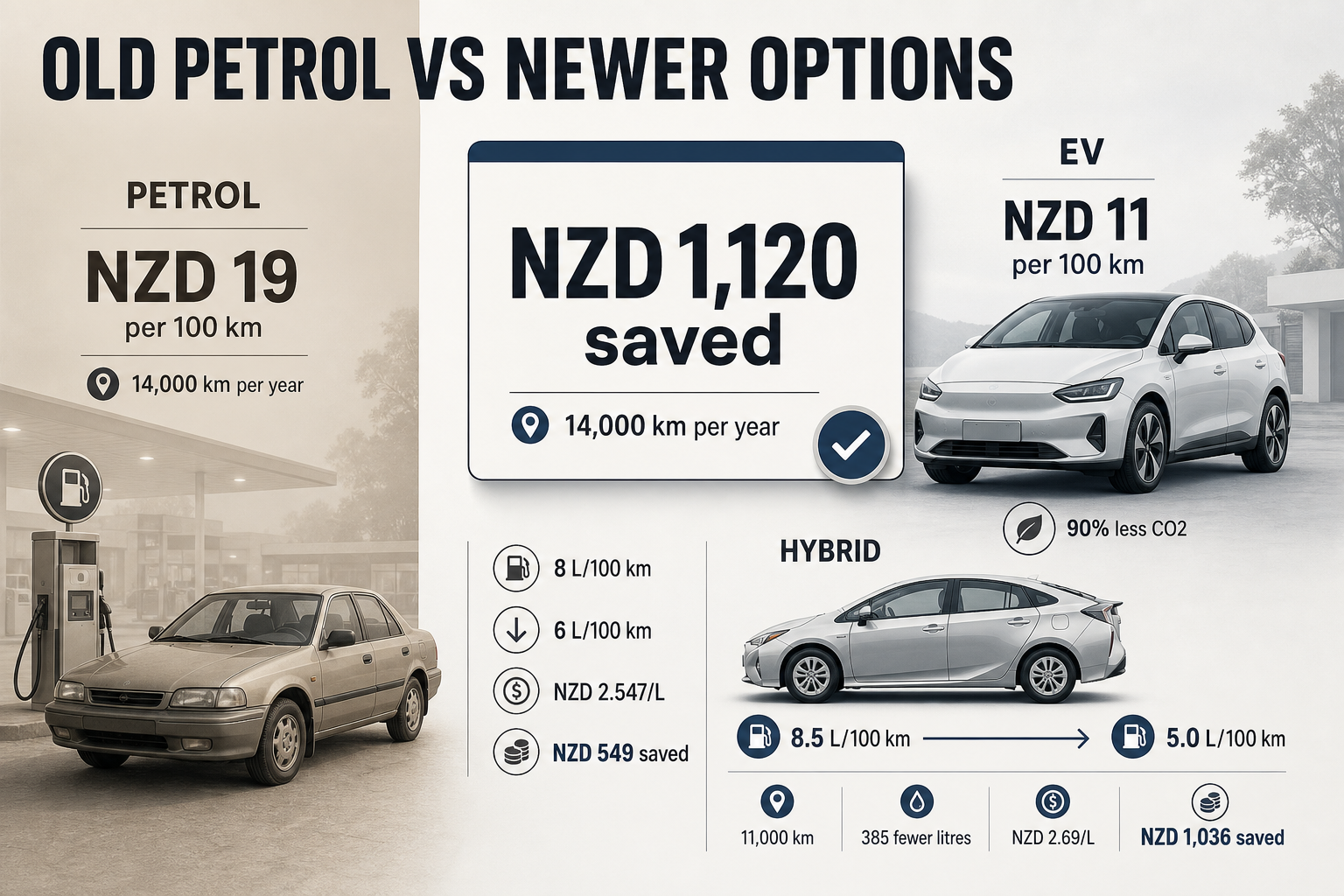
- EV versus petrol running costs: EECA estimates a home-charged EV costs about NZD 11 per 100 km off-peak, versus about NZD 19 per 100 km for a petrol car [1]. Over the EECA standard of 14,000 km per year, that's roughly NZD 1,120 in annual savings from energy alone [1][4].
- Even a modest efficiency gain helps: Moving from an 8 L/100 km petrol car to a 6 L/100 km vehicle at MBIE's Q4 2024 regular petrol price of NZD 2.547/L saves about NZD 549 a year at average distance [12][11].
- Hybrid versus older petrol: If your current car uses 8.5 L/100 km and a replacement hybrid uses 5.0 L/100 km over 11,000 km, that's roughly 385 fewer litres and about NZD 1,036 saved annually at NZD 2.69/L [13][14].
- Emissions aren't abstract either: EECA says EVs driven in New Zealand emit about 90% less CO2 than equivalent petrol vehicles, thanks to our renewable-heavy electricity grid [1][2].
None of these savings start until you actually make the switch. Every month of delay is another month paying the old cost base.
How does this play out at your place?
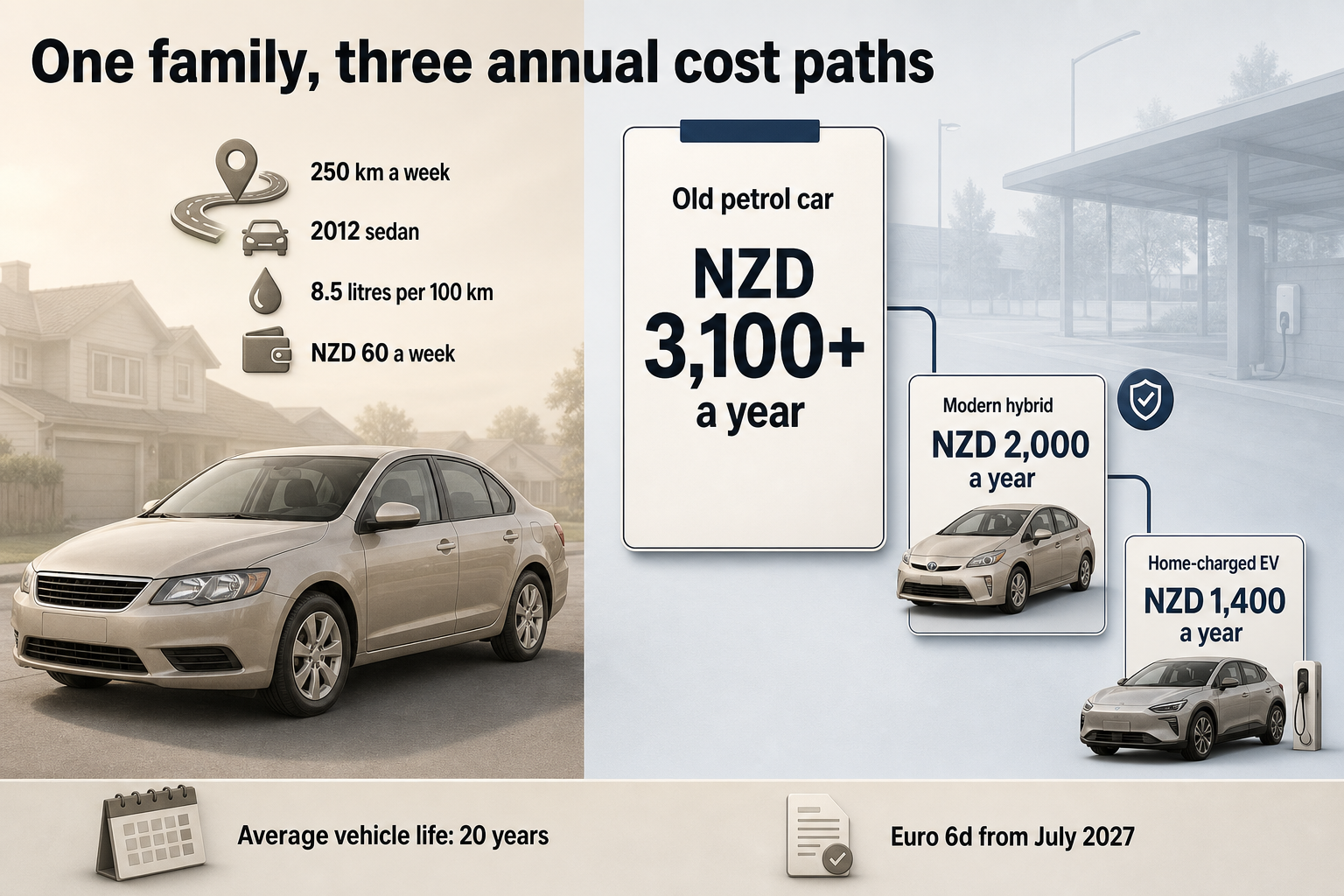
Say you're a suburban family outside Hamilton, doing a predictable 250 km a week between work, school, and weekend activities. Your 2012 sedan sips about 8.5 litres per 100 km. Fuel costs you roughly NZD 60 a week - not painful, but not nothing.
Over 12 months, that's more than NZD 3,100 in petrol. A modern hybrid doing the same trips might cost you NZD 2,000. An EV charged overnight at home could drop that to around NZD 1,400. The gap isn't just money. It's the slow drip of spending that stops you putting cash toward the kids' sports fees, a family holiday, or simply building a buffer. Meanwhile, your car sits in a fleet where vehicles last an average of about 20 years [7], and emissions standards are tightening - Euro 6d phases in from July 2027 [9]. The longer you wait, the further your car drifts from where the market is heading.
What should you actually weigh up?
Rather than asking "Can I keep going another year?", run your decision through three filters:
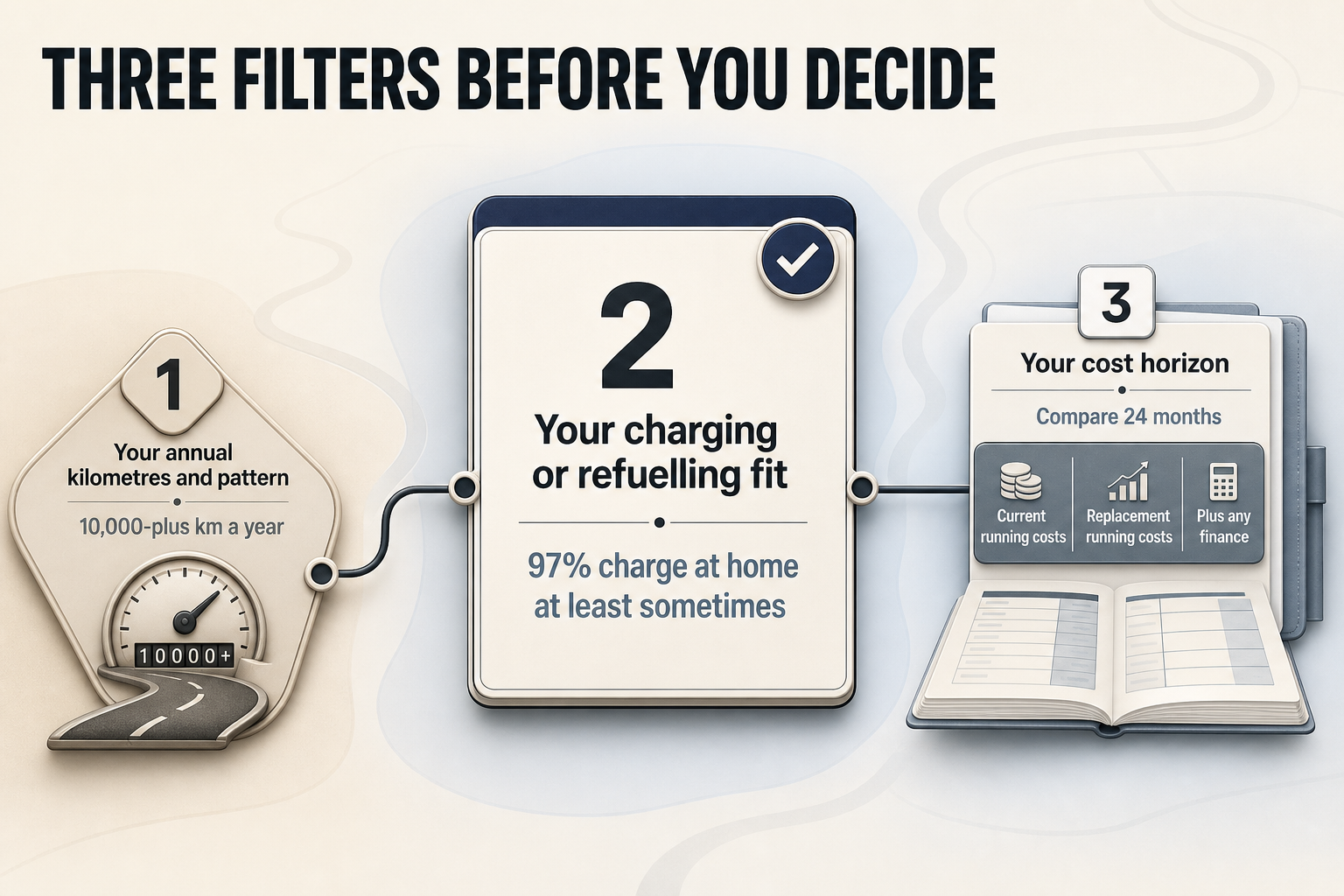
- Your annual kilometres and pattern. Predictable, regular driving is where efficiency gains compound fastest. If you're doing 10,000-plus km a year, the savings are real.
- Your charging or refuelling fit. If you can charge at home overnight - and 97% of NZ EV owners do charge at home at least sometimes [21] - the cost advantage is strongest. No home charging? A hybrid still cuts your fuel bill without needing a plug.
- Your cost horizon. Compare 24 months of your current running costs against 24 months of a replacement's running costs plus any finance. The old car's "free" status often looks less impressive across a two-year window.
Ignoring this doesn't pause the cost. It just keeps it invisible.
So what's the smartest move for your household?
Start by making your current car's true operating cost visible. Check your fuel receipts or banking app for the last three months, multiply out to a year, and write that number down. Then look up a comparable newer hybrid or EV on EECA's vehicle energy labels to see its estimated annual running cost at 14,000 km [4][10]. The gap between those two numbers is what delay costs you each year.
If you drive a lot and can charge at home, an EV gives you the biggest operating-cost shift - potentially NZD 800 to NZD 1,100 a year in energy savings alone [1][4].
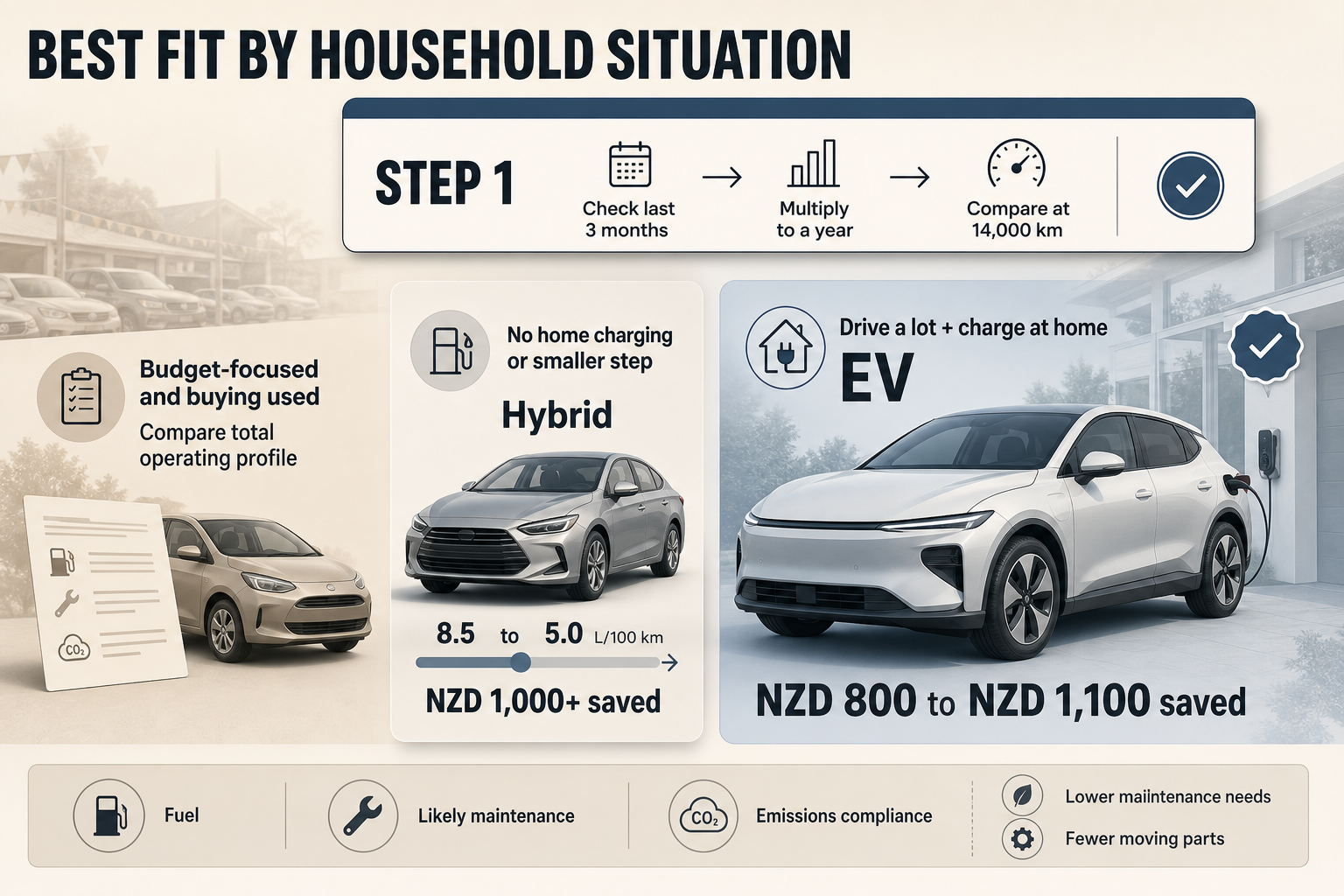
If home charging isn't practical or you want a smaller step, a modern hybrid still cuts fuel use meaningfully. Moving from 8.5 to 5.0 L/100 km can save more than NZD 1,000 a year at current petrol prices [13][14].
If you're budget-focused and buying used, compare the total operating profile - fuel, likely maintenance, emissions compliance - not just the sticker price. EECA notes battery EVs generally have lower maintenance needs due to fewer moving parts [1][5].
The real shift here isn't about going green for its own sake. It's recognising that your paid-off petrol car carries a running-cost premium you're paying every week, whether you notice it or not. The sooner you put a number on that gap, the sooner you can decide whether keeping the old operating model is genuinely the conservative choice - or just the familiar one.
You may also be interested in these independent articles
Sources
- [1]EECA - Benefits of electric vehicles for your home, 2026
- [2]EECA - The impact of electric homes, 2026
- [3]EECA - Drive efficiently and save on fuel costs, 2026
- [4]EECA - About the Vehicle Emissions and Energy Economy Labelling Programme, 2026
- [5]EECA - Compare electric vehicle types and benefits, 2026
- [6]NZ Transport Agency Waka Kotahi - Considering new safety requirements for vehicles entering the New Zealand fleet, 2025
- [7]Ministry of Transport - Frequently Asked Questions, 2025
- [8]Ministry of Transport - Reducing noxious vehicle emissions from road transport, 2026
- [9]EECA - About the Vehicle Emissions and Energy Economy Labelling Programme, 2026
- [10]NZ Transport Agency Waka Kotahi - Considering changes to light vehicle inspections, 2025
- [11]MBIE - Oil: Energy in New Zealand 2025, 2025
- [12]New Zealand Parliament - Monthly Economic Review: March 2026, 2026
- [13]Rewiring Aotearoa - Scale and speed: why the climate needs electric vehicles, 2025
- [14]EECA - How to charge your EV at home and on the road, 2026
© 2026 pyfoi. All rights reserved.