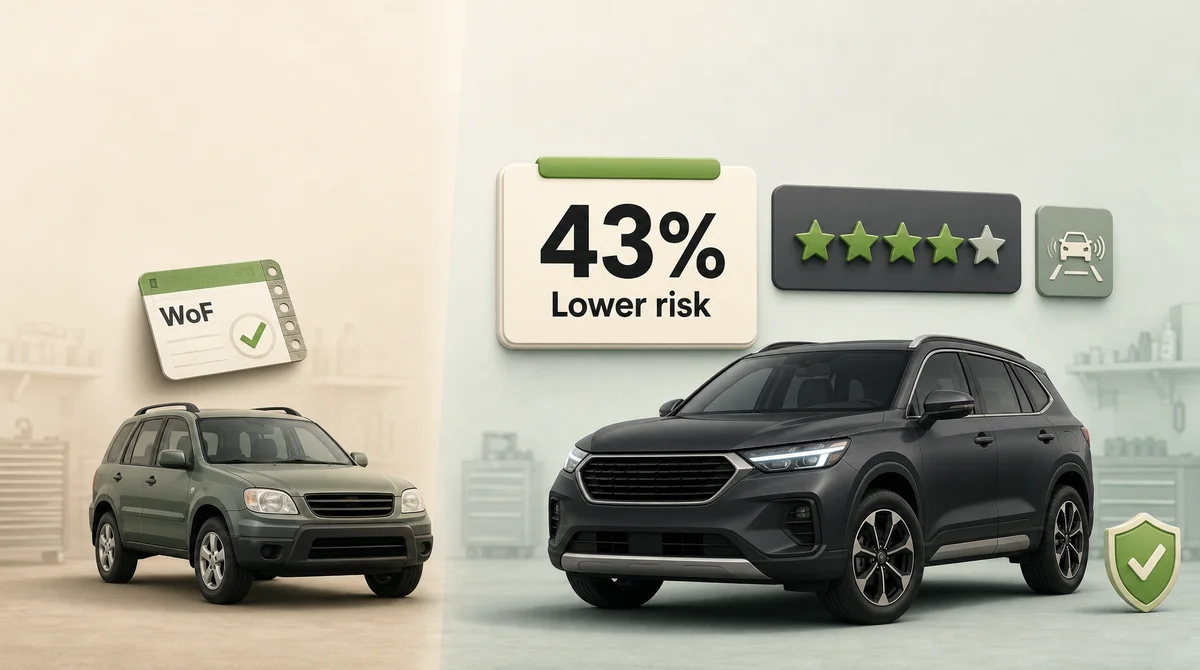

Why a WoF Pass Can Cost Your Family More
A WoF pass does not equal family car safety. Learn how older NZ cars raise crash risk, repair costs, and why Rightcar checks matter now.
What if your biggest car expense isn't the one you're paying?
Say you're sitting in the driveway after another clean WoF pass, sticker fresh on the windscreen. The car's paid off. No monthly repayments. Feels like the smartest financial move you can make - just keep driving. But that sense of savings might be the most expensive assumption your household is making right now. Every month you hold onto a 2011-era family car because "it still passes," you're quietly stacking up costs that never appear on a single invoice. Let's walk through what that ladder actually looks like.
Does a WoF pass really mean your family car is safe?
Here's the belief most households run on: if the car passed its Warrant of Fitness, it's been checked and confirmed safe. That feels logical. The WoF is government-mandated, carried out by certified inspectors, and it's pass or fail. But NZTA is explicit - a WoF confirms basic roadworthiness at the time of inspection, not modern crash protection or crash-avoidance capability [1][2]. AA puts it even more plainly: a current WoF is not proof the vehicle is safe [3].
Think of it like a building code inspection on a 1990s house. The inspector confirms the roof doesn't leak and the wiring won't start a fire today. They're not certifying it has modern insulation, double glazing, or earthquake strengthening. You wouldn't tell your family the house is "up to code" if what you mean is "it hasn't fallen down yet." The same gap exists in your garage.
So the better questions are: what's my car's actual safety star rating? Which crash-avoidance systems does it have - or lack? And how does its protection compare to what a 2025 or 2026 vehicle offers?
What's the baseline cost of waiting one more month?
The first rung on the ladder is the safety gap itself. About 40% of New Zealand's light vehicles - roughly 1.8 million - sit at just 1 or 2 safety stars [4]. Those low-rated vehicles are involved in 66% of death and serious injury crashes [5]. NZTA data shows drivers in 2023-model vehicles face 43% lower risk of death or serious injury compared to those in 2001-era cars [6].
That's not a marginal difference. It's a generational shift in protection your family misses out on every single month you wait.
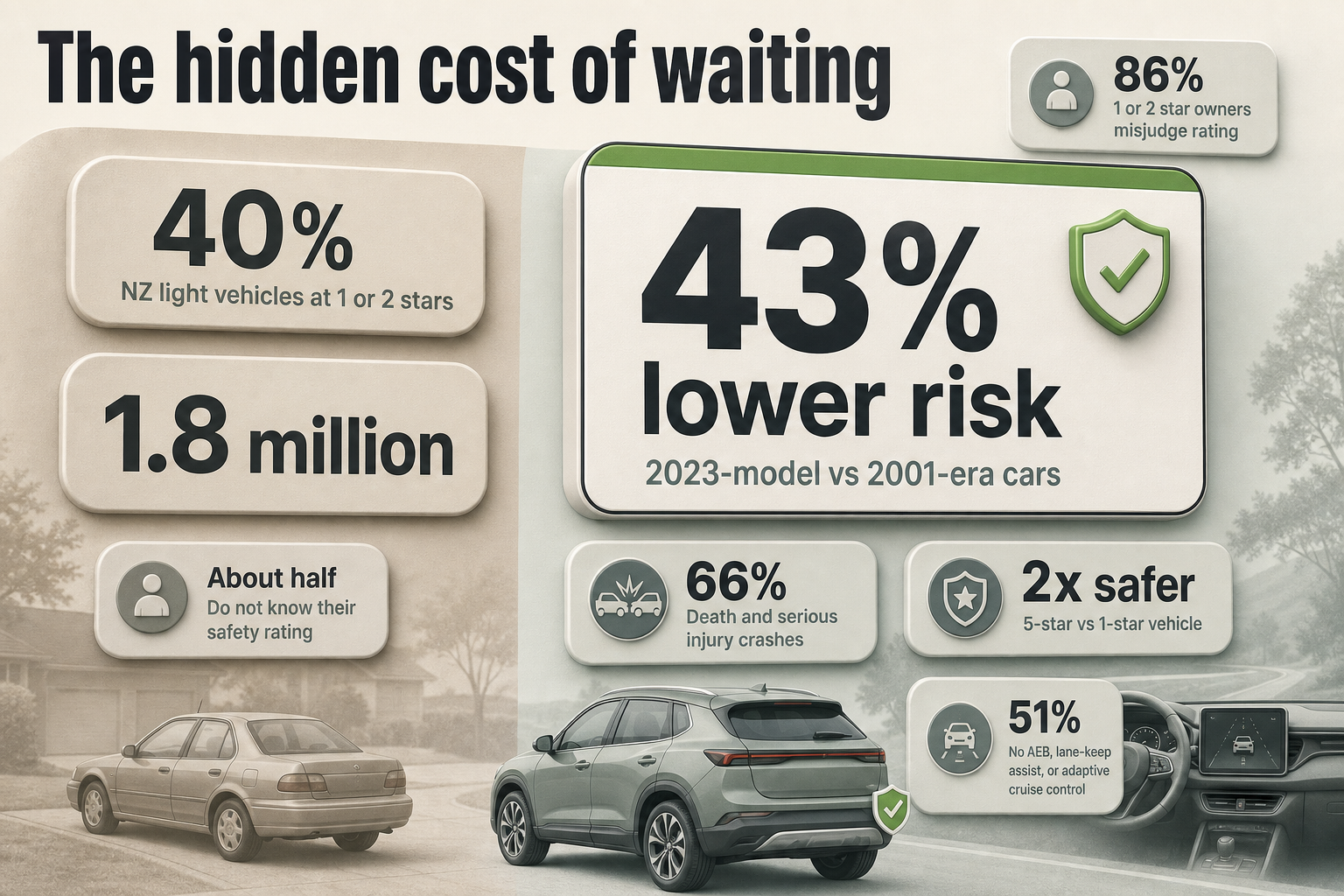
- NZTA says people are twice as safe in a 5-star vehicle as in a 1-star vehicle [4][7].
- About half of vehicle owners don't know their car's safety rating, and 86% of 1- or 2-star vehicle owners either don't know or overestimate it [7].
- AA's 2025 survey found 51% of members said their main vehicle had none of the common safety technologies like AEB, lane-keep assist, or adaptive cruise control [8].
How do costs compound beyond safety?
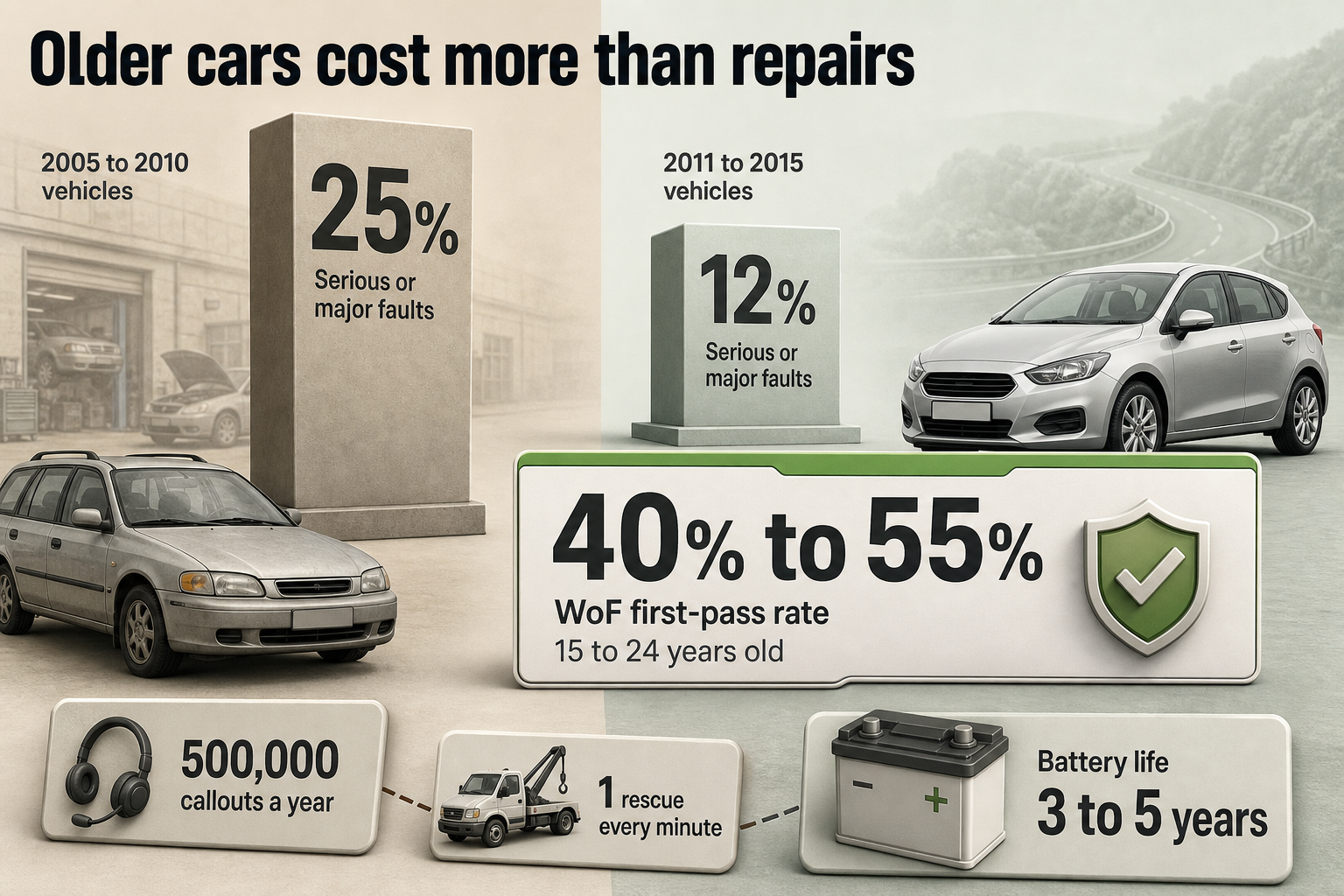
Layer on the mechanical reality. Consumer NZ found roughly 25% of 2005 to 2010 vehicles had serious or major faults, compared with 12% for 2011 to 2015 models [9]. NZTA consultation data shows WoF first-pass rates for vehicles aged 15 to 24 years sit between about 40% and 55% - meaning nearly half fail on the first attempt [10]. Each fail means remediation costs, time off the road, and the quiet stress of wondering what's next.
AA Roadservice handles about half a million callouts a year - roughly one rescue every minute [11]. Batteries typically last three to five years and can fail without warning after that [12]. These aren't dramatic breakdowns. They're Tuesday-morning disruptions that chip away at your time, your budget, and your confidence in the car.
What does this feel like at the kitchen table?
Take a Thursday evening when you're reviewing the bank account after a $900 suspension repair that wasn't on the radar three weeks ago. The car passed its WoF in April, so you assumed you were clear until October. Now you're juggling whether to fix it again or start shopping under pressure - except you haven't researched safety ratings, you don't know what crash-avoidance features to look for, and the school holidays are two weeks away. That's the moment delay converts from "saving money" to "losing control of the decision." Your family's safety, your finances, and your peace of mind all land on the table at once.
How should you think about the keep-or-replace decision?
Instead of asking "did it pass?", run every keep-or-replace conversation through three filters:
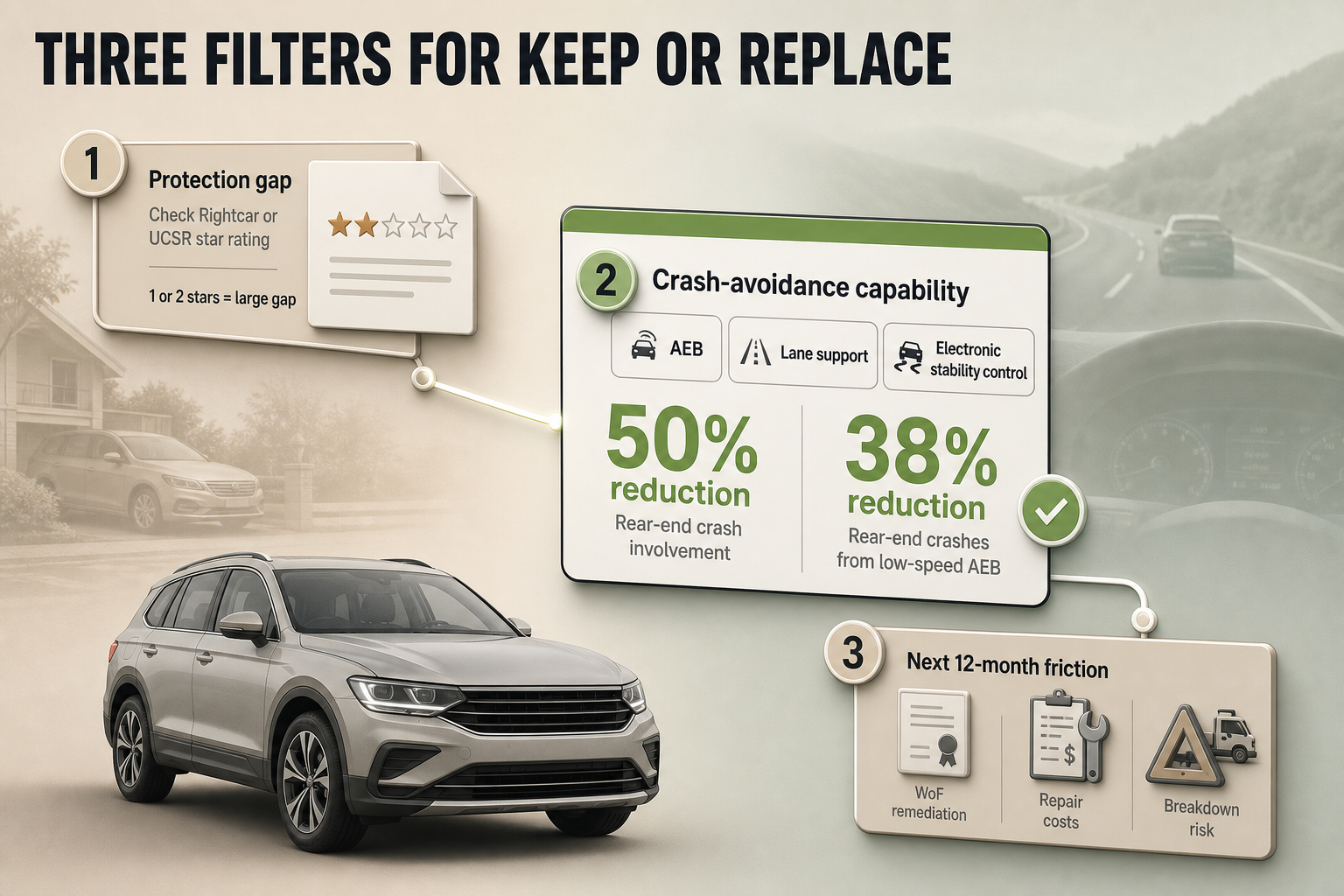
- Protection gap - Look up your car's Rightcar or UCSR star rating and compare it to a modern replacement. If you're at 1 or 2 stars, the gap is large.
- Crash-avoidance capability - Does your car have AEB, lane support, or electronic stability control? IIHS research links front crash prevention systems to a 50% reduction in rear-end crash involvement [13]. ANCAP cites a 38% reduction in rear-end crashes from low-speed AEB [14]. If your car has none of these, that's not a feature wish-list - it's a missing safety layer.
- Next-12-month friction - Estimate likely WoF remediation, repair costs, and breakdown risk. If you're spending to maintain minimum compliance on a car that doesn't protect like a modern one, you're funding the wrong thing.
So what should you actually do this week?
Start by looking up your vehicle on Rightcar.govt.nz. Check the safety star rating and the crash-avoidance features rating [4][15]. If your car sits at 1 or 2 stars and lacks AEB or lane support, you now have the real picture - not the WoF-pass picture.
For families with kids in the car daily, prioritise that protection gap over badge, styling, or sticker price. A 4- or 5-star vehicle with AEB and lane support is a fundamentally different level of family cover, not just a newer model.
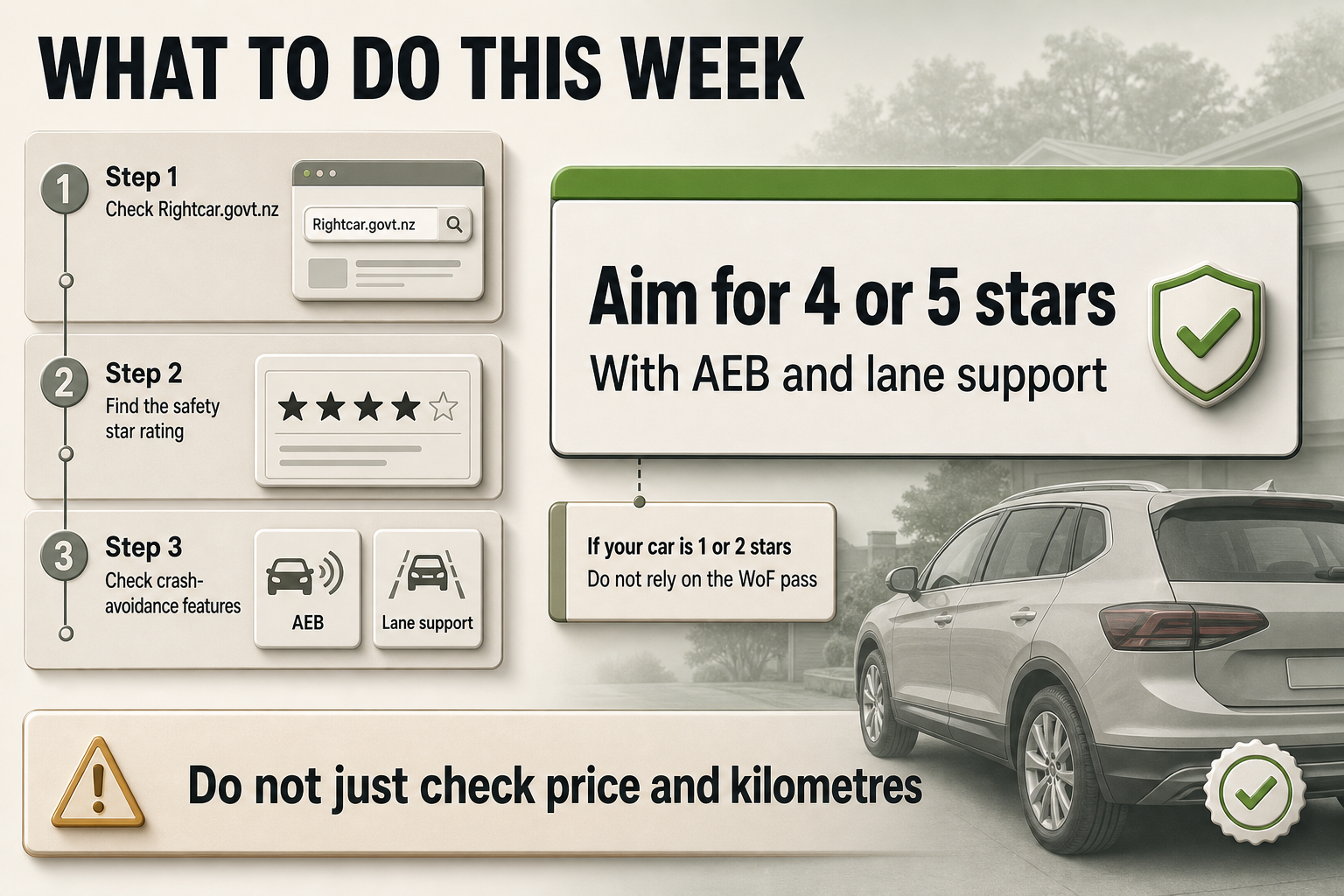
If you're budget-conscious and leaning toward used imports, don't just check price and kilometres. Check the Rightcar rating and whether the model includes crash-avoidance systems - NZTA is consulting on requiring AEB and lane-keep support for vehicles entering the fleet, signalling these are becoming baseline expectations [16].
For households also considering lower running costs or electrification, treat WoF status as irrelevant to the bigger question: you may be delaying both a safety upgrade and meaningful fuel savings simultaneously.
The core shift is simple. Stop using "it passed" as your keep-or-replace rule. Your WoF sticker confirms your car was roadworthy on one day. It says nothing about whether your 2011 family car protects your household like a 2026 vehicle does. That comparison - your driveway car versus today's safety baseline - is the one that matters.
What the brands say
These brands have chosen to respond directly to this independent research. We publish brand responses unedited because we believe transparency builds trust - and that brands willing to engage openly with independent analysis deserve to be heard.
You may also be interested in these independent articles
Sources
- [1]NZ Transport Agency Waka Kotahi - Warrant of fitness, 2026
- [2]NZ Transport Agency Waka Kotahi - Considering changes to light vehicle inspections, 2025
- [3]New Zealand Automobile Association - AA welcomes new WoF rule, 2013
- [4]NZ Transport Agency Waka Kotahi - Vehicle safety, 2026
- [5]NZ Transport Agency Waka Kotahi - Considering new safety requirements for vehicles entering the New Zealand fleet, 2025
- [6]NZ Transport Agency Waka Kotahi - Buying a car? Check the stars, 2025
- [7]NZ Transport Agency Waka Kotahi - Kiwis urged to check vehicle safety ratings, 2023
- [8]New Zealand Automobile Association - AA Vehicle Technology Survey 2025, 2025
- [9]Consumer NZ - Should you buy a used or nearly new car?, 2026
- [10]NZ Transport Agency Waka Kotahi - Vehicle Standards Compliance Amendment 2025, 2025
- [11]New Zealand Automobile Association - AA Roadservice, 2026
- [12]New Zealand Automobile Association - AA Battery Service, 2026
- [13]Insurance Institute for Highway Safety - Effectiveness of forward collision warning and autonomous emergency braking systems, 2019
- [14]ANCAP - Study confirms effectiveness of Autonomous Emergency Braking, 2015
- [15]NZ Transport Agency Waka Kotahi - 2024 vehicle safety ratings released on Rightcar.govt.nz, 2024
- [16]NZ Transport Agency Waka Kotahi - Considering new safety features for vehicles imported into New Zealand, 2026
© 2026 pyfoi. All rights reserved.