
How to Read Refrigerator Review Ratings in NZ
Refrigerator review ratings can mislead NZ buyers. Learn how to compare fridge reviews, energy labels, noise, service and running costs.
A refrigerator’s review rating is a shortcut, not a verdict. It usually rolls up customer satisfaction, reliability, noise, layout, cooling performance and after-sales support into a simple star score, but the number only helps if you know what sits behind it.
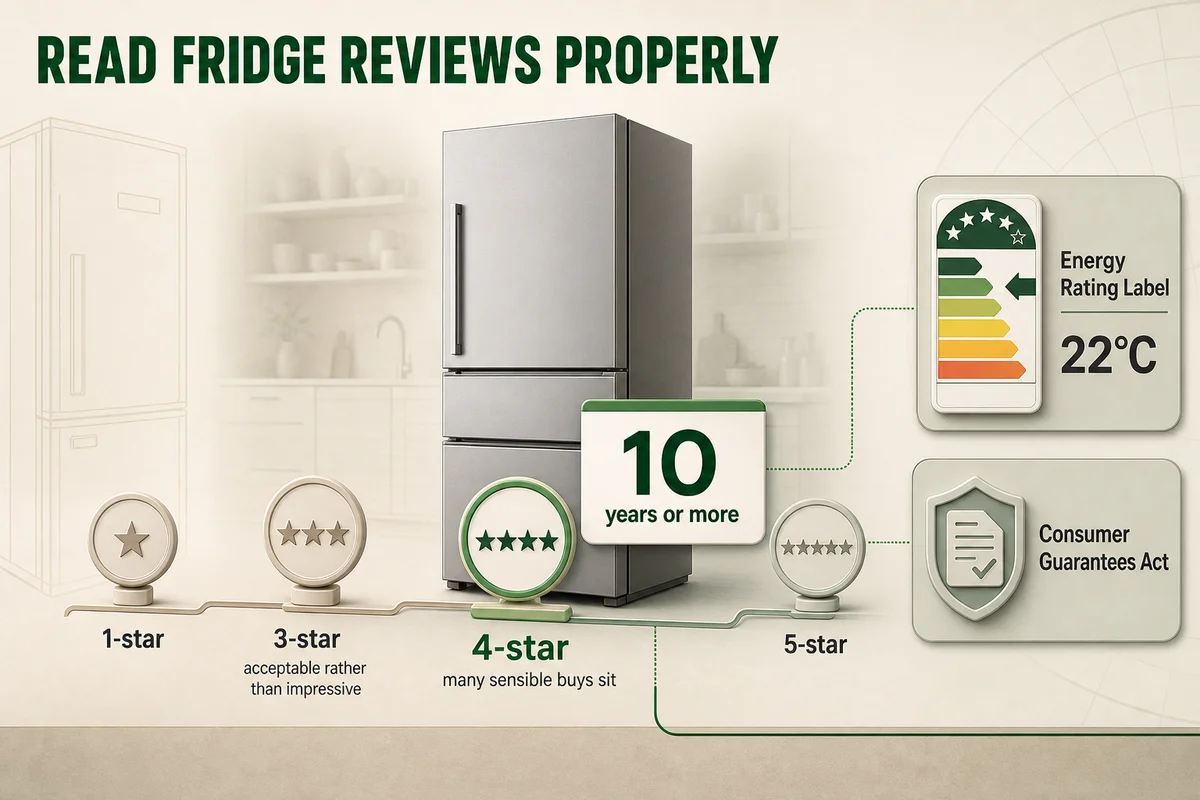
For New Zealand buyers, this matters because a fridge is a long-life appliance that runs 24 hours a day. A model with glowing early reviews can still be a poor buy if it is noisy in an open-plan home, awkward to service outside the main centres, or expensive to run over time. Consumer NZ notes that a new fridge should last 10 years or more, while EECA’s guidance and labels help you compare ongoing electricity use before you buy. (consumer.org.nz)
What Goes Into the Rating
A refrigerator review rating is usually built from either customer feedback, expert testing, or a mix of both. Customer ratings tend to reflect day-to-day ownership: whether the fridge is quiet, whether shelves are practical, whether the ice maker is annoying, whether the doors seal properly, and whether the brand sorted out problems quickly. Expert reviews usually go deeper into temperature stability, usable storage space, energy use, noise, ease of cleaning and how well crisper drawers and freezer sections work. Consumer NZ says its fridge reviews combine expert testing with member feedback on reliability and satisfaction, which is more useful than a bare retail star score on its own. (consumer.org.nz)
On a 5-star review scale, a 1-star refrigerator rating usually signals major dissatisfaction. That might mean repeated faults, poor internal layout, loud operation, flimsy fittings or frustrating service. A 2-star score often points to a fridge that works but has obvious compromises, such as uneven cooling, awkward shelving or disappointing support if something fails.
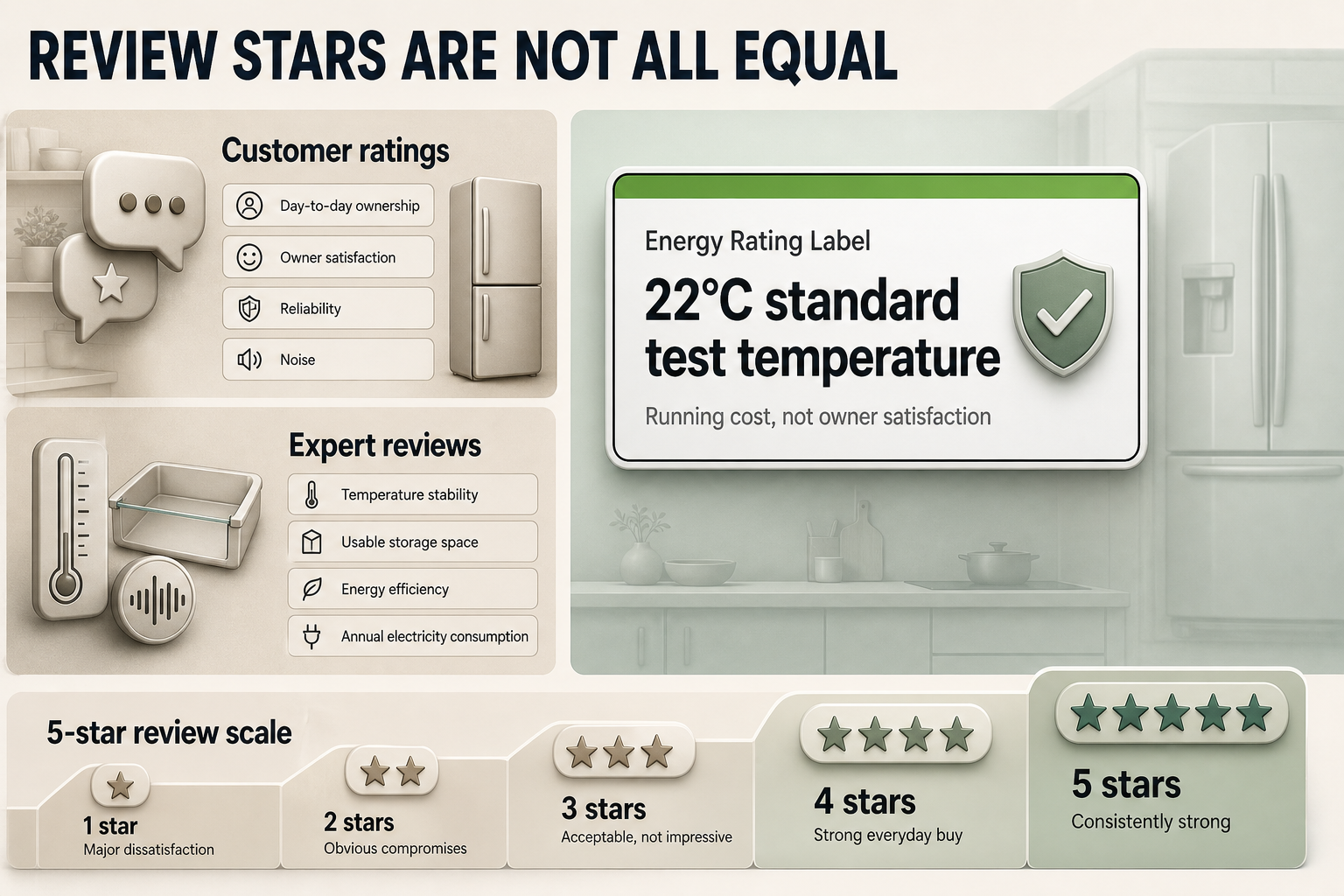
A 3-star rating is the middle ground. These fridges are often acceptable rather than impressive. They may suit a tight budget or a secondary space such as a garage kitchenette, but they rarely stand out for quietness, finish or long-term owner satisfaction. You should expect trade-offs somewhere, whether in storage flexibility, freezer design, or service experience.
A 4-star rating is where many sensible buys sit. These refrigerators usually perform well in everyday use, have fewer recurring complaints, and offer a better balance of reliability, usability and value. A 5-star rating suggests consistently strong ownership experience or top-tier test performance, but even then you still need to check whether the model suits your kitchen, household size and power bill expectations.
The biggest trap is assuming all stars are measured the same way. They are not. A retailer’s website might average a small number of buyer comments, while an independent review body may use structured testing. An energy star rating is different again. In New Zealand, the Energy Rating Label on fridges and freezers shows energy efficiency and annual electricity consumption, based on standard testing assumptions, including a surrounding temperature of 22°C. That label is about running cost, not owner satisfaction. (eeca.govt.nz)
What to Look For
Start by checking who created the rating. Independent testing and large-sample owner surveys usually tell you more than a handful of retail reviews. If the score comes from customer feedback, look at how many reviews sit behind it. A refrigerator with 4.8 stars from 12 buyers is less convincing than one with 4.3 stars from several hundred owners over a longer period.
Next, read beyond the average. With refrigerators, the written comments often matter more than the final star number. Look for repeated mentions of temperature problems, compressor noise, broken door bins, condensation, poor shelf design or slow warranty handling. One complaint could be bad luck. Twenty similar complaints usually point to a pattern.
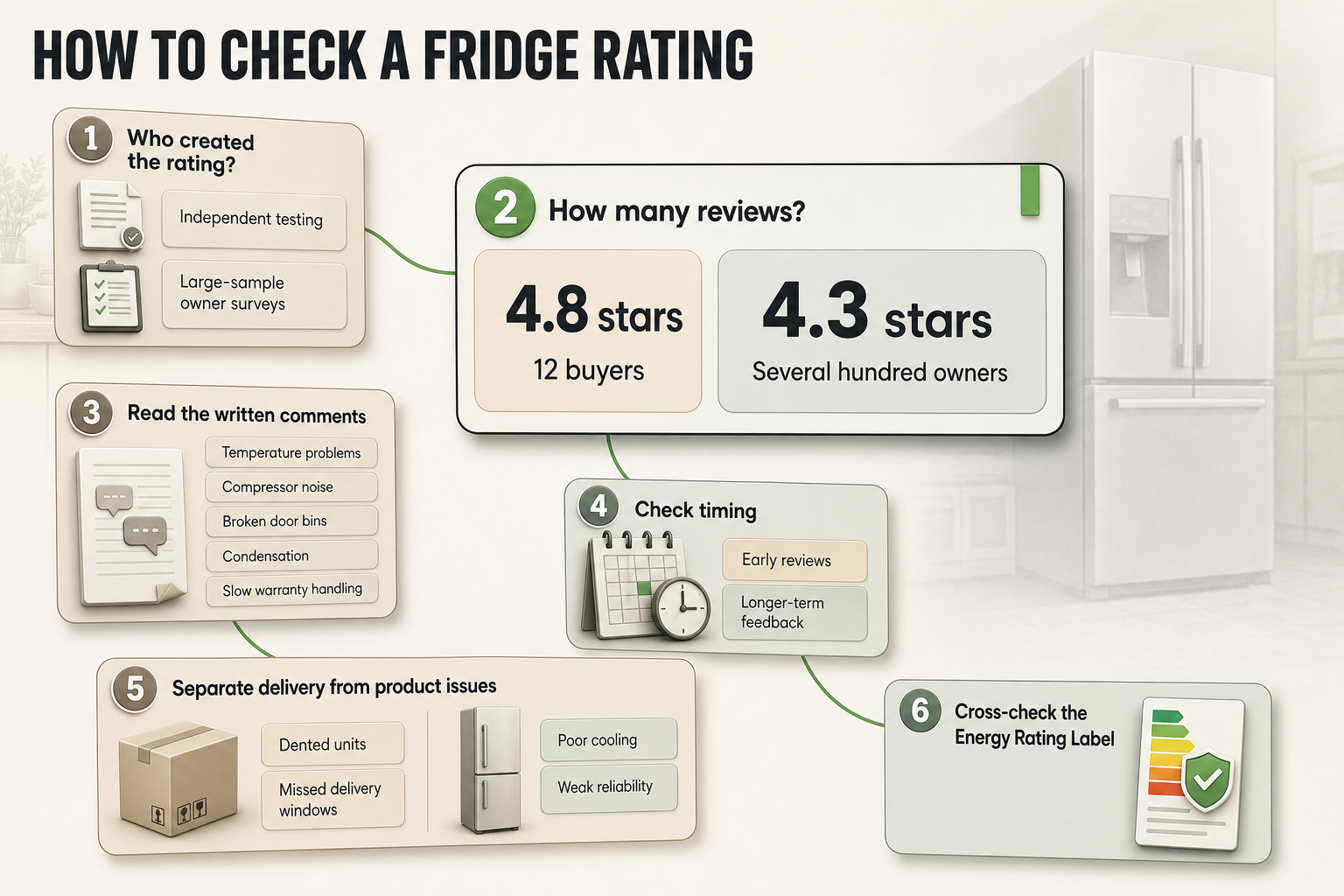
Pay close attention to timing. Many fridge reviews are posted in the first few weeks, when buyers are still happy with the finish and door feel. That tells you very little about reliability. Longer-term feedback is more useful because faults with seals, electronics, ice makers, fans and hinges often show up later. Consumer NZ’s reliability and satisfaction data is valuable for that reason, because it draws on owners’ lived experience rather than first impressions alone. (consumer.org.nz)
You should also separate product complaints from delivery complaints. A low retailer score might reflect dented units, missed delivery windows or poor installation rather than a bad refrigerator. Those issues still matter, especially for large built-in or French-door models, but they are not the same as poor cooling or weak reliability.
Check the product information sheet or manual as well. Consumer NZ recommends looking at the manufacturer’s manual, installation guide or product information sheet before buying. That is a smart way to confirm whether review complaints are tied to real design limits, such as narrow shelves, door clearance needs or noise in certain installation setups. (consumer.org.nz)
A good review rating should also be cross-checked against the Energy Rating Label. A well-reviewed fridge that uses far more electricity than similar-sized rivals may cost you more over its life. EECA says the label helps you compare how much energy similar appliances use and what they cost to run before purchase. For a fridge that stays on all year, that matters more in New Zealand than many buyers realise. (eeca.govt.nz)
NZ Context
New Zealand gives you a useful safety net that is separate from review scores. Under the Consumer Guarantees Act, goods bought from businesses must be of acceptable quality, fit for purpose and durable. If a refrigerator develops a fault, your rights do not disappear just because the written manufacturer warranty has ended. Consumer Protection also says that for faulty appliances you may be entitled to a repair, replacement or refund, depending on the problem and how serious it is. (consumerprotection.govt.nz)
That matters when you are comparing review ratings, because a brand with a decent service network in New Zealand can be a safer buy than a slightly higher-rated brand with patchy support. This is especially relevant if you live outside Auckland, Wellington or Christchurch, where access to authorised repairers can be slower. Reviews that mention long waits for parts or repeated technician visits should carry extra weight for regional buyers.
Energy use is also part of the NZ picture. EECA’s fridge and freezer guidance highlights the Energy Rating Label and annual kWh figure as key comparison points, and notes that more efficient models can cut running costs and emissions. In a country where electricity prices make appliance running costs noticeable over a 10-year life, a fridge with strong owner reviews and better energy performance is often the smarter buy than a cheaper unit with a slightly higher retail star score. (eeca.govt.nz)
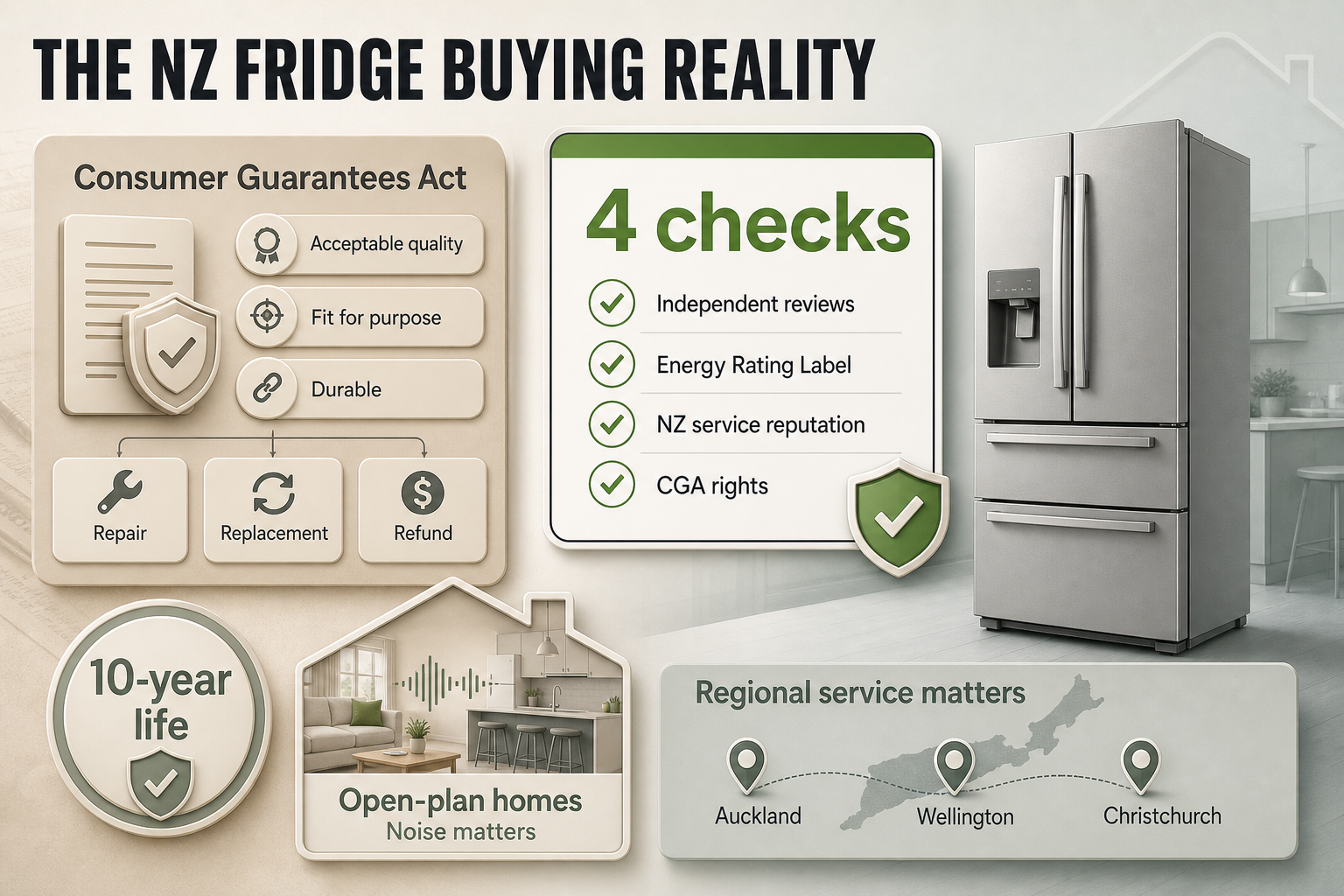
Climate and home layout affect how you should read reviews too. New Zealand homes often have open-plan kitchen and living areas, so noise complaints matter more than they do in a closed-off kitchen. Consumer NZ points out that fridge noise differences are meaningful, with higher decibel figures sounding much louder in practice. If reviewers repeatedly call a model buzzy, rattly or intrusive, do not dismiss that as fussiness. In a compact Auckland apartment or a modern open-plan home in Tauranga, that can become a daily irritation. (consumer.org.nz)
The best approach is to treat review ratings as one layer of evidence. For a refrigerator, a trustworthy buying decision usually combines four checks: independent reviews or broad owner feedback, the Energy Rating Label, the brand’s NZ service reputation, and your CGA rights if something goes wrong. If a model scores well across all four, the star rating is telling you something useful. If it only looks good on a retailer page, keep digging.
You may also be interested in these independent articles
Sources
- [1]EECA - Fridges and Freezers Energy Rating Labels
- [2]EECA - How to use Energy Rating Labels and star ratings
- [3]EECA - Requirements under E3 for fridges and freezers
- [4]EECA - Choose an efficient fridge or freezer to cut costs
- [5]Consumer NZ - Fridges: expert reviews, buying guide and advice
- [6]Consumer NZ - How to buy the best fridge
- [7]Consumer Protection NZ - Consumer Guarantees Act
- [8]Consumer Protection NZ - Faulty appliances and devices
- [9]Consumer Protection NZ - When things go wrong
© 2026 pyfoi. All rights reserved.