
Battery Economy Explained for NZ EV Buyers
Learn what battery economy means for NZ EV and PHEV buyers, from kWh/100km and WLTP to charging costs, range, and RUC in 2026.
Battery economy tells you how much electrical energy a vehicle uses to travel 100km. For New Zealand buyers looking at a BEV or PHEV, it is one of the clearest ways to compare real efficiency, running costs, and how far a charge is likely to go in daily use.
What the numbers mean
Battery economy is usually shown as kWh/100km, which means kilowatt-hours per 100 kilometres. Think of it as the EV equivalent of litres per 100km for a petrol car. Lower is better. A car using 14kWh/100km is more efficient than one using 20kWh/100km, because it needs less electricity to cover the same distance.
In practical terms, this number helps you estimate both charging cost and range. If your EV uses 16kWh/100km and has a usable battery of about 64kWh, you can expect roughly 400km of theoretical range before allowing for weather, speed, hills, and charging buffers. If another car uses 22kWh/100km with the same battery size, its range will be noticeably shorter.
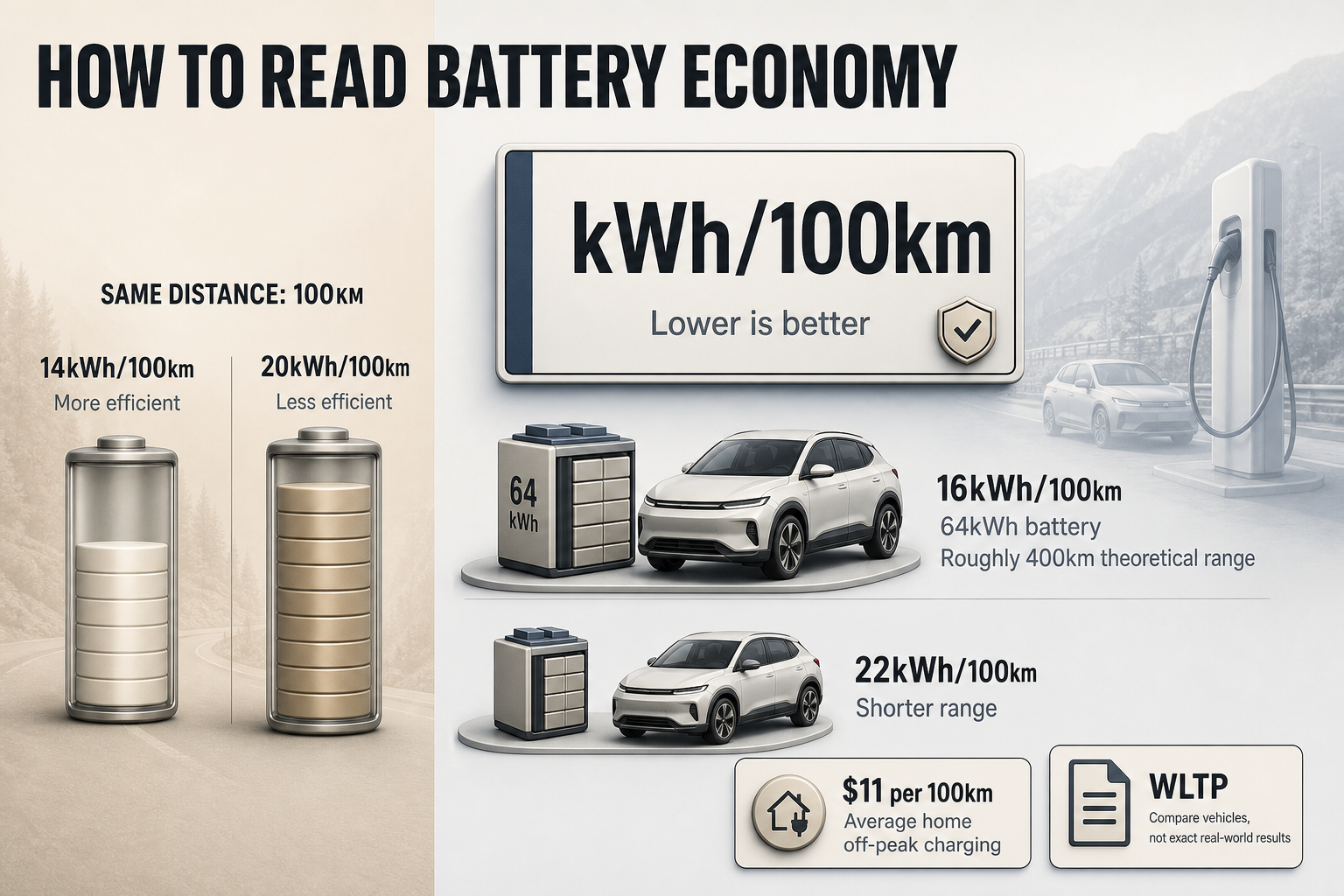
It also gives you a quick way to estimate charging cost. EECA says charging an EV at home off-peak costs about $11 per 100km on average in New Zealand, although your own tariff and the vehicle’s efficiency will shift that up or down. EECA and EECA’s vehicle label system also use kWh/100km as the standard electricity economy figure for EVs and PHEVs, based on laboratory testing to the WLTP standard. Those figures are designed for comparing vehicles, not promising exact real-world results. (eeca.govt.nz)
Typical ranges
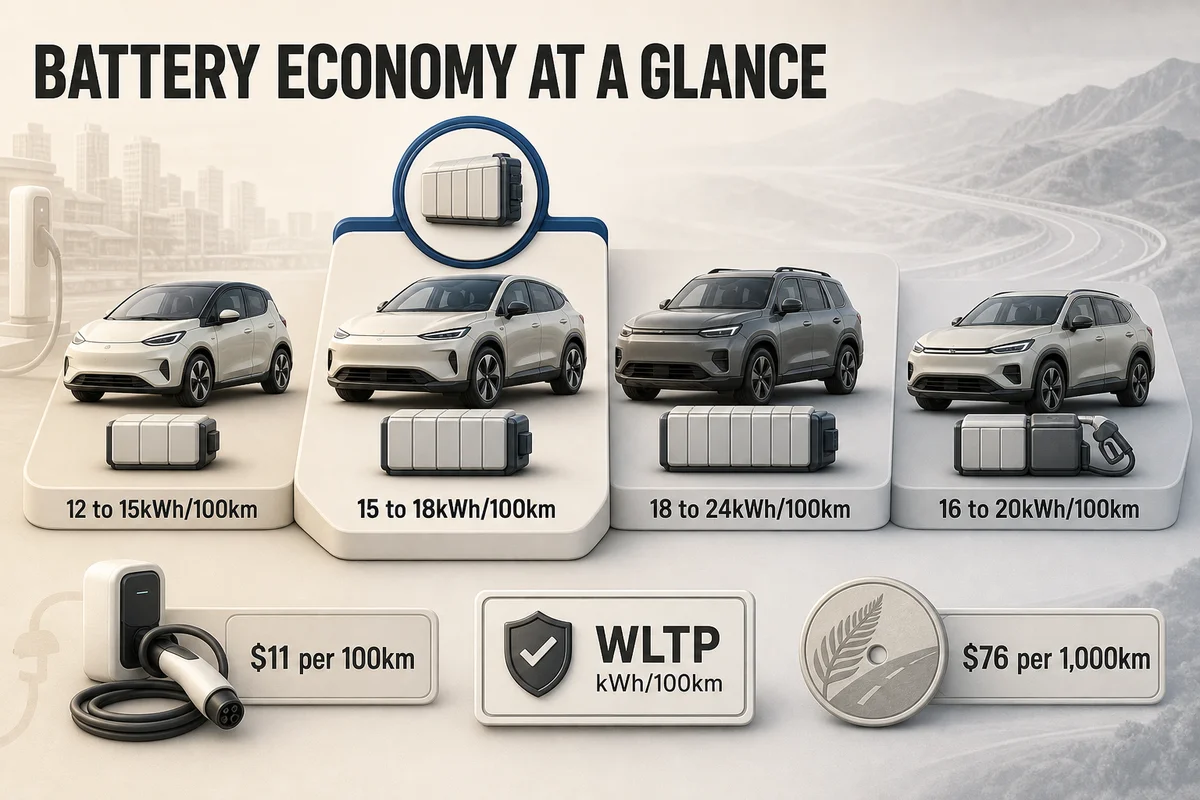
For small EVs and efficient hatchbacks, a low consumption figure is usually around 12 to 15kWh/100km. That is the sweet spot for urban use, lighter vehicles, and models with good aerodynamics. If most of your driving is around Auckland, Wellington, or Christchurch, and you do not carry heavy loads, numbers in this band are excellent.
For mainstream family EVs, expect roughly 15 to 18kWh/100km. This covers many compact SUVs, medium hatchbacks, and sedans. It is a sensible middle ground for Kiwi buyers who want enough space for kids, sports gear, or a weekend away without stepping into the higher energy use of a larger SUV or ute-based EV.
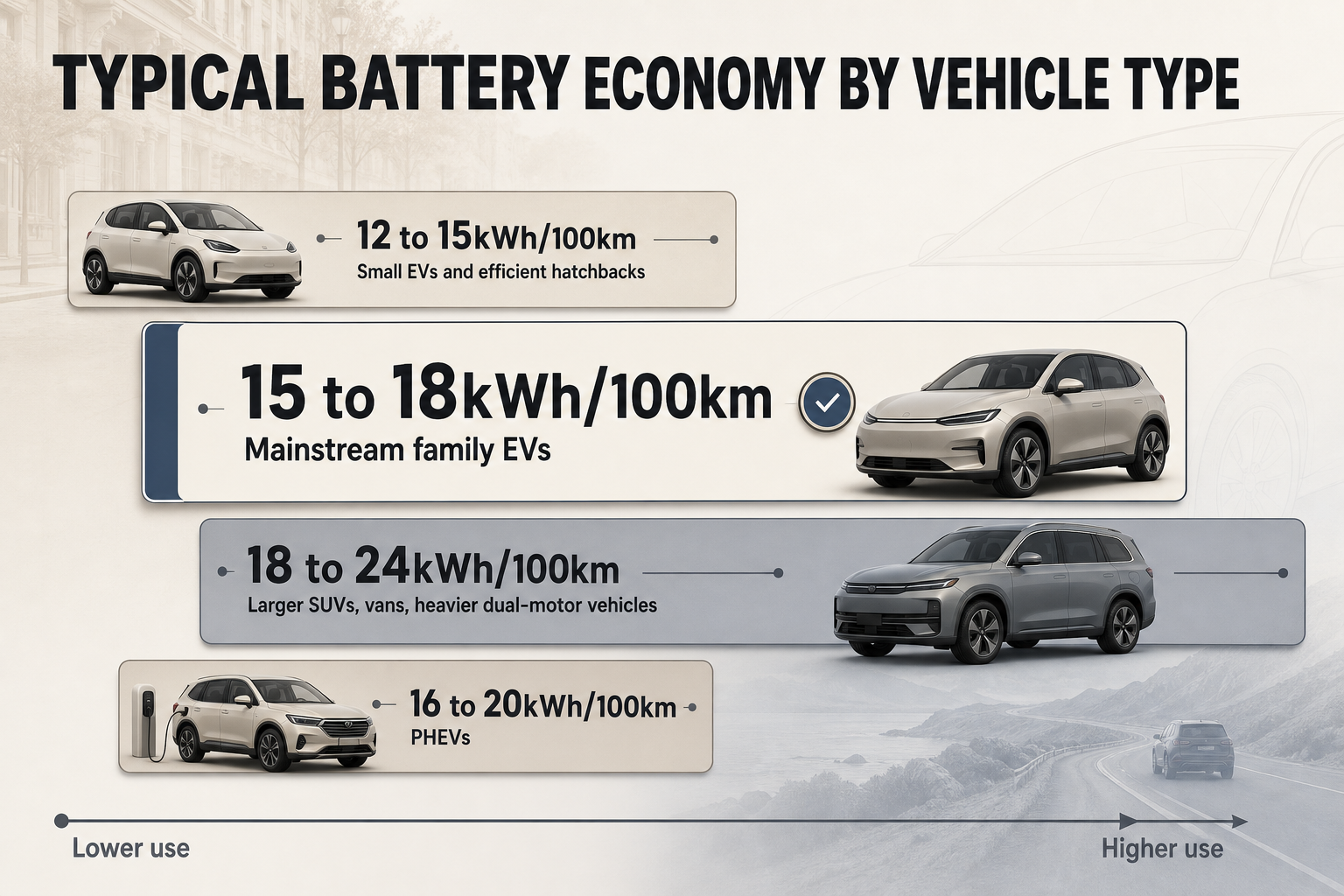
For larger SUVs, vans, and heavier dual-motor vehicles, 18 to 24kWh/100km is common. Some big seven-seaters, performance EVs, and electric commercial vehicles can go beyond that. These vehicles often trade efficiency for size, power, towing ability, or all-wheel-drive traction.
PHEVs need a slightly different reading. Their electric consumption figure still matters, but only for the distance they can travel on battery power alone. A PHEV showing 16 to 20kWh/100km may look efficient, but if its electric-only range is short and you rarely plug in, your actual running costs can end up closer to a petrol SUV than an EV. That is why battery economy is most useful for PHEVs when you look at it alongside electric range and your charging habits. EECA’s label programme specifically includes electricity economy for EVs and PHEVs and uses WLTP as the underlying test method. (eeca.govt.nz)
Use-case guidance
If your driving is mostly short commuting, school runs, and supermarket trips, aim for 12 to 16kWh/100km if possible. In stop-start city traffic, efficient EVs can be very cheap to run because regenerative braking helps recover energy that would otherwise be wasted. For a buyer doing 40km a day, the difference between 14 and 19kWh/100km may not sound huge, but over a year it adds up in both charging cost and how often you need to plug in.
For mixed family use, 15 to 18kWh/100km is usually the practical target. This gives you a wider choice of body styles without taking too much of a penalty at the plug. It suits the kind of driving many New Zealand households do, with weekday urban trips and weekend motorway runs to see family, reach the beach, or head out of town.
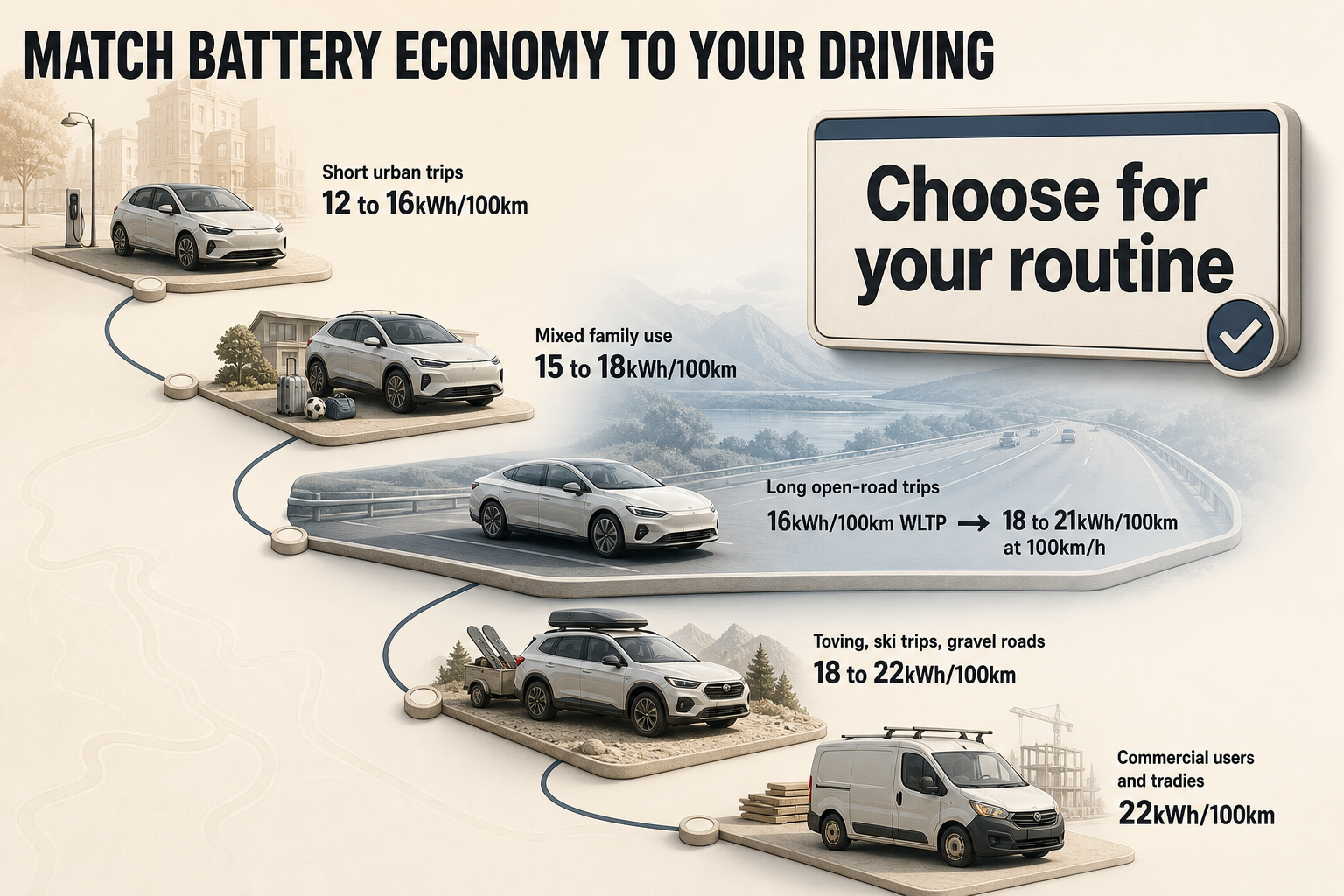
If you regularly do long open-road trips, especially across the central North Island or through the South Island, battery economy matters even more than in town. At 100km/h, consumption often rises sharply compared with the official figure. A vehicle rated at 16kWh/100km in WLTP testing may use closer to 18 to 21kWh/100km on a fast motorway run, and more again into a strong headwind or over hilly terrain. That means efficient models make trip planning easier and reduce charging stops.
For towing, ski trips, or gravel-road travel, expect a clear jump in consumption. Roof boxes, bikes on the back, winter temperatures, and steep climbs all hit range. If you need an SUV for family adventures to Ruapehu, Wānaka, or Tekapo, do not chase the lowest number blindly. A vehicle in the 18 to 22kWh/100km range may still be the right buy if it gives you the space, traction, and battery size you need.
For commercial users and tradies, battery economy should be read together with payload and charging downtime. A van using 22kWh/100km may still make perfect sense if most of its work is predictable urban delivery with overnight depot charging. What matters is whether the total operating cost works for your route, not whether the number looks impressive on paper.
NZ-specific factors
New Zealand’s official vehicle energy labels make this easier than it used to be. EECA’s system shows electricity economy in kWh/100km, estimated yearly running costs, and uses WLTP test data where available. The annual running cost estimate is based on 14,000km of driving and, importantly for EV and PHEV buyers in 2026, includes road user charges. (eeca.govt.nz)
That matters because EV running costs are no longer just about your power bill. NZTA says light EVs now need to pay RUC, and from 1 April 2024 EVs and PHEVs became subject to road user charges, with light EVs charged $76 per 1,000km and PHEVs $38 per 1,000km, plus admin fees. This has narrowed the gap between a very efficient EV and a less efficient one in pure cents-per-kilometre terms, but battery economy still has a direct effect on what you pay for electricity and how convenient the car is to live with. (nzta.govt.nz)
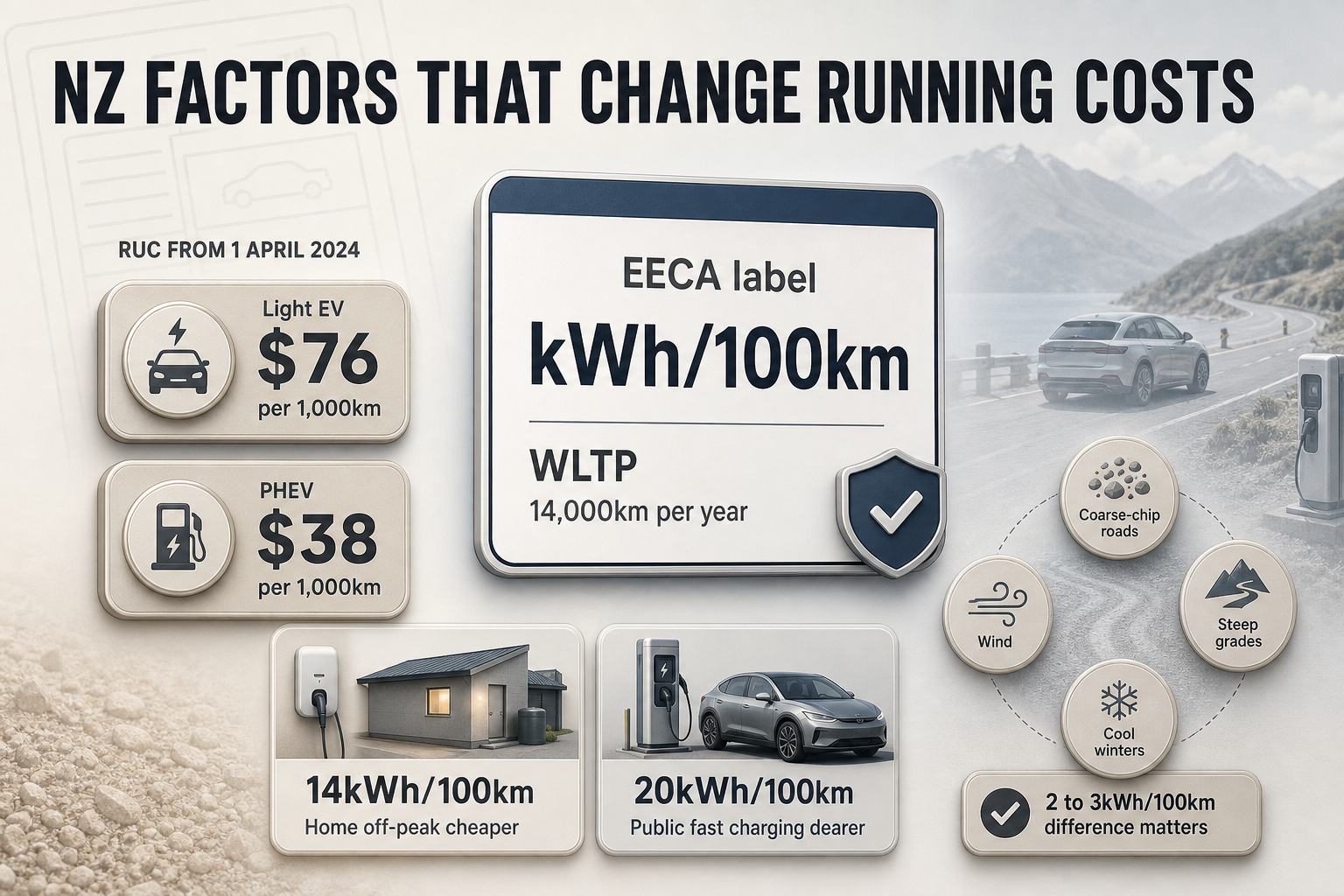
Electricity prices also vary by region, retailer, and time of use. MBIE’s electricity price monitoring shows household electricity prices are tracked in cents per kWh, and those tariffs differ around the country. If you can charge overnight on an off-peak plan, a car using 14kWh/100km can be meaningfully cheaper to run than one using 20kWh/100km. If you rely heavily on public fast chargers, the cost gap often grows further because public charging is usually more expensive than home charging. (mbie.govt.nz)
Roads and climate also matter in New Zealand more than many brochure figures suggest. Our mix of coarse-chip road surfaces, steep grades, windy highways, and cooler winter temperatures can push real consumption above the label figure. That is especially true on trips over the Bombay Hills, the Kaimais, the Desert Road, or alpine routes in the South Island. A buyer comparing two EVs should treat a 2 to 3kWh/100km difference as meaningful, because in Kiwi conditions that can translate into a noticeable change in motorway range.
The smartest way to use this parameter is simple. Start with the official kWh/100km figure, prefer WLTP data, then adjust for how you actually drive. If your life is mostly short urban trips, chase the lowest number. If you need space, AWD, towing ability, or frequent open-road capability, accept a higher figure but make sure the battery size and charging setup still suit your routine. (eeca.govt.nz)
You may also be interested in these independent articles
Sources
- [1]EECA: About the Vehicle Emissions and Energy Economy Labelling Programme
- [2]EECA: Benefits of electric vehicles for your home
- [3]NZ Transport Agency Waka Kotahi: Road user charges
- [4]NZ Transport Agency Waka Kotahi: Electric vehicles and plug-in hybrids to start paying road user charges from 1 April 2024
- [5]MBIE: Energy prices
© 2026 pyfoi. All rights reserved.