
Which Car Body Style Suits Your Life in NZ?
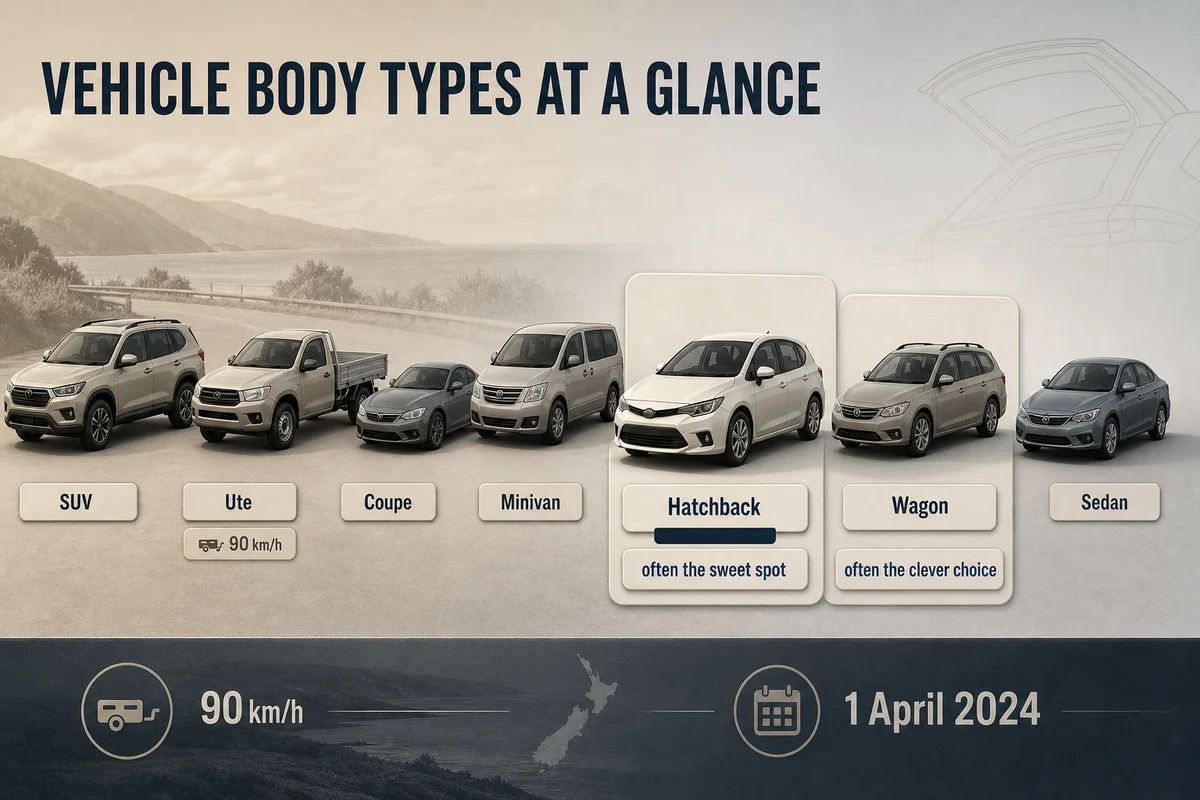
Choosing the right car body style in New Zealand can cut costs and stress. Compare SUV, ute, hatchback, wagon and sedan before you buy.
Your car’s body type shapes almost everything about how it fits your life. It affects cabin space, boot access, ride height, fuel use, handling, parking ease and even how comfortable the car feels on rough New Zealand roads.
A lot of buyers start with brand or price, but body style is often the better first filter. Get that choice right and the shortlist becomes much clearer.
The Options
SUV
An SUV is a taller vehicle with a raised seating position, more ground clearance and a hatch-style rear opening. In 2026, many so-called SUVs sold in New Zealand are actually crossovers, which means they use car-like underpinnings rather than old-school truck hardware, but for buyers the key traits are still the same: higher ride height, easy access and flexible cargo space. (nzta.govt.nz)
The big draw is everyday practicality. You sit higher, which many drivers like in Auckland traffic or on long Waikato and Canterbury highway runs. It is usually easier to get children into car seats, and the larger door openings help older passengers too. On gravel roads, ski-field approaches and uneven rural driveways, the extra clearance can be genuinely useful.
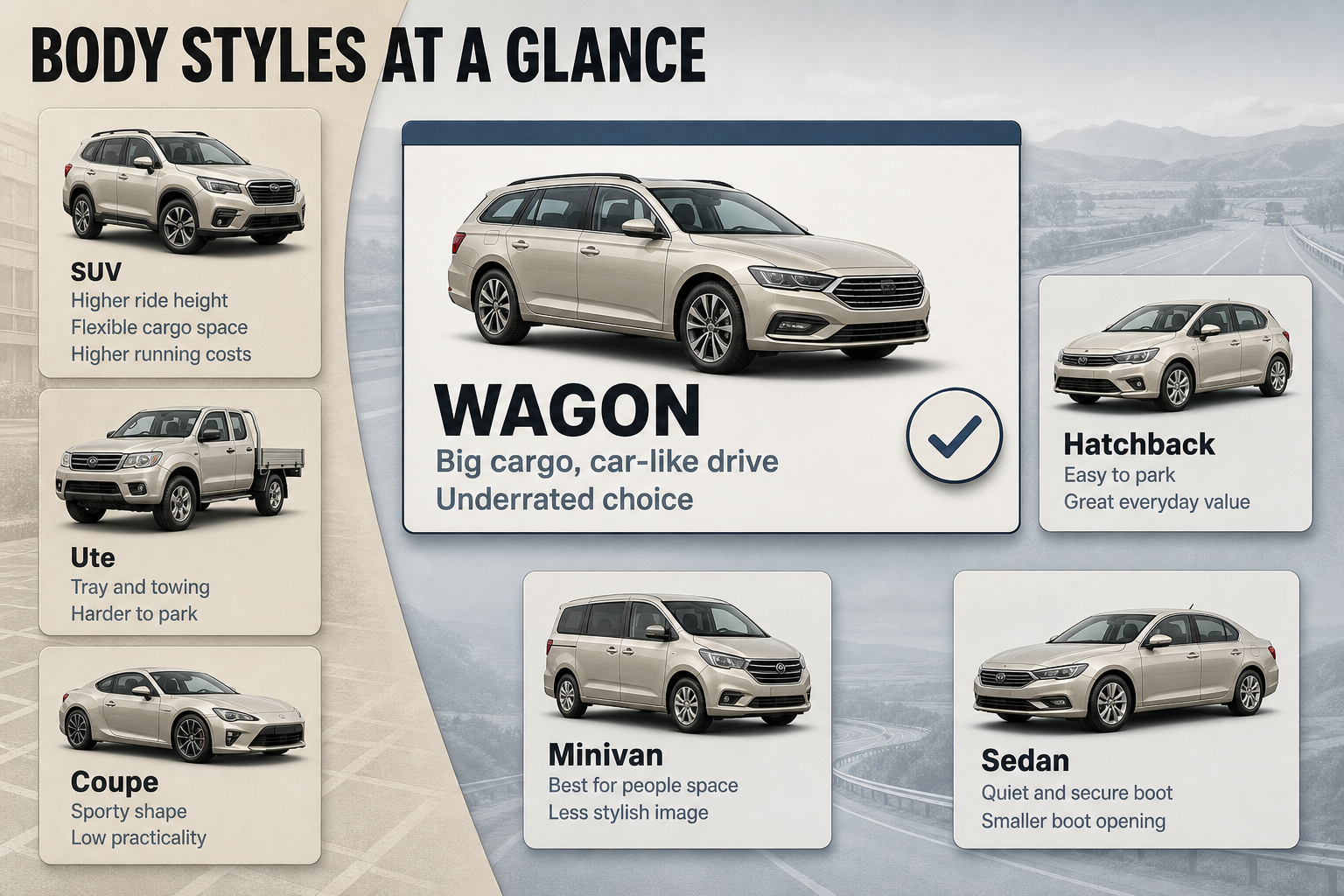
The trade-offs are real. SUVs are usually heavier and less aerodynamic than an equivalent hatchback, sedan or wagon, so they often use more fuel or electricity. Their taller shape also means they can feel less tidy in corners than a lower car. You may like the commanding view, but you pay for it in running costs and, sometimes, purchase price.
For many New Zealand buyers, an SUV makes sense if you regularly carry family, sports gear, dogs, or travel on rougher roads. But you probably do not need one just for school runs in central Wellington or suburban Christchurch. A compact hatch or wagon may do the same job more cheaply.
Ute
A ute is a pickup-style vehicle with a separate tray, usually built for hauling, towing and hard use. In New Zealand, double-cab utes are especially popular because they mix five-seat practicality with a load bed for tools, bikes, muddy gear or farm supplies.
This body style suits buyers who genuinely need payload and towing ability. If you tow a boat to the Coromandel, carry fencing gear in Southland, or need a vehicle that can handle muddy worksites, a ute is often the obvious answer. Many also offer four-wheel drive, which helps on slippery paddocks, forestry roads and remote tracks.
The downsides show up in daily driving. Utes are long, harder to park, and often less comfortable unloaded than passenger cars. Rear-seat space can be tighter than the exterior size suggests, and the tray is less secure than an enclosed boot unless you add a canopy or shutter. They also tend to use more fuel than lighter body styles.
If towing is part of your plan, body style matters because utes are commonly chosen for that job, but you still need to check the actual braked towing rating, payload and towball download limits for the specific model. In New Zealand, a light vehicle towing a trailer is generally limited to 90 km/h on the open road. (nzta.govt.nz)
Coupe
A coupe is usually a two-door car with a lower roofline and a sportier shape. Some have small rear seats in a 2+2 layout, while others are strictly two-seaters.
The appeal is style and driver focus. Coupes are often lower, lighter and more agile than taller body styles, which can make them more enjoyable on a winding road like the Desert Road approaches or the Takaka Hill. They usually look special too, which is part of the point.
The compromise is practicality. Rear-seat access is awkward, boot openings are often smaller, and low ride height can be annoying on steep driveways, ferry ramps or rough chipseal shoulders. If this is your only car, you need to be honest about how often you carry adults, child seats or bulky cargo.
For most Kiwi households, a coupe works best as a second car or for singles and couples who value design and driving feel over versatility. If your weekends involve bikes, prams, dogs or airport runs with lots of luggage, another body style will usually be easier to live with.
Minivan
The supplied data lists “minivan”, which in New Zealand is better understood as an MPV or people mover. This body style is built around passenger space, with a tall roof, large rear cabin and flexible seating. Think of vehicles used for bigger families, airport shuttles or school transport.
This is one of the smartest body styles for carrying people. Sliding rear doors are brilliant in tight supermarket parks, the upright shape gives excellent headroom, and third-row seating is usually more usable than in many SUVs. If you have three or more children, grandparents in the mix, or frequent road trips with lots of passengers, a minivan can be much more practical than a fashionable SUV.
The reason some buyers avoid them is image rather than function. They are not usually as stylish as SUVs, and they can feel larger to drive. Some also sit lower than SUVs, so they are not ideal for rough tracks or deep ruts.
In New Zealand terms, a minivan suits large families doing regular inter-city travel, sports drop-offs and holiday runs with everyone on board. If your life involves people first and gear second, this body style is often the most rational choice.
Hatchback
A hatchback has a rear door that lifts with the back window, giving access to a cargo area that is integrated with the cabin. It is one of the most flexible body styles for everyday use, especially in small and medium sizes.
For city driving, hatchbacks are hard to beat. They are easy to park, efficient to run and usually offer more useful cargo access than a sedan of similar size. Folding rear seats make them surprisingly versatile for flat-pack furniture, prams or a weekend away.
Their weakness is outright space. A small hatchback may feel tight for a growing family, and with the cargo area open to the cabin they can be noisier than sedans on coarse-chip roads. Security can also be slightly worse if luggage is visible through the rear glass.
For Auckland commuting, Wellington parking buildings and student life in Dunedin, a hatchback makes a lot of sense. If you mostly drive solo or as a couple and want the best mix of size, value and usability, this is often the sweet spot.
Wagon
A wagon is essentially a longer-roof version of a car, with an extended rear cargo area and a large tailgate. It gives you much of an SUV’s carrying ability without the same height, weight or bulk.
This is one of the most underrated body styles in New Zealand. Wagons are great for families who want generous luggage space for pushchairs, dogs, camping gear or sports equipment, but still prefer car-like handling and fuel economy. They also tend to load more easily than SUVs because the boot floor is lower.
The main downside is market preference. Buyers have shifted heavily toward SUVs, so there are fewer new wagons on sale than there used to be. Some people also prefer the higher seating position of an SUV, even when a wagon would suit their needs better.
For South Island touring, long SH1 runs, and family life where you carry lots of gear but do not need extra ground clearance, a wagon is often the clever choice. If you want practicality without the SUV penalty, start here.
Sedan
A sedan is a four-door car with a separate boot. It is the traditional three-box shape, with engine bay, cabin and luggage compartment clearly separated.
Sedans still have some strong advantages. They are often quieter at highway speeds than hatchbacks because the boot is isolated from the cabin, and the separate luggage area can be more secure. Many also have a tidy, stable feel on the open road, which suits regular travel between centres.
Their weakness is access. A sedan boot can be deep but the opening is smaller, which makes bulky items harder to load. If you regularly carry bikes, dogs, large pushchairs or DIY supplies, a hatchback or wagon is usually easier.
A sedan suits buyers who mostly carry people rather than awkward cargo, and who spend a lot of time on sealed roads. If you want a comfortable commuter or business car with a more traditional shape, it still makes good sense.
How to Choose
Start with your real weekly use, not your once-a-year trip. If 90 percent of your driving is commuting, school runs and supermarket trips, do not buy around the one weekend you might go up a gravel road. Many buyers in New Zealand choose SUVs for reassurance, but a hatchback, sedan or wagon is often cheaper to buy and run while still handling normal Kiwi roads perfectly well.
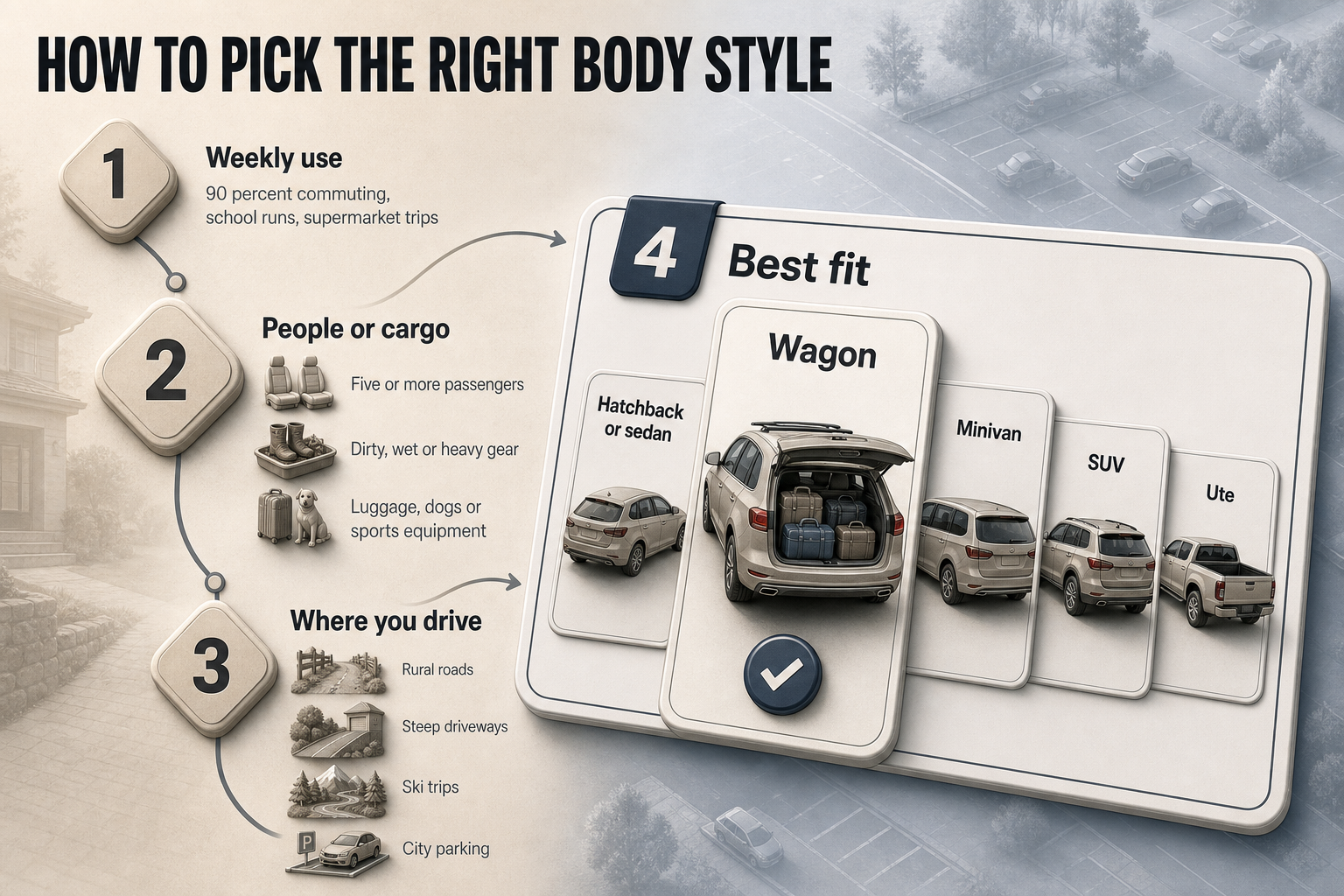
Think next about people versus cargo. If you carry five or more passengers often, a minivan is usually better than squeezing everyone into a medium SUV. If you carry dirty, wet or heavy gear, a ute has advantages no wagon or SUV can match. If you carry luggage, dogs or sports equipment but want good road manners, a wagon deserves far more attention than it usually gets.
Then consider where you drive. Rural roads, steep driveways and ski trips can justify extra clearance, but not always full SUV bulk. Urban drivers should be honest about parking. A large ute or seven-seat SUV can be a nuisance in older city car parks and narrow suburban streets.
NZ Context
Body style has a direct effect on running costs in New Zealand. Larger, taller and heavier vehicles usually consume more fuel, which matters when petrol and diesel prices are volatile. MBIE’s energy price monitoring shows how exposed Kiwi motorists are to fuel price swings, while EECA notes that EVs are significantly cheaper to run than equivalent petrol vehicles even with road user charges included. (mbie.govt.nz)
That matters because SUVs and utes are often the least efficient body styles, while hatchbacks, sedans and wagons usually do better. If you are comparing petrol, diesel and electric versions across different body styles, remember that light EVs in New Zealand now pay road user charges, just as diesel vehicles do. That has applied since 1 April 2024. (nzta.govt.nz)
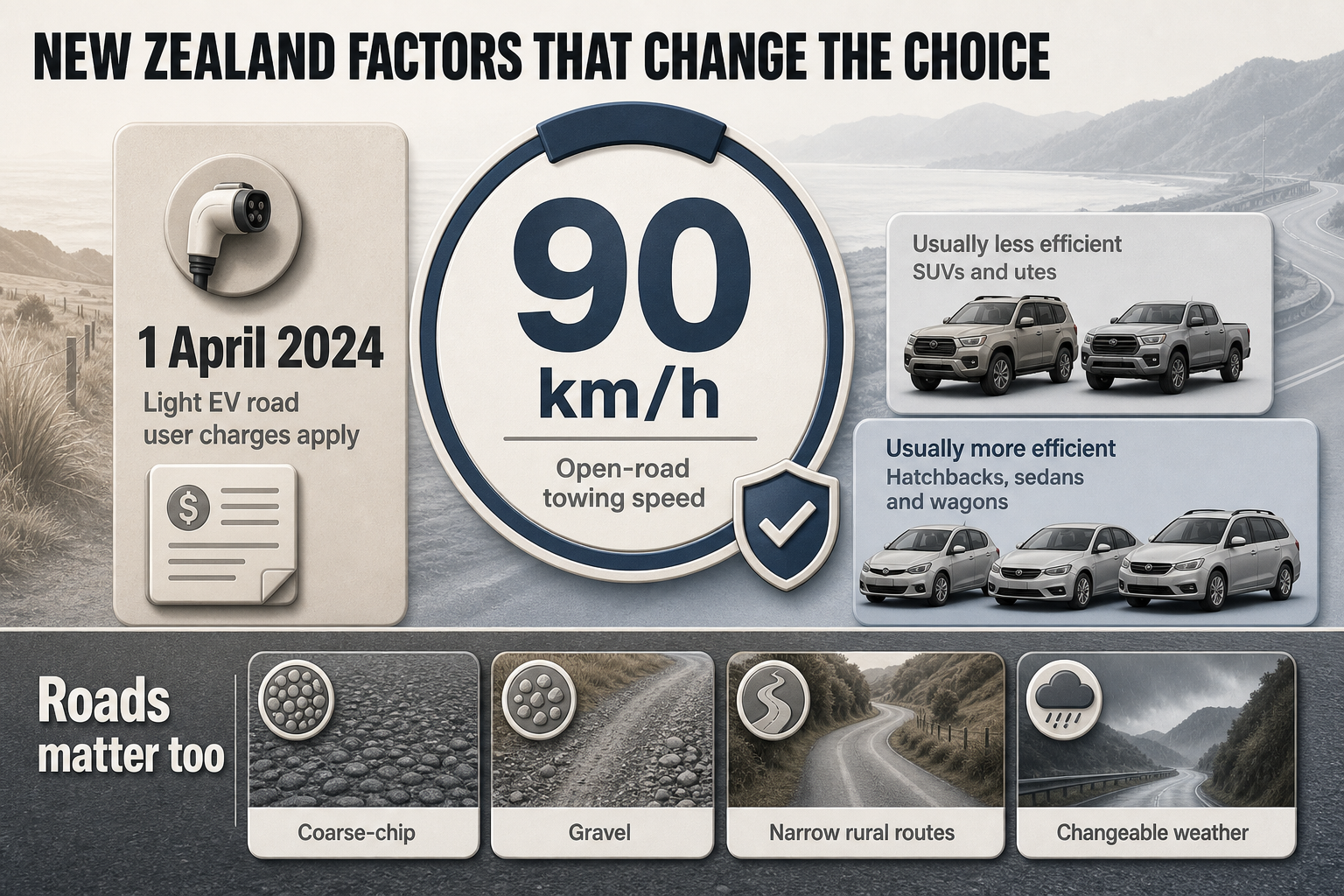
Road conditions also matter here more than in some countries. New Zealand has plenty of coarse-chip sealed roads, narrow rural routes, gravel sections and changeable weather. Extra ride height can help, but tyre choice, drivetrain and suspension tune often matter just as much as body style. A well-set-up wagon on good tyres can be better on a wet back road than a cheap SUV on poor rubber.
Towing is another local factor. If you plan to tow a trailer, caravan or boat, do not assume body style tells the whole story. Utes and large SUVs are common tow vehicles, but the legal open-road speed while towing is generally 90 km/h, and the actual safe towing limit depends on the exact vehicle specification, trailer weight and load setup. (nzta.govt.nz)
You may also be interested in these independent articles
Sources
- [1]NZ Transport Agency Waka Kotahi - Road user charges
- [2]NZ Transport Agency Waka Kotahi - Electric vehicles and plug-in hybrids to start paying road user charges from 1 April 2024
- [3]NZ Transport Agency Waka Kotahi - Safe loading and towing for light vehicles
- [4]NZ Transport Agency Waka Kotahi - Vehicle dimensions and mass
- [5]EECA - Benefits of electric vehicles for your home
- [6]EECA - Compare electric vehicle types and benefits
- [7]MBIE - Energy prices
© 2026 pyfoi. All rights reserved.