
How to Read Vehicle Review Ratings in NZ
Vehicle review ratings can help NZ buyers shortlist cars fast, but they miss safety, variant and ownership costs. Here is what to check first.
A vehicle reviews rating is a quick score, usually out of five stars, that sums up how well a car performs across the things buyers care about most. It matters because it can help you shortlist cars faster, but only if you understand what that score actually includes and what it leaves out.
For New Zealand buyers, that matters even more. A car that earns glowing reviews overseas might still be a poor fit for our chipseal roads, long-distance touring, rural servicing, towing needs, or the reality of parking in Wellington, Auckland, or central Christchurch.
What Goes Into the Rating
A reviews rating is not the same as a safety rating, reliability survey, or ownership-cost calculation. It is usually an editorial judgement that blends several factors into one score, such as ride comfort, handling, cabin quality, performance, fuel use, practicality, value for money, technology, and sometimes expected resale or ownership appeal. Review sites and motoring organisations each use their own approach, so a 4.5-star score on one site is not automatically equal to 4.5 stars on another. (aa.co.nz)
That is the first thing to understand: a review score is a summary, not a universal standard. One reviewer may put more weight on driving enjoyment, while another may prioritise family practicality, cabin finish, or price. If you are comparing vehicles, the most useful comparison is often within the same publication, where the scoring style is at least consistent.
In practical terms, a 5-star review usually means the car is excellent in most areas and easy to recommend. A 4-star car is often still very good, but with a few compromises such as tight rear seating, firm ride quality, high price, or average infotainment. A 3-star result tends to mean the car is acceptable but unremarkable, or good in one area while weak in another. Anything below that usually signals major drawbacks, poor value, outdated safety kit, or a mismatch between price and performance. That interpretation is an inference based on how editorial star systems are commonly used, rather than a single NZ-wide rule. (aa.co.nz)
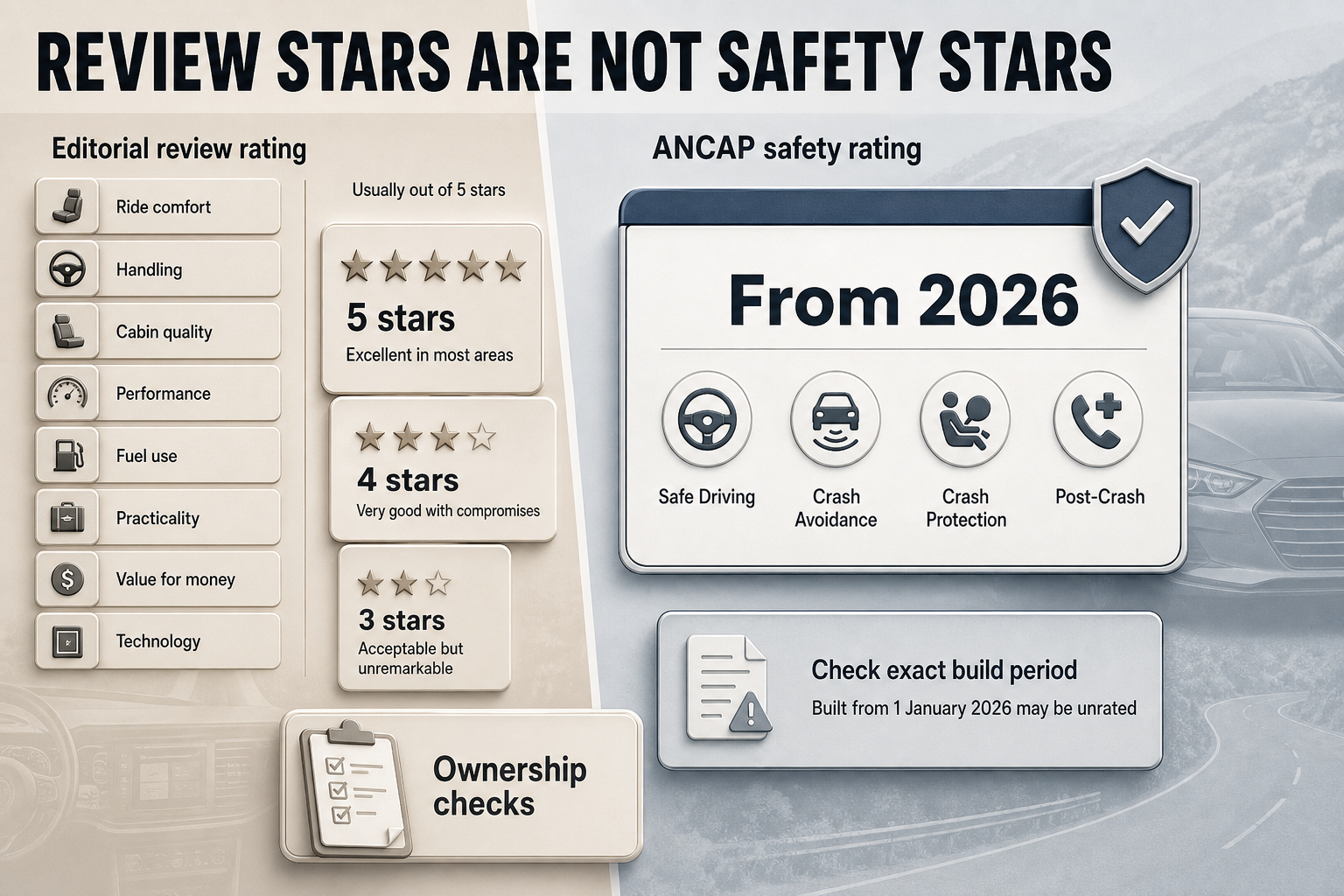
It also helps to separate review ratings from ANCAP safety ratings. ANCAP is an independent safety programme for Australia and New Zealand, and its star ratings assess how well a vehicle helps avoid crashes and protects occupants and other road users. ANCAP states that its ratings are designed to help consumers make informed safety choices, and from 2026 it is using an updated framework covering Safe Driving, Crash Avoidance, Crash Protection, and Post-Crash performance. (ancap.com.au)
That means a car can earn a strong editorial review score while having only an average or even unrated safety result, especially if it is an older design or a newly updated variant. ANCAP also notes that some vehicles built from 1 January 2026 can be unrated even when earlier versions of the same model held five stars, so you need to check the exact build period rather than assume the badge tells the full story. (ancap.com.au)
What to Look For
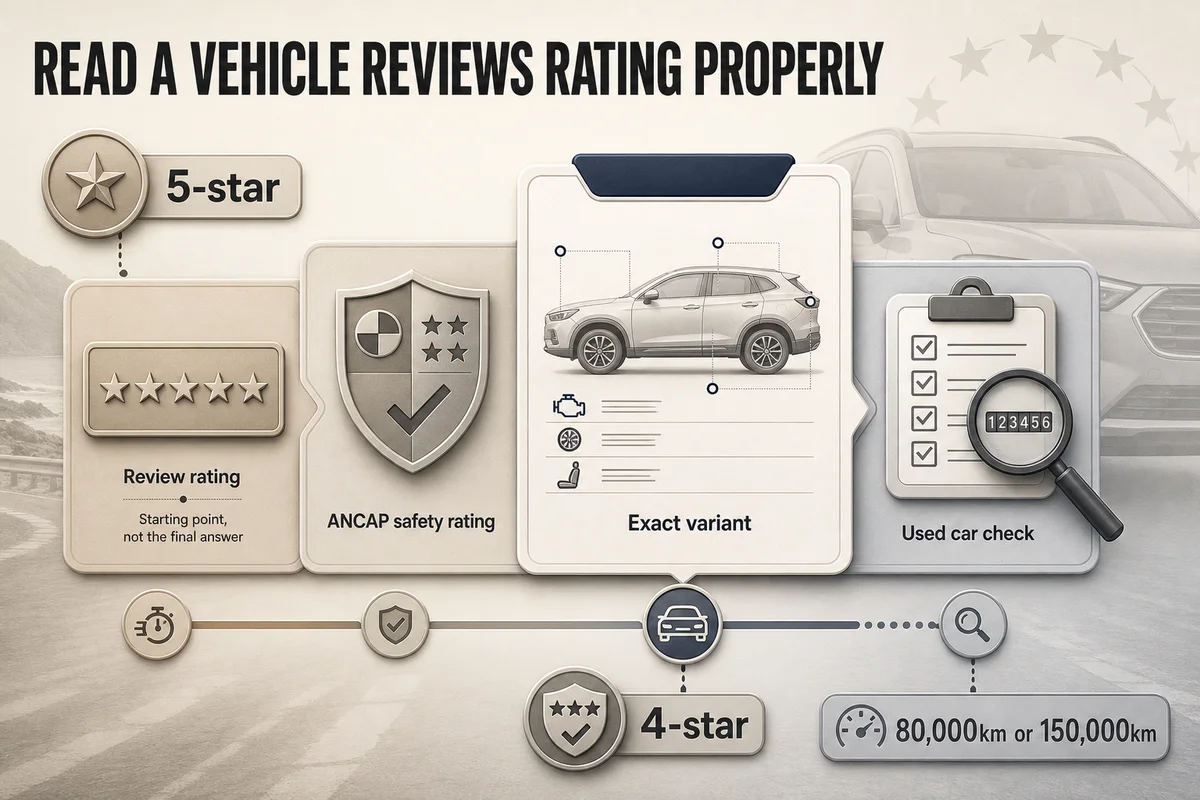
The best way to use a vehicle reviews rating is as a starting point, not the final answer. If a car has 4.5 or 5 stars, read the full review and look for the reasons behind the score. You want to know whether the reviewer loved it for the same reasons that matter to you. A sporty hatch with sharp steering may score highly, but if you spend most of your time on rough suburban roads with kids in the back, ride comfort and rear-seat space may matter more than cornering feel.
Look closely at what the review says about real-world usability. In New Zealand, that includes how the car copes with coarse-seal roads, motorway trips between cities, steep driveways, wet winters, and occasional gravel. A review that mentions tyre noise, limited boot space, poor visibility, or a fussy driver-assistance system is giving you more useful information than the star score alone.
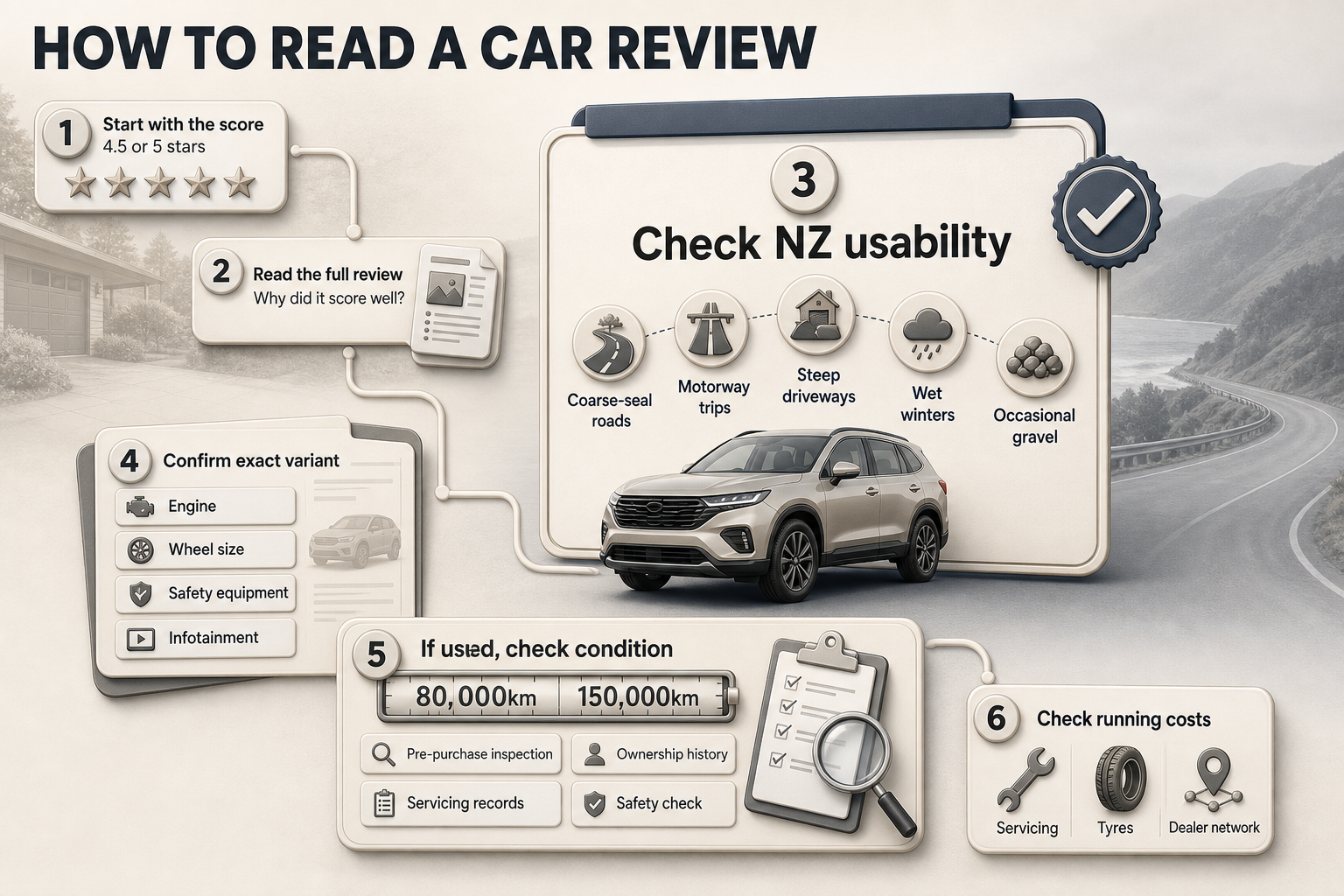
You should also check whether the review is for the exact variant you are considering. The base model may have a lower-powered engine, smaller wheels, less safety equipment, or a different infotainment setup than the higher-grade version the reviewer tested. That matters because wheel size can affect ride quality, and safety technology can vary across trim levels. ANCAP ratings can also apply only to certain build dates or variants, so it is worth confirming the details on the official safety report. (ancap.com.au)
If you are buying used, treat review ratings with even more caution. A glowing review from when the car was new tells you how it drove and felt at launch, but not how it has aged after 80,000km or 150,000km on New Zealand roads. For used cars, combine the review with a pre-purchase inspection, ownership history, servicing records, and a safety check. The AA specifically recommends a pre-purchase inspection to help assess condition and identify issues before you commit. (aa.co.nz)
You should also ask whether the review score reflects long-term costs. A car can be great to drive and still disappoint you if servicing is expensive, tyres are costly, or the dealer network is thin outside the main centres. That is especially relevant if you live in provincial New Zealand, where brand support can vary a lot compared with Auckland or Christchurch.
NZ Context
New Zealand buyers need to read review ratings through a local lens. Our vehicle fleet is older than many markets, used imports are common, and a large share of buyers shop outside the new-car showroom system. The AA notes that used imports can differ significantly in safety rating from a similar New Zealand-new model, so you should not assume two cars that look identical have the same safety result. (aa.co.nz)
Consumer protection matters too. If you buy from a dealer in New Zealand, the Consumer Guarantees Act gives you rights around acceptable quality, fitness for purpose, safety, and durability, and those rights apply whether or not you also have a manufacturer warranty. Consumer Protection also says manufacturer and extended warranties sit on top of your CGA rights, not instead of them. (consumerprotection.govt.nz)
That is important because a high reviews rating does not override your need to check the basics. If a dealer describes a car as reliable, economical, or suitable for towing, those claims should stand up in the real world. If the vehicle does not meet the legal guarantees, you may have remedies under New Zealand consumer law. Consumer Protection also makes clear that rights for dealer purchases differ from private sales, so the source of the car matters as much as the review score. (consumerprotection.govt.nz)
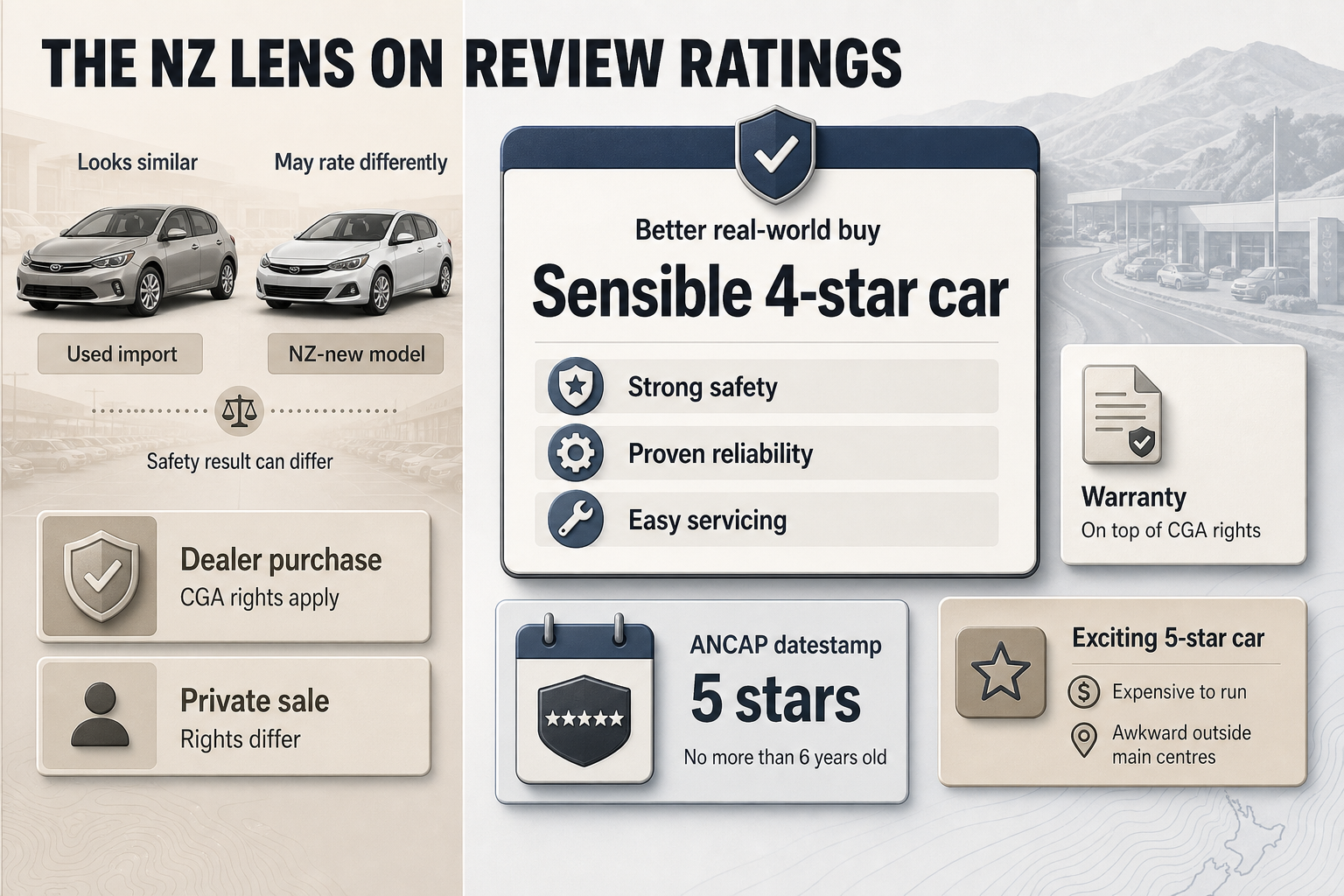
For safety, NZ buyers should give extra weight to current ANCAP information, especially on newer vehicles. ANCAP recommends that vehicles used for work purposes have a five-star rating with a datestamp no more than six years old, which shows how much test standards and vehicle safety expectations move over time. A five-star result from several years ago is still useful, but it is not directly equivalent to a recent five-star result under newer criteria. (ancap.com.au)
The smartest approach is to read the reviews rating as one piece of evidence. If the car scores well, then check the ANCAP result, exact variant specification, warranty support, servicing access, and whether the car suits your actual driving. For many NZ buyers, a sensible 4-star car with strong safety, proven reliability, and easy servicing will be a better buy than a more exciting 5-star review darling that is expensive to run or awkward to own outside the main centres.
You may also be interested in these independent articles
Sources
- [1]Consumer Protection NZ - Consumer Guarantees Act
- [2]Consumer Protection NZ - Warranties
- [3]Consumer Protection NZ - Consumer rights when buying a car
- [4]Consumer Protection NZ - Solving issues with your car dealer
- [5]AA NZ - Car Reviews and Ratings
- [6]AA NZ - Crash Test & Car Safety Ratings for Used Cars
- [7]AA NZ - Used Car Review: Toyota Aqua
- [8]AA NZ - Used Car Review: Mazda Demio
- [9]ANCAP - Car Safety Ratings
- [10]ANCAP - Car Safety FAQs
- [11]ANCAP - Safety before, during and after a crash: New gen rating approach from 2026
- [12]ANCAP - Land Rover Range Rover Evoque Safety Rating & Report
- [13]ANCAP - Mercedes-Benz G-Class Safety Rating & Report
- [14]ANCAP - Suzuki e VITARA Safety Rating & Report
- [15]ANCAP - Nissan Qashqai Safety Rating & Report
© 2026 pyfoi. All rights reserved.