
What Is Good Ground Clearance in NZ?
Find the right ground clearance for NZ roads, from city cars to SUVs and utes. Learn what mm figures mean before you buy and avoid costly scrapes.
Ground clearance is the minimum distance between the ground and the lowest fixed part of a vehicle. It sounds like a niche spec, but it has a real effect on how easily your car handles steep driveways, speed bumps, gravel roads, farm tracks, floodwater splash zones, and rough holiday-park access roads around New Zealand. (nzta.govt.nz)
A low car can feel sharper on the road and easier to load, but it is more likely to scrape its underside. A taller vehicle usually gives you more confidence on broken surfaces, though it can cost more to buy and run, and the higher centre of gravity can affect handling and efficiency. (suzuki.co.nz)
What the Numbers Mean
Ground clearance is measured in millimetres from the ground to the vehicle’s lowest point, excluding items like tyres and mudflaps. The key word is minimum. A vehicle may look tall at the wheel arches, but a low exhaust, battery shield, towbar, or suspension component can still be the point that scrapes first. (nzta.govt.nz)
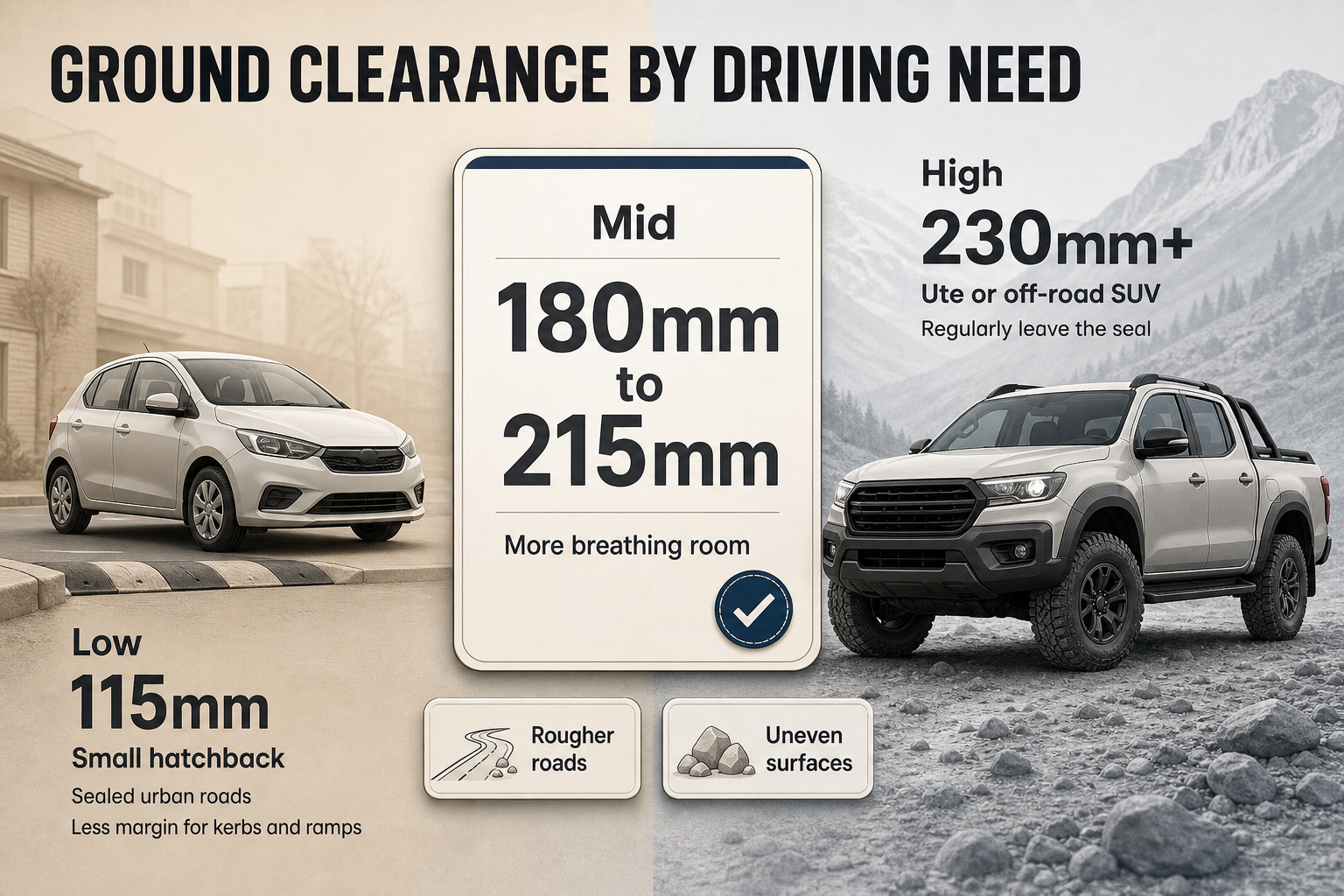
In practical terms, 115mm is typical small hatchback territory. That is enough for sealed urban roads, but it leaves less margin for high kerbs, abrupt driveway ramps, and corrugated gravel with a hump in the middle. A vehicle around 180mm to 215mm gives you noticeably more breathing room for rougher roads and uneven surfaces. A ute or off-road-focused SUV can push beyond 230mm, which is useful once you regularly leave the seal. (suzuki.co.nz)
It also helps to remember that ground clearance is only one part of the picture. Approach angle, departure angle, wheelbase, suspension travel, tyre sidewall height, and whether the vehicle is loaded all affect whether it will actually clear an obstacle. A long car with decent clearance can still scrape on a ferry ramp or a steep campground entrance if its overhangs are low. This is an inference based on how clearance is defined and how vehicle dimensions interact in use. (nzta.govt.nz)
Typical Ranges
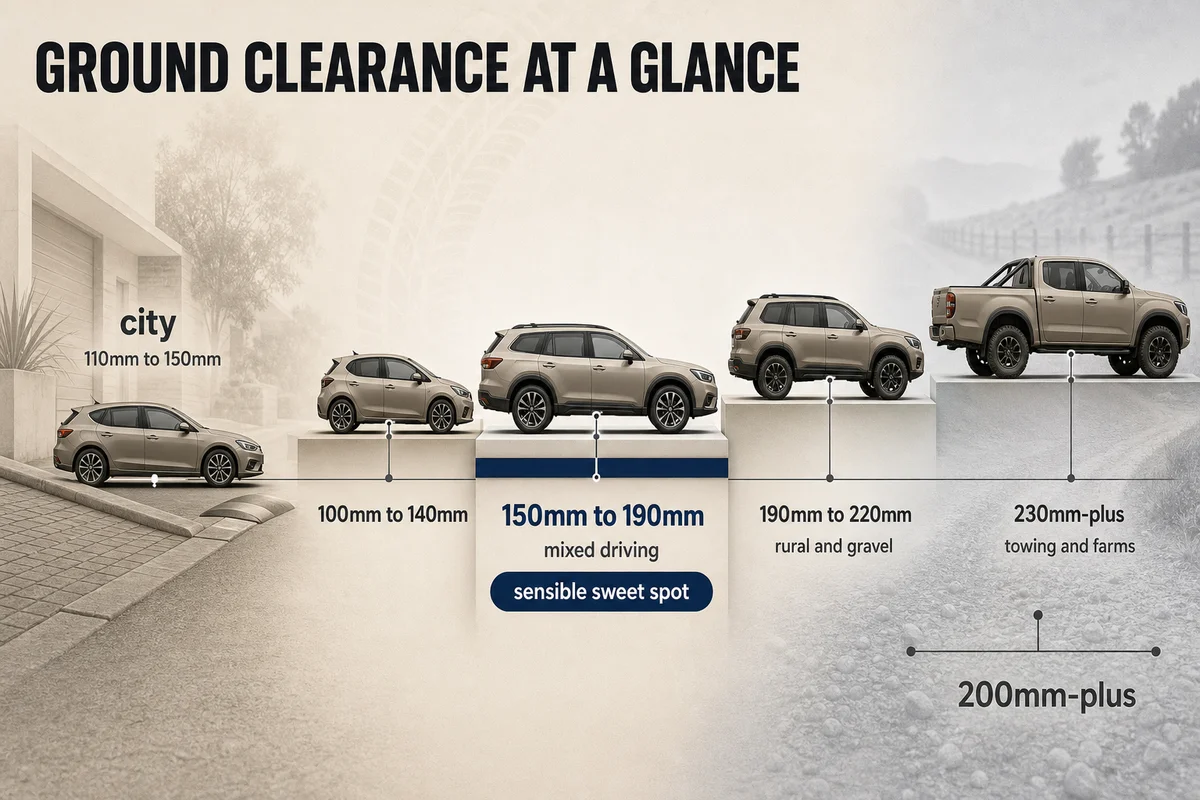
A low ground-clearance vehicle is usually around 100mm to 140mm. This is common for small hatchbacks, some sedans, and sportier cars. In New Zealand, the Suzuki Swift is listed at 115mm, which gives you a useful real-world reference point for a city-focused small car. (suzuki.co.nz)
A mid-range vehicle usually sits around 150mm to 190mm. This covers many wagons, crossovers, and some medium SUVs. Older and road-focused SUVs often land in this bracket. Toyota’s earlier RAV4 specs show figures around 167mm to 187mm, which is a good example of how even within one model line the number can vary by drivetrain and trim. (toyota.co.nz)
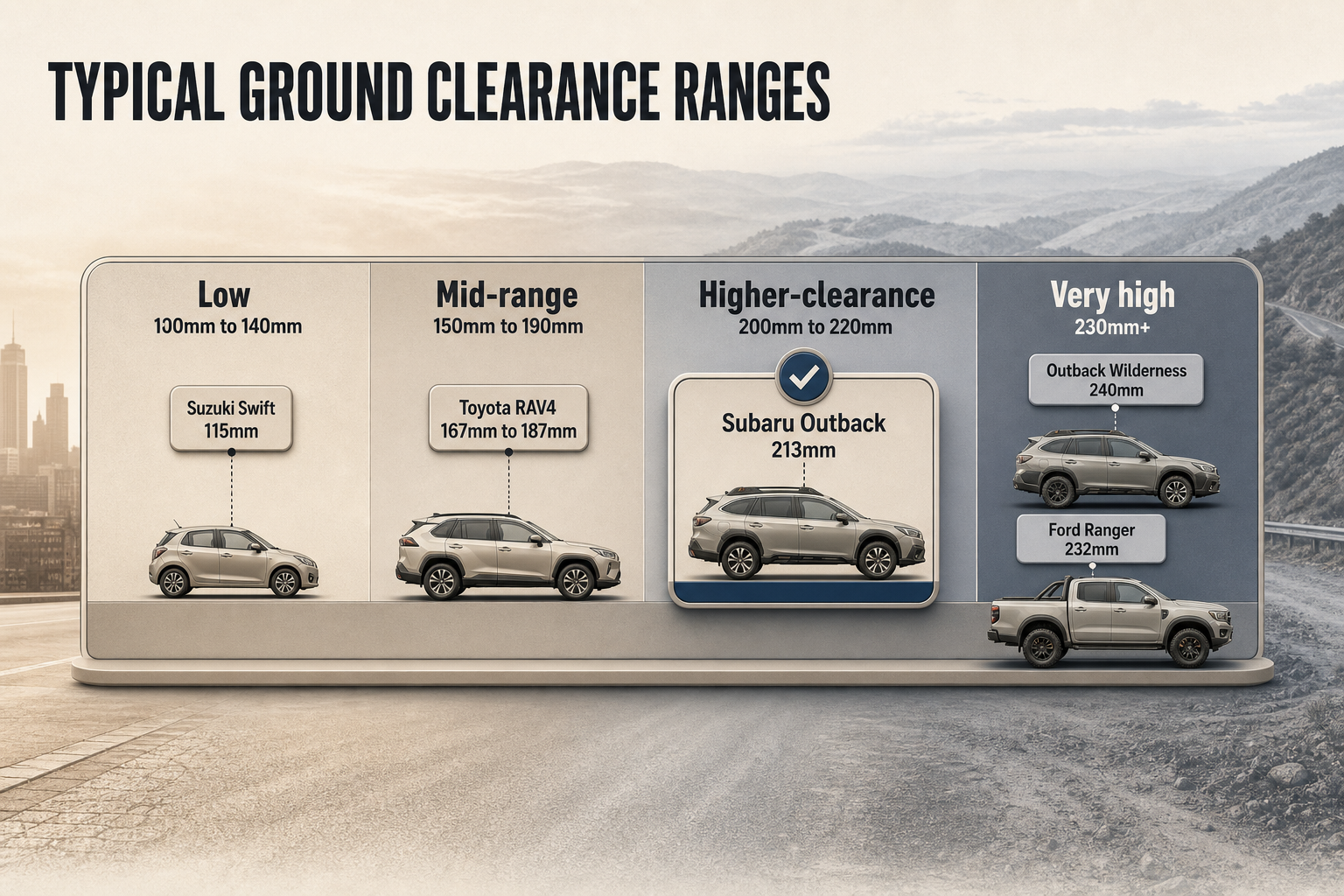
A higher-clearance passenger vehicle is usually around 200mm to 220mm. This is where many adventure-oriented SUVs and soft-roaders sit. The current Subaru Outback sold in New Zealand is listed at 213mm, which is one reason it is so popular with buyers who spend time on gravel roads, ski-field access roads, and rural driveways without wanting a full ute. (subaru.co.nz)
A very high clearance vehicle is usually 230mm and up. That includes many utes and more off-road-focused SUVs. Ford’s Ranger brochure lists 232mm unladen, while the newly announced Subaru Outback Wilderness for New Zealand is quoted at 240mm. At that point you are buying extra capability that many urban drivers simply will not use every week. (ford.co.nz)
Use-Case Guidance
If you mainly drive in Auckland, Wellington, Christchurch, or Hamilton on sealed roads, a car with around 110mm to 150mm is often enough. You will still want to be careful with steep parking-building ramps, crowned speed humps, and older driveways, but you do not need SUV-level clearance just for commuting and school runs. A small hatch or sedan can be perfectly suitable if the places you visit regularly are smooth and paved. (suzuki.co.nz)
For mixed urban and regional driving, 150mm to 190mm is a sensible sweet spot. This suits buyers who do weekend trips, occasional gravel roads, boat-ramp car parks, unsealed holiday-home access roads, and the odd rough shoulder without wanting a larger, heavier vehicle. It is also a useful buffer if your driveway has a sharp breakover angle or you often carry passengers and luggage. (toyota.co.nz)
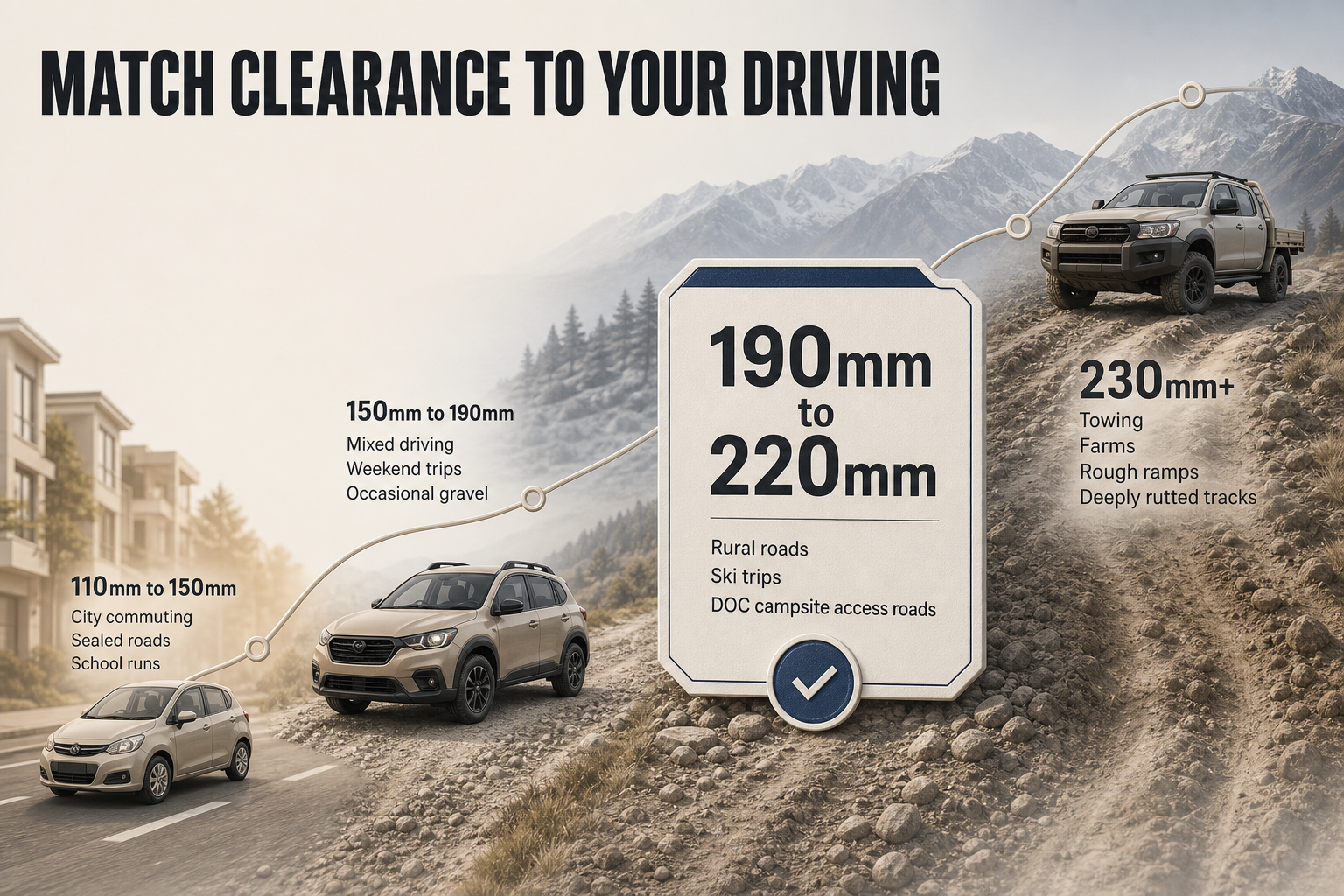
If your routine includes rural roads, ski trips, DOC campsite access roads, or regular travel on loose gravel and broken seal, look closer at 190mm to 220mm. That is where vehicles such as the Subaru Outback earn their keep. You are not buying clearance for bragging rights. You are buying fewer scrapes, less stress, and more freedom to take the road that looks interesting without wondering what is underneath the car. (subaru.co.nz)
If you tow on uneven ground, visit farms, launch boats from rough ramps, or head onto deeply rutted tracks, 230mm-plus starts to make sense. Even then, clearance alone is not enough. You also want suitable tyres, decent underbody protection, and in some cases four-wheel drive. A high-clearance two-wheel-drive vehicle can still get stuck or damage itself if the surface is loose and uneven. (ford.co.nz)
NZ-Specific Factors
New Zealand roads can change quickly once you leave the main centres. A vehicle that feels fine on urban streets may feel vulnerable on coarse-chip rural roads, pothole-damaged sections, forestry detours, or gravel roads in the Mackenzie Basin, Central Otago, Northland, or the West Coast. That is why ground clearance matters more here than it might in a country where most driving is on smooth motorways. (subaru.co.nz)
You should also separate need from image. Many buyers assume they need a tall SUV because they live in New Zealand, but plenty of people never drive beyond sealed suburban roads. If that sounds like you, extra clearance may just mean higher fuel use, a higher purchase price, and slightly clumsier access for kids or older passengers. That matters because running costs remain important here, and government policy still pushes lower-emission vehicles through the Clean Car Standard even though the Clean Car Discount ended on 31 December 2023. (nzta.govt.nz)
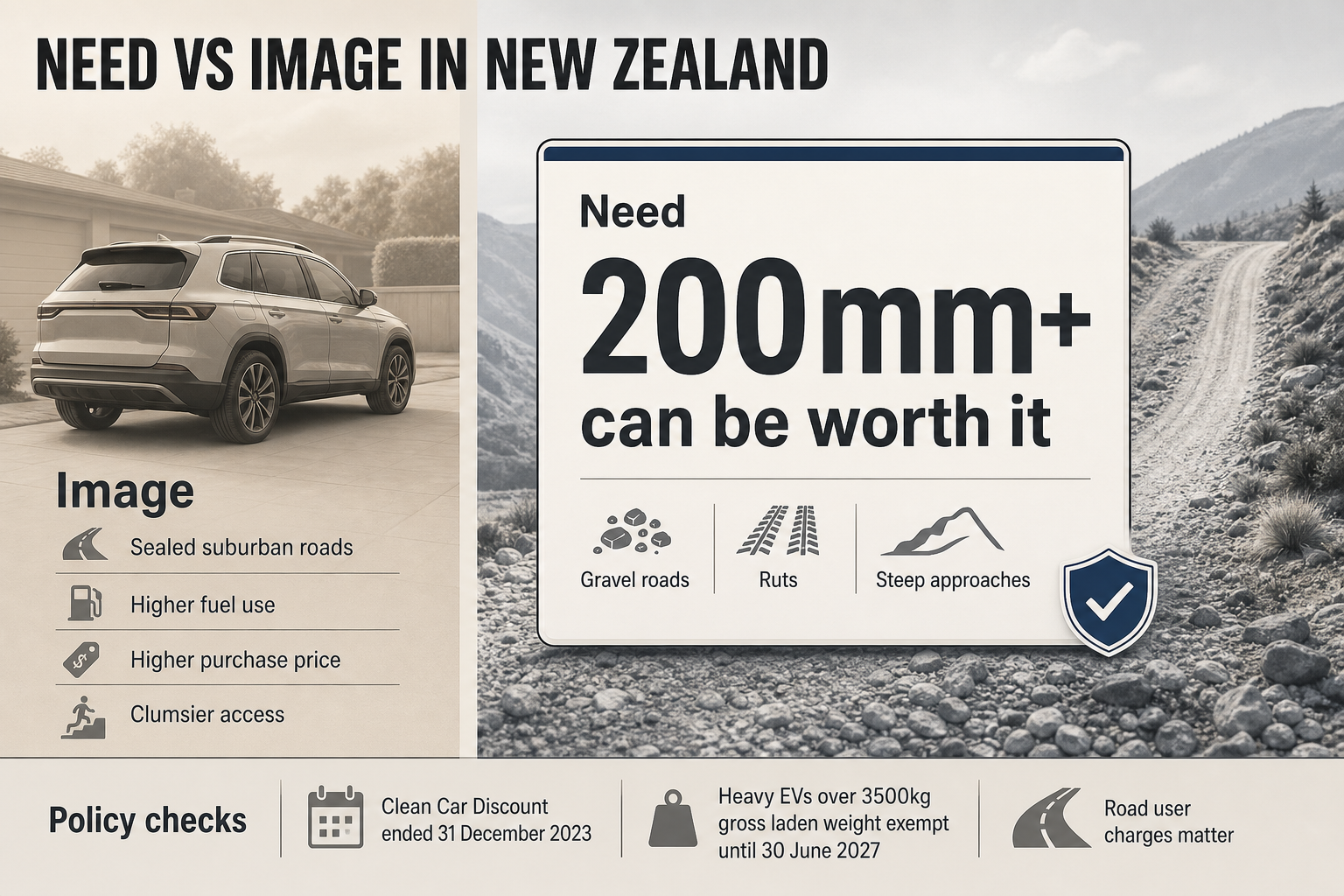
For electrified vehicles, clearance can be especially worth checking because battery placement under the floor can affect underbody design, even if the vehicle’s official figure looks healthy. And if you are comparing diesel SUVs, diesel utes, EVs, or plug-in hybrids, remember that ownership costs in New Zealand are shaped by more than just the sticker price. Road user charges now matter for vehicle choice too, with the old EV exemption no longer applying to most light EVs, while heavy EVs over 3500kg gross laden weight remain exempt until 30 June 2027. (nzta.govt.nz)
The smartest way to judge ground clearance is not to chase the biggest number. Think about the worst road, driveway, ramp, campsite, or ski-lodge car park you actually use each month. If your real life rarely gets rougher than a supermarket car park and a sealed motorway, low to mid clearance is fine. If your weekends involve gravel, ruts, and steep approaches, paying for 200mm-plus can be money well spent. (suzuki.co.nz)
You may also be interested in these independent articles
Sources
- [1]NZ Transport Agency Waka Kotahi: Vehicle dimensions and mass
- [2]Suzuki New Zealand: Swift specifications
- [3]Subaru of New Zealand: Outback
- [4]Subaru of New Zealand: 2023 Outback brochure
- [5]Subaru of New Zealand: Outback Wilderness news
- [6]Ford New Zealand: Ranger brochure
- [7]Toyota New Zealand: RAV4 brochure archive
- [8]NZ Transport Agency Waka Kotahi: Clean Car Programme
- [9]NZ Transport Agency Waka Kotahi: RUC exemptions
© 2026 pyfoi. All rights reserved.