
Best Car Transmission for NZ Drivers
Choosing a car transmission in NZ affects fuel use, towing, EV costs and comfort. Compare automatic, manual, CVT and direct drive before you buy.
Your car’s transmission is the system that sends engine or motor power to the wheels and decides how that power is delivered. For New Zealand buyers, it matters because the right transmission can make a big difference to fuel use, towing confidence, city driving comfort, maintenance costs, and how a car feels on our mix of motorways, steep hills, gravel roads, and open rural highways.
The Options
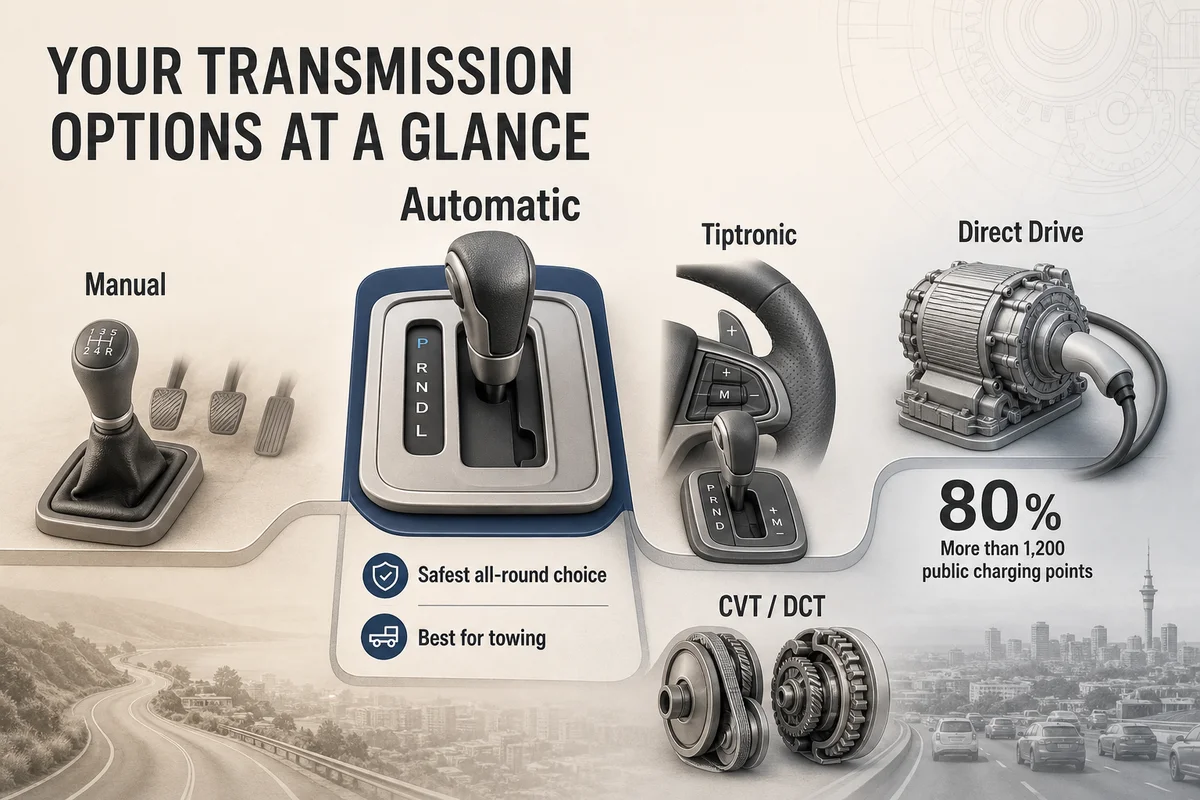
Automatic
A conventional automatic uses a set of fixed gears and changes between them for you. In plain English, it is the classic self-shifting gearbox most Kiwi drivers think of when they hear “auto”. Modern versions usually have six, eight, or even more gears, and they are common in everything from family SUVs to utes and large tow vehicles. The AA notes that transmission choices now go well beyond the old manual-versus-auto split, but the conventional automatic remains the default option many buyers expect. (aa.co.nz)
The big advantage is ease of use. In Auckland stop-start traffic, Wellington hills, or long holiday drives to Northland or Central Otago, a good automatic is smooth and relaxed. It is also often the best fit for towing because torque-converter automatics tend to handle low-speed manoeuvring and pulling away with a trailer more cleanly than some other gearbox types. That is one reason many diesel SUVs and double-cab utes sold in New Zealand use them.
The downsides are weight, complexity, and sometimes fuel use. Older automatics could be thirstier than manuals, though modern ones are much better. Repair bills can still be high if a neglected used vehicle has transmission problems, so service history matters. If you are buying second-hand, especially a used import, you want proof that the transmission fluid has been changed at the right intervals and that it shifts cleanly when cold and warm.
For many NZ buyers, this is the safest all-round choice. If you regularly tow a boat to the ramp, carry the family to the ski field, or want a relaxed daily driver for mixed urban and highway use, a conventional automatic is hard to fault.
Tiptronic
Tiptronic is essentially an automatic transmission with a manual-select mode that lets you choose gears yourself, usually by nudging the gear lever or using steering-wheel paddles. It is not a separate basic transmission family in the engineering sense so much as a branded way of giving the driver more control. In many vehicles, especially European models, it still behaves like a normal automatic most of the time. (porsche.com)
The appeal is flexibility. Around town, you leave it in full auto. On a winding road over the Kaimais or through Arthur’s Pass, you can hold a lower gear for stronger engine braking or sharper response. That can also help when descending steep hills with a load on board. In slippery winter conditions, being able to choose a gear yourself can make the car feel more predictable, though tyre choice and driver technique still matter more than the badge on the shifter. The AA’s winter driving advice stresses using the engine to help with braking, whether your car is automatic or manual. (aa.co.nz)
The catch is that many buyers overestimate how much they will use the manual mode. Most people try it for a week, then go back to full auto. It also does not automatically mean the gearbox is sportier or more durable than another automatic. Treat Tiptronic as a useful extra feature, not a reason by itself to pay more.
If you enjoy driving and want a bit more involvement without giving up convenience, Tiptronic can be a nice middle ground. For ordinary commuting, though, it should not outrank condition, service history, or the overall suitability of the vehicle.
Manual
A manual transmission uses fixed gears that you select yourself with a gear lever and clutch pedal. You control when the car changes gear, which gives you direct involvement and, in the right car, a stronger sense of connection. Manual lessons and licence training are still available in New Zealand, but the AA notes most learner instruction now happens in automatics, which tells you where the market has moved. (aa.co.nz)
The strengths are simplicity, driver control, and often lower purchase price on the used market. In smaller petrol cars and older utes, manuals can also be cheaper to repair than some complex modern automatics. On steep roads or loose surfaces, a skilled driver can control the car very precisely. If you live rurally, drive on gravel, or want an older farm runabout, a manual can still make good sense.
The weaknesses are obvious if you spend time in traffic. Constant clutch work in Hamilton, Christchurch, or central Auckland gets tiring. Manuals can also be a pain at boat ramps or on steep suburban streets if you are not confident with hill starts. Resale can be narrower too, because fewer buyers now want three pedals.
A manual suits buyers who genuinely enjoy driving, want maximum control, or are shopping in older and cheaper parts of the market. It is also worth considering if you want a basic work vehicle and are happy to trade convenience for simplicity. But if your daily routine is mostly urban commuting, you probably do not need to force yourself into a manual just because you think it is the “proper driver’s choice”.
Direct Drive
Direct Drive here refers to the single-speed reduction gear used by most battery electric vehicles. Unlike a petrol or diesel car, an EV motor produces strong torque from very low speed, so it usually does not need multiple gears. You press the accelerator and the car simply goes, with no traditional gear changes. EECA’s guidance on EV types explains that battery electric vehicles are powered solely by electricity stored in the battery. (eeca.govt.nz)
The advantages are smoothness, simplicity, and easy performance. In city traffic, a single-speed EV feels effortless. There is no hunting between gears, no clutch, and no stepped shifts. That makes direct-drive EVs especially pleasant for commuting, school runs, and urban delivery work. Running costs can also be low when you charge at home. EECA says around 80% of EV owners do more than half their charging at home, and home charging is usually cheaper than public charging. (eeca.govt.nz)
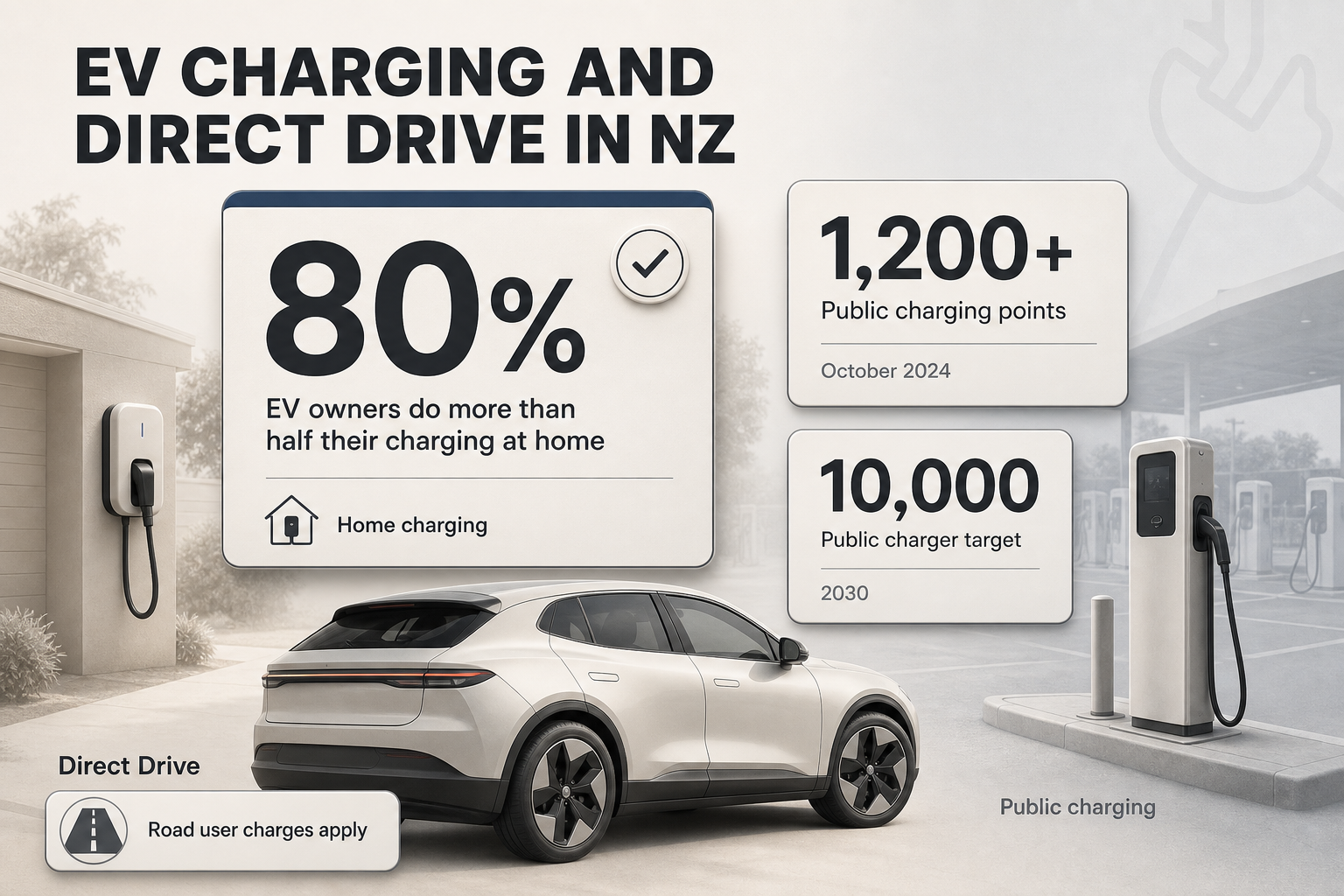
The trade-offs are less about the transmission itself and more about EV ownership. Long-distance travel depends on battery range and charging access. New Zealand’s public charging network is growing, with EECA reporting more than 1,200 public charging points as of October 2024 and a government target of 10,000 public chargers by 2030, but charger availability still matters more in an EV than gearbox type ever did in a petrol car. (eeca.govt.nz)
For NZ buyers with off-street parking and predictable daily driving, direct drive is excellent. It suits urban and suburban life particularly well. If you regularly drive long distances through remote areas, you need to think more carefully about charging stops, especially in winter or when towing. Also remember that light electric vehicles in New Zealand pay road user charges, just like light diesels. (nzta.govt.nz)
Other
“Other” is the catch-all bucket, and in real buying terms it often covers transmissions such as CVTs and dual-clutch gearboxes when a listing site does not label them clearly. That matters because these gearboxes can feel very different from a normal automatic.
A CVT, or continuously variable transmission, does not shift through fixed gears in the usual way. The AA explains that it uses pulleys and a belt to vary the ratio continuously. In practice, that means very smooth acceleration and good efficiency, which is why CVTs are common in small cars, hybrids, and many Japanese models. Subaru New Zealand’s Lineartronic CVT is one current local example. Toyota hybrids also use e-CVT systems. (aa.co.nz)
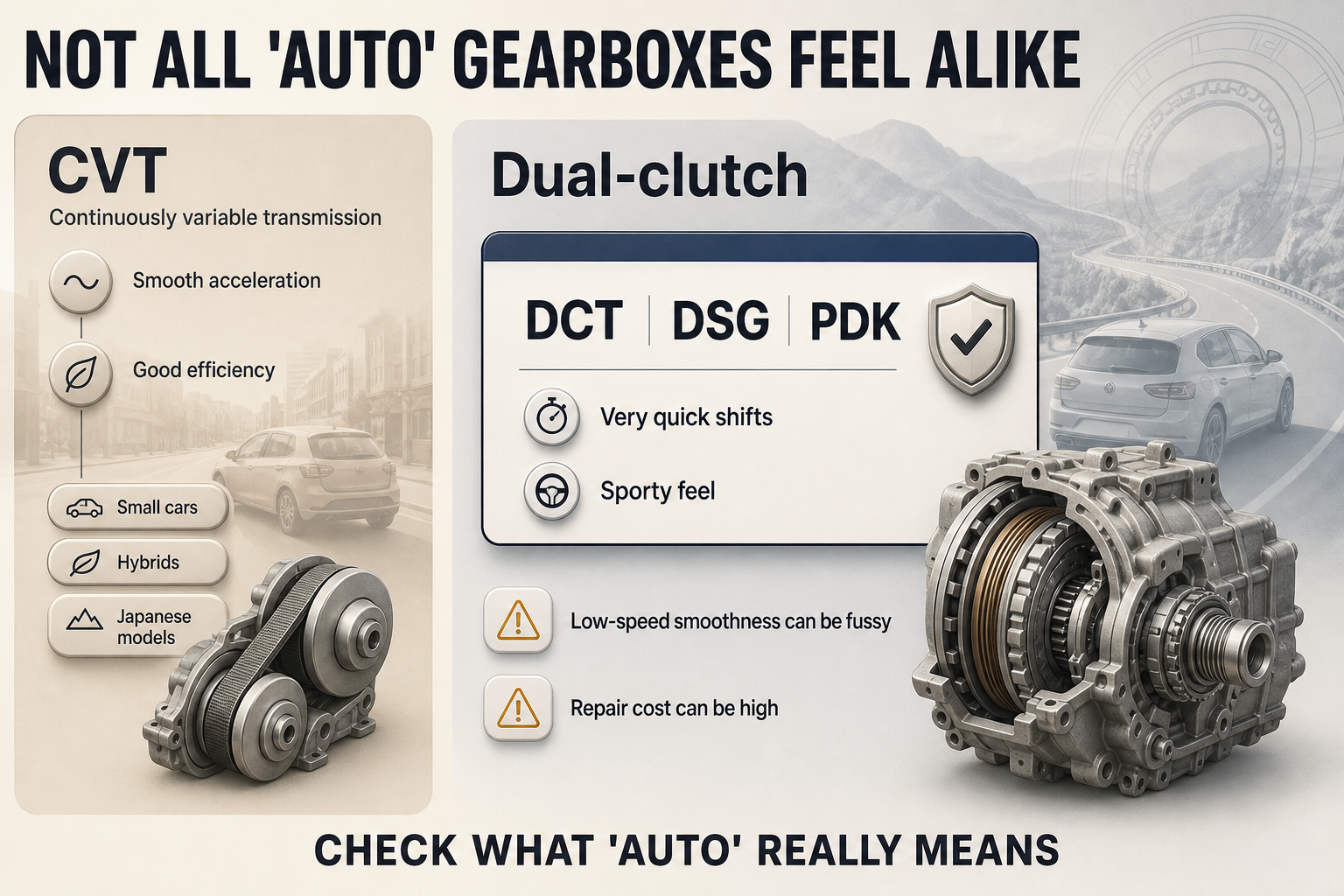
For New Zealand buyers, a CVT can be a smart choice for commuting and family use. It is usually smooth in traffic and efficient on fuel. The downside is feel. Some drivers dislike the elastic, revvy sensation under hard acceleration, especially when overtaking on open roads. Used-car buyers should also be careful about servicing, because CVTs are not gearboxes you want maintained on guesswork alone.
A dual-clutch transmission, often called DCT, DSG, PDK, or similar, is more like two automated manual gearboxes working together. Porsche explains that PDK is its dual-clutch transmission, designed to combine manual-like response with automatic convenience. DCTs can shift very quickly and feel sharp and sporty, which suits performance cars and some European hatchbacks and SUVs. (porsche.com)
Their weakness can be low-speed smoothness and repair cost. Some are excellent, some are fussy, and some have expensive reputations once out of warranty. If a used listing just says “auto”, it is worth checking whether it is actually a conventional automatic, a CVT, or a dual-clutch unit, because ownership experience can differ a lot.
How to Choose
Start with where and how you actually drive. If most of your life is school runs, supermarket trips, and motorway commuting, a conventional automatic or a direct-drive EV will usually suit you best. If you want the lowest-effort daily driving experience, those are the easy answers.
If you do long rural trips, tow regularly, or want a vehicle for mixed family and recreational use, a conventional automatic is often the best bet. It tends to be the most forgiving option for towing a trailer, backing a boat, or climbing steep roads with a full load. Tiptronic is fine if it comes with the right vehicle, but it should be a bonus rather than your deciding factor.
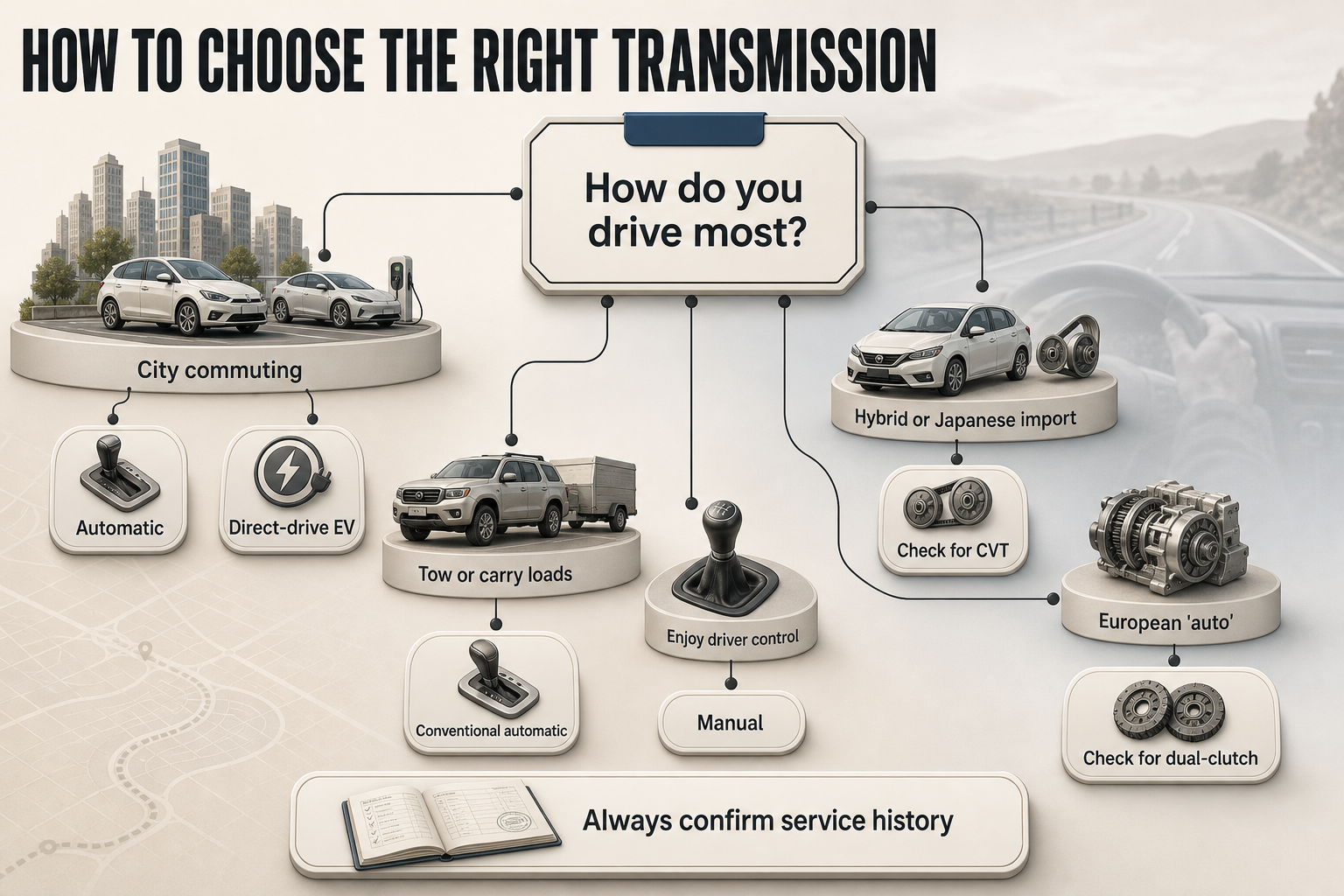
If you enjoy driving and do not mind extra effort, a manual still has a place. It can work well in older performance cars, basic work utes, and budget-friendly used cars. Just be honest with yourself about traffic. You probably do not need a manual for Auckland commuting just to prove a point.
If you are looking at hybrids and small Japanese imports, pay close attention to whether the car uses a CVT. Many do, and that is not automatically a bad thing. It usually means smooth, efficient driving, but you should confirm service history and make sure you like the way it feels on a test drive. If you are shopping European, check whether the “auto” is actually a dual-clutch transmission, because that can affect both driving feel and long-term maintenance.
NZ Context
New Zealand conditions make transmission choice more than a spec-sheet detail. Our roads include everything from dense urban traffic to steep volcanic passes, rough chipseal, gravel back roads, and long holiday hauls with bikes, kayaks, or small trailers. That is why smooth low-speed behaviour, hill performance, and service support matter as much as outright performance.
Running costs are also important. EVs with direct drive can be very cheap to run if you charge at home, and EECA says home charging is the main charging method for most owners, but public charging tends to cost more and light EVs also pay road user charges in New Zealand. (eeca.govt.nz)
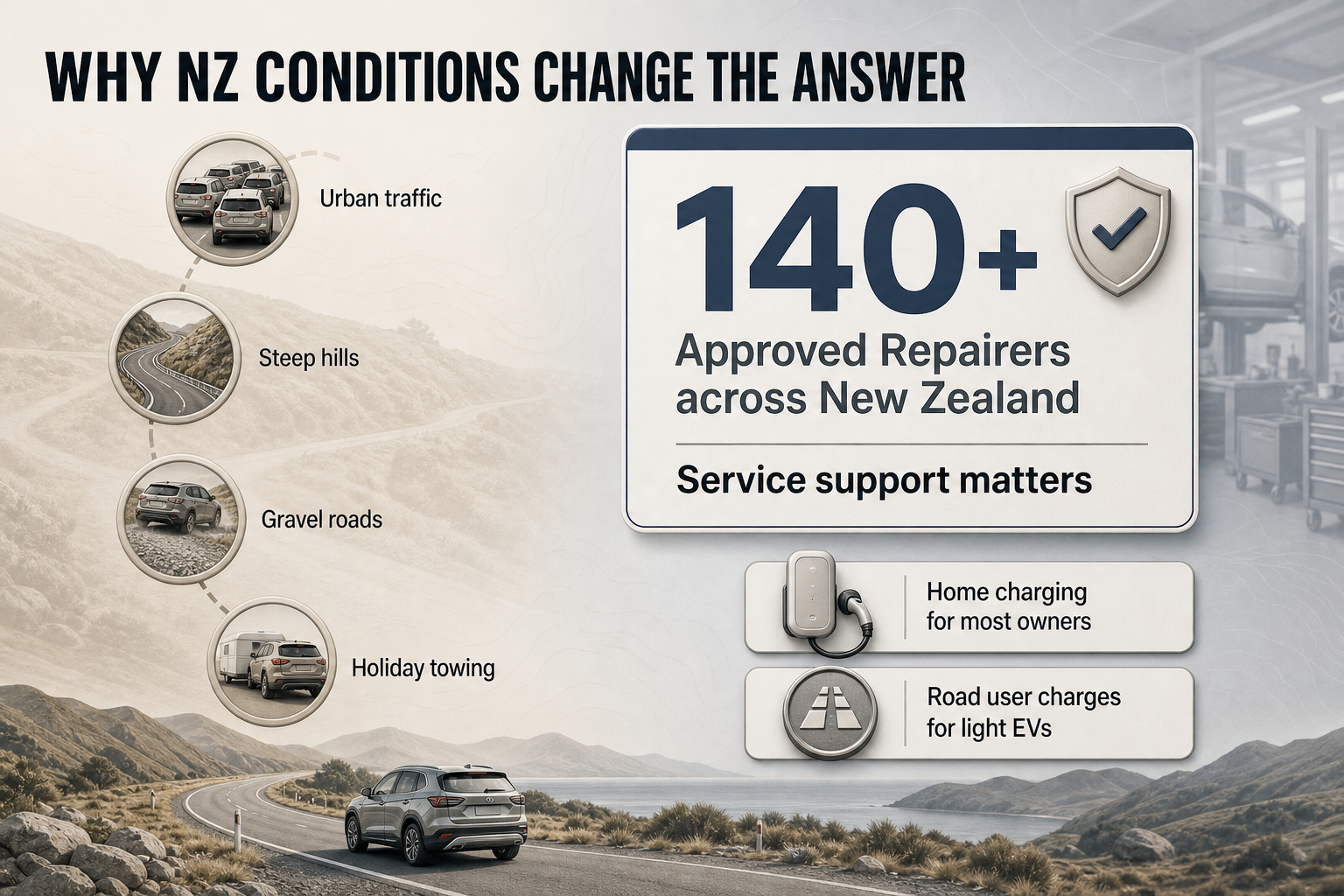
Finally, think about support and inspection. The AA has more than 140 Approved Repairers across New Zealand, including transmission specialists, which is useful if you are buying used and want an expert opinion before committing. With any transmission type, the smartest buyer question is not “which one is best?” but “has this specific car been maintained properly for the way I’ll use it?” (aa.co.nz)
You may also be interested in these independent articles
Sources
- [1]NZ Transport Agency Waka Kotahi - Vehicles
- [2]NZ Transport Agency Waka Kotahi - RUC for electric vehicles
- [3]EECA - How to charge your EV at home and on the road
- [4]EECA - Public EV Charger Dashboard
- [5]EECA - How New Zealand is electrifying its roads
- [6]EECA - Compare electric vehicle types and benefits
- [7]AA - The differences between transmissions
- [8]AA - Top tips for safe winter driving
- [9]AA - Learn in a manual car
- [10]AA - Approved Repairers
- [11]Subaru of New Zealand - Forester Strong Hybrid
- [12]Porsche - What is PDK?
- [13]Consumer NZ - Should you buy a used or nearly new car?
© 2026 pyfoi. All rights reserved.