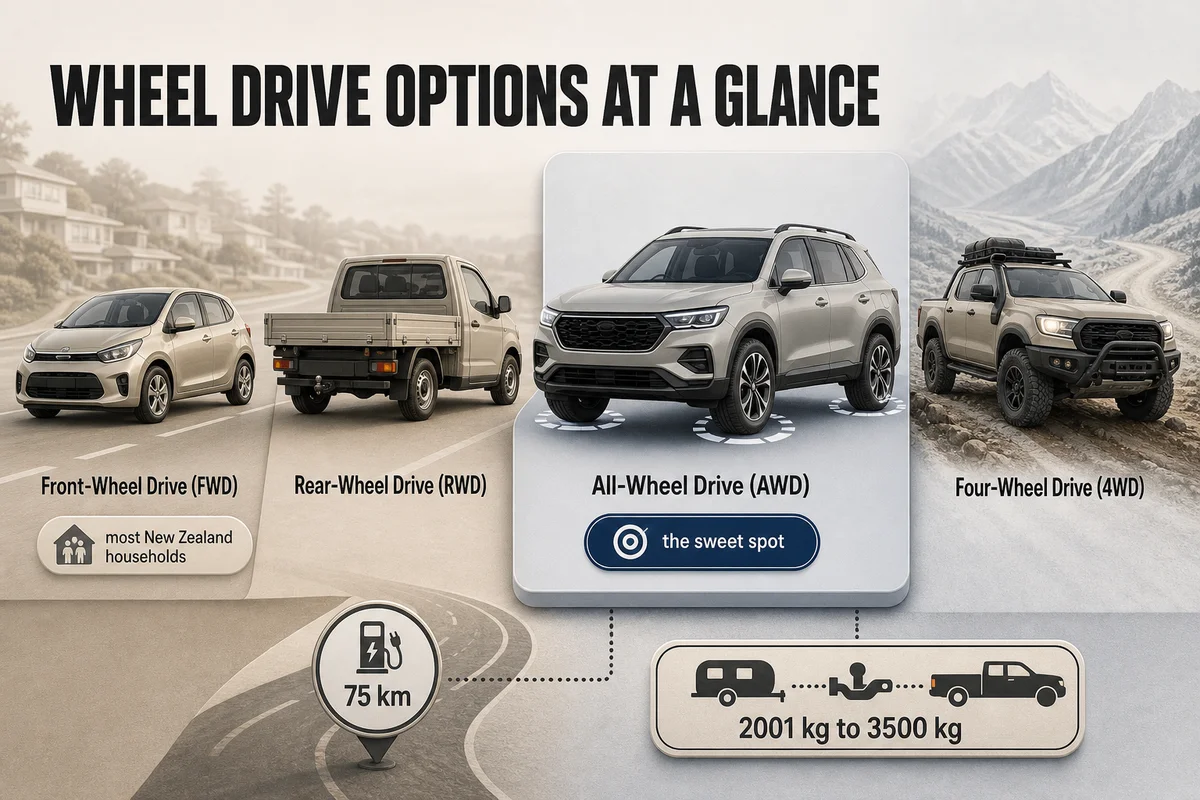

Wheel Drive Layouts Explained for NZ Buyers
FWD, RWD, AWD or 4WD? This NZ guide explains traction, towing, fuel use and winter grip so you can choose the right drivetrain before you buy.
Your car’s wheel drive layout tells you which wheels receive the engine or motor’s power. It affects traction, fuel use, towing feel, handling, tyre wear, and how confident the car feels on wet roads, gravel, snow, or boat ramps.
For New Zealand buyers, wheel drive matters because our driving conditions vary a lot. Auckland commuters, Canterbury gravel-road users, Central Otago ski-field regulars, and people towing a boat in Northland can all need very different things from the same vehicle category. (nzta.govt.nz)
The Options
Front-Wheel Drive (FWD)
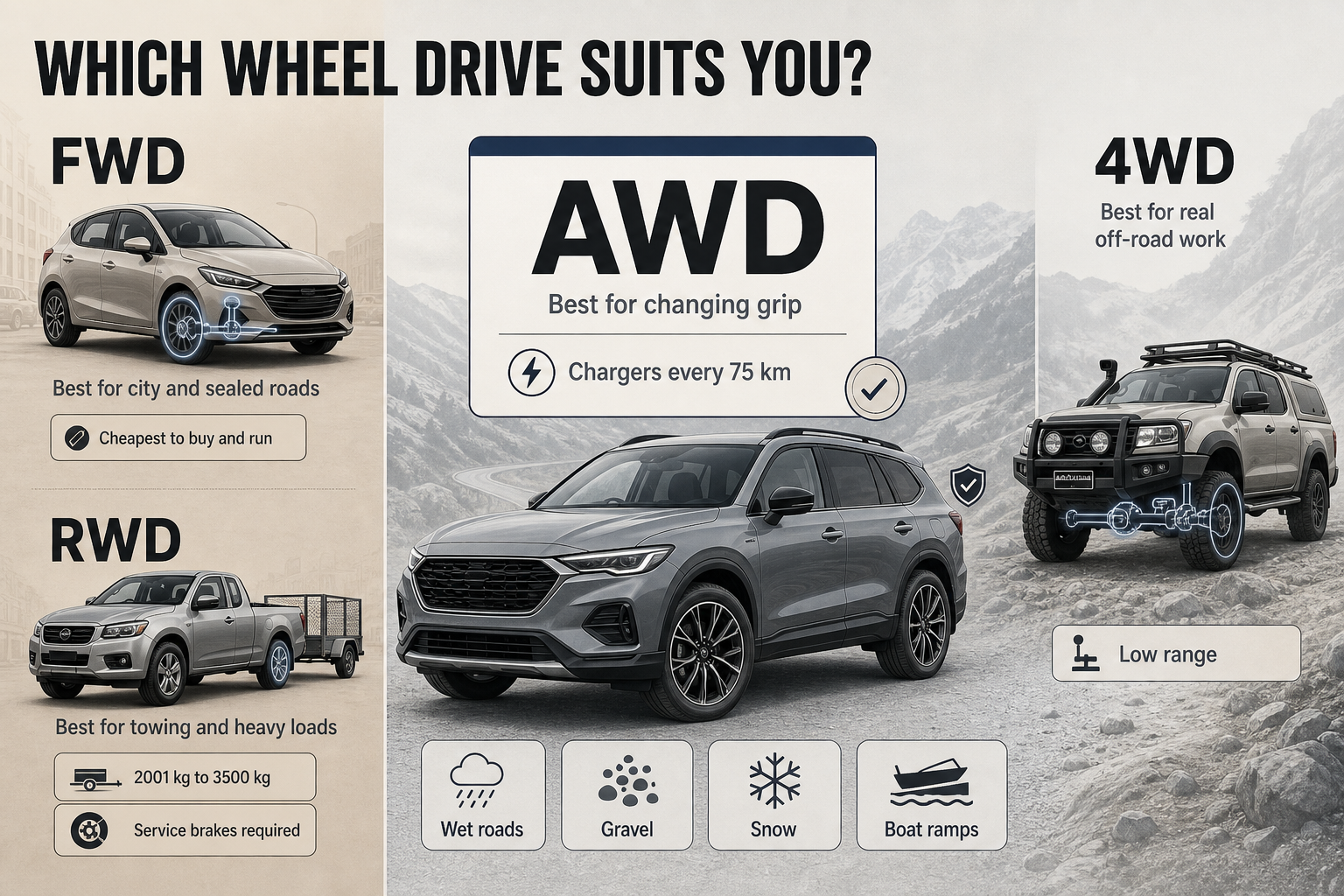
Front-wheel drive means the front wheels both steer the car and pull it along. This is the most common setup in small cars, many medium SUVs, hybrids, and family hatchbacks because it is compact, efficient, and usually cheaper to build and maintain than more complex drivetrains.
The big advantage of FWD is efficiency. With fewer heavy drivetrain parts than AWD or 4WD systems, FWD cars are usually lighter, which helps fuel economy or EV range. That matters in New Zealand, where running costs are a real part of ownership, and buyers can compare energy economy on the mandatory vehicle labelling programme. (eeca.govt.nz)
FWD also works well in everyday bad weather. Because the engine’s weight is usually over the driven wheels, a FWD car can feel secure pulling away on wet roads. That said, no drivetrain can overcome poor tyres or excessive speed. NZTA advises that wet, frosty and icy roads are more slippery and that good tyres, brakes and steering matter even more in bad weather. (nzta.govt.nz)
The downsides show up when loads and conditions get tougher. Under hard acceleration, especially in powerful cars, FWD can struggle for traction and tug at the steering wheel. It is also not ideal for regular heavy towing, repeated gravel-road punishment, or low-speed off-road work.
For most New Zealand households, FWD is enough. If your driving is mainly urban commuting, school runs, open-road trips on sealed roads, and the occasional holiday journey, you probably do not need anything more complicated. A FWD hatch, sedan, hybrid, or crossover will usually be the cheapest option to buy and run.
Rear-Wheel Drive (RWD)
Rear-wheel drive sends power to the back wheels while the front wheels focus on steering. This layout is common in utes, many vans, performance cars, and some large SUVs because it separates steering from driving duties and often handles heavy loads better.
RWD’s main strength is balance under load. When you accelerate, weight shifts rearward, which can help the driven wheels grip more effectively. That is one reason RWD is popular in towing vehicles and commercial vehicles. It can also feel more natural and stable when towing a trailer, horse float, or small boat, especially if the vehicle has a long wheelbase and a proper tow rating. NZTA’s towing guidance and brake rules become especially relevant once trailer weights rise, with service brakes required on trailers from 2001 kg to 3500 kg. (nzta.govt.nz)
The trade-off is that RWD can be less reassuring on slippery roads if the vehicle is lightly loaded. A ute with an empty tray, for example, can lose traction more easily on wet seal, loose gravel, or frosty back roads than many buyers expect. That does not make RWD unsafe, but it does mean tyre quality and driver inputs matter a lot. NZTA specifically warns that stopping distances increase on slippery roads and recommends increasing following distance in bad weather. (nzta.govt.nz)
RWD suits buyers who tow regularly, carry heavy loads, or want a more traditional commercial-vehicle setup. It also suits enthusiasts who value handling feel. For a city-based family SUV, though, RWD is less common and often not the most practical choice.
All-Wheel Drive (AWD)
All-wheel drive sends power to all four wheels, either full-time or automatically when extra grip is needed. Many modern SUVs, EVs, wagons, and premium cars use AWD systems. Brand names vary, but if the system is automatic and does not have a proper low-range transfer case, it is usually AWD rather than 4WD.
AWD’s key benefit is extra traction in changing conditions. On wet roads, gravel, frosty mornings, and steep unsealed driveways, an AWD vehicle can feel calmer and more sure-footed than a two-wheel-drive equivalent. That can be useful in New Zealand, where road surfaces and weather can change quickly, especially in alpine areas and on rural roads. NZTA notes that bad weather reduces grip and visibility, while our road surfaces vary by region and material. (nzta.govt.nz)
AWD is particularly common in EVs and electrified SUVs because electric motors make it relatively easy to drive both axles. That can improve straight-line traction without the full weight and mechanical complexity of a traditional off-road 4WD system. EECA also notes that EVs are cheaper to run than equivalent petrol cars, even with road user charges factored in, and that public chargers are available at least every 75 km on most state highways. (eeca.govt.nz)
The downside is cost. AWD versions of the same model usually cost more to buy, weigh more, and use more fuel or energy than FWD versions. Tyre replacement can also be pricier, and some AWD systems are sensitive to mismatched tyre wear. AWD improves traction when moving off, but it does not shorten braking distances on wet or icy roads.
AWD is a good fit if you live on a gravel road, head to ski fields each winter, regularly drive in heavy rain, or want extra confidence without stepping up to a full off-road vehicle. It is often the sweet spot for Kiwi buyers who genuinely need more grip but do not need low-range gearing.
Four-Wheel Drive (4WD)
Four-wheel drive usually means a more heavy-duty system designed for rough terrain, towing, and difficult low-speed work. In many vehicles it is selectable rather than always on, and proper 4WDs often include low range, which gives you very low gearing for climbing, descending, crawling, or pulling heavy loads on loose surfaces.
This is the setup you want for genuine off-road use. Farm tracks, riverbed access, muddy paddocks, deeply rutted forestry roads, and steep boat ramps are where 4WD earns its keep. Low range gives you control that AWD does not. If you tour remote parts of the South Island, launch boats regularly, or need a ute for rural work, 4WD can be the right answer.
The penalties are clear. 4WD vehicles are usually heavier, dearer, and thirstier than FWD or AWD equivalents. On sealed-road commuting in Wellington, Hamilton, or Christchurch, much of that hardware may never be used. In many cases, buyers pay extra for toughness they rarely need.
There is also a common misunderstanding here. 4WD does not mean you can ignore road conditions. Snow, ice, mud, and wet seal still demand careful driving, proper tyres, and sensible speed. If you are heading to alpine areas, drivetrain helps, but tyres, chains, and clearance can matter just as much depending on the road and conditions. NZTA’s bad-weather advice remains the baseline. (nzta.govt.nz)
How to Choose
Start with where you actually drive, not with the badge on the tailgate. If your life is mostly motorway commuting, supermarket runs, and family trips on sealed roads, FWD is usually the smart buy. It is lighter, simpler, and often gives you the best value.
If you tow often, carry serious loads, or want a ute or van for work, RWD deserves a close look. It is often better matched to commercial use and steady towing than people realise. Just be realistic about wet-weather traction when the vehicle is unloaded.
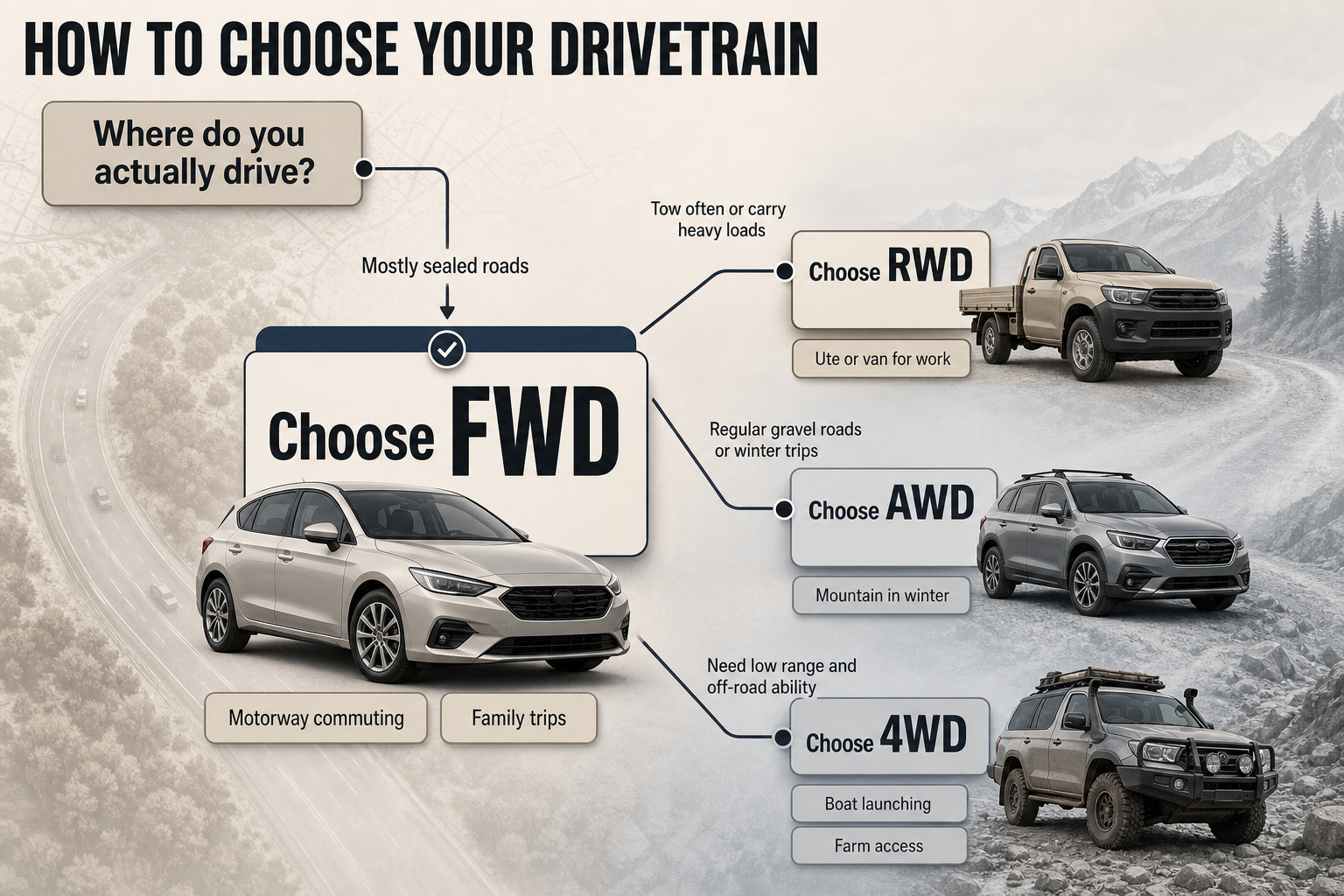
If you live rurally, use gravel roads often, or head to the mountain in winter, AWD is often the most sensible upgrade. It gives you extra traction where it helps most, without the bulk and fuel penalty of a full 4WD system. For many Kiwi SUV buyers, AWD is useful, but not essential. You probably do not need it for suburban Auckland or central Christchurch commuting alone.
Choose 4WD if you know you need low range or genuine off-road ability. That means regular boat launching on slippery ramps, farm access, hunting tracks, remote camping, or repeated towing and hauling on loose surfaces. If that is not your reality, AWD or even FWD may serve you better and cost less over time.
NZ Context
New Zealand roads place a premium on tyres, suspension, and driver judgement as much as drivetrain. NZTA highlights that roads are especially slippery just after rain starts, and that braking distances increase in wet, frosty, or icy conditions. So while AWD and 4WD can help you get moving, they do not replace safe speeds and good tyres. (nzta.govt.nz)
Running costs matter too. More driven wheels usually mean more weight and more mechanical drag, so FWD is often the efficiency leader in petrol and hybrid cars. For EVs, AWD versions can offer stronger performance and better traction, but they usually sacrifice some range compared with single-motor two-wheel-drive versions. EECA’s guidance on EV benefits and charging coverage is useful if you are comparing electric SUVs and crossovers. (eeca.govt.nz)
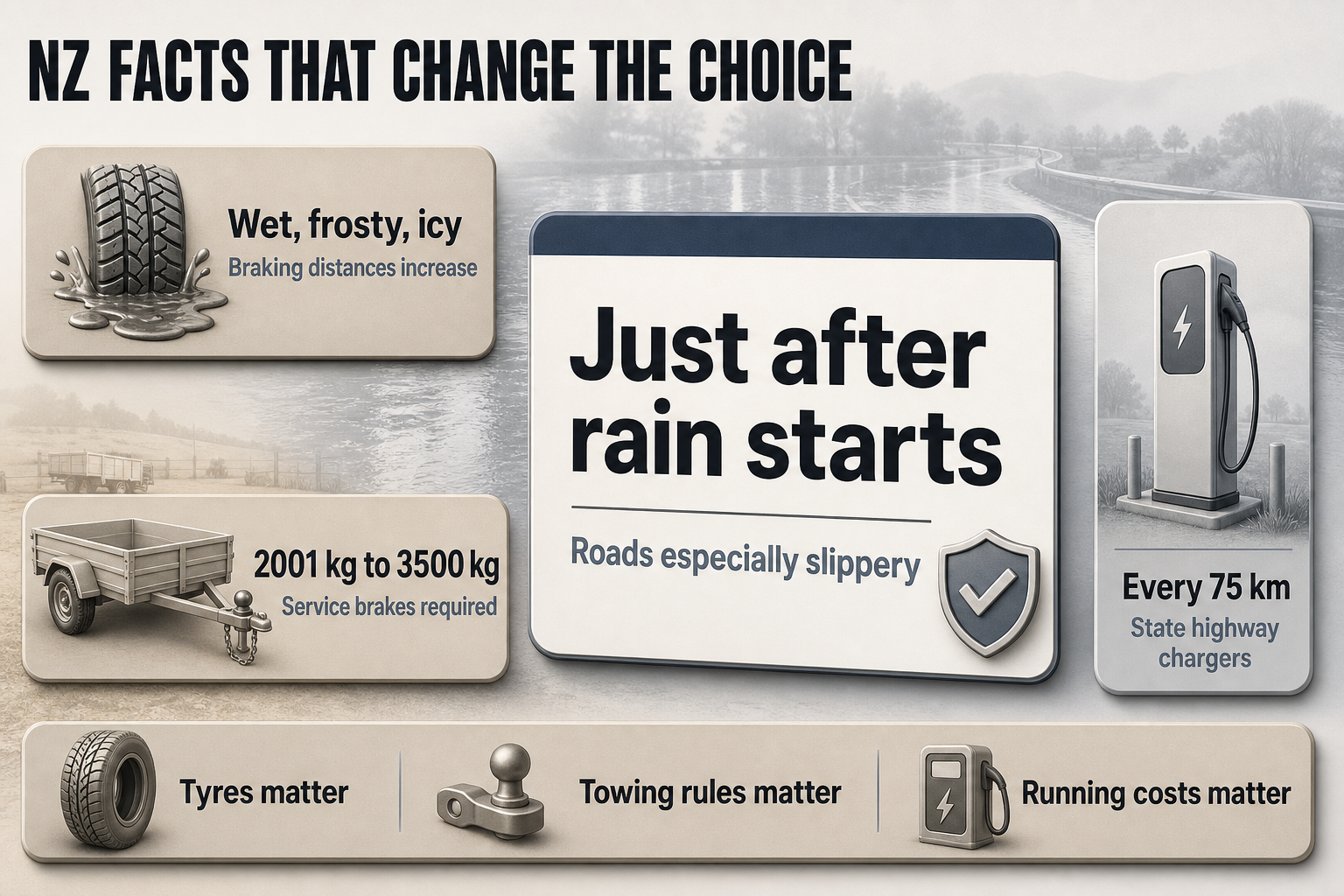
Towing is another area where buyers should focus on the whole package, not just drivetrain. A 4WD badge does not override legal brake requirements, towbar standards, payload limits, or gross combined mass. NZTA guidance notes that trailers from 2001 kg to 3500 kg require service brakes, and towbar compliance matters for light-trailer towing. (nzta.govt.nz)
For winter travel, especially in the central North Island and South Island alpine regions, extra traction can help, but road closures, chain requirements, and weather conditions can still affect any vehicle. A capable AWD wagon on proper tyres can be a better real-world fit than a heavy 4WD on road-biased tyres, while a FWD car with quality winter-ready tyres may outperform a poorly shod SUV.
You may also be interested in these independent articles
Sources
- [1]NZ Transport Agency Waka Kotahi - Driving in bad weather
- [2]NZ Transport Agency Waka Kotahi - Road surfacing
- [3]NZ Transport Agency Waka Kotahi - Guide to safe loading and towing for light vehicles
- [4]NZ Transport Agency Waka Kotahi - Vehicle Inspection Portal trailer brake requirements
- [5]NZ Transport Agency Waka Kotahi - Vehicle Inspection Portal towbars
- [6]EECA - Benefits of electric vehicles for your home
- [7]EECA - Compare electric vehicle types and benefits
- [8]EECA - Regulations
© 2026 pyfoi. All rights reserved.