
How Much Engine Power Do You Need in NZ?
Find the right engine power in kW for NZ driving, towing and family use. Learn what counts as enough power before you overpay or regret it.
Engine power tells you how much work an engine can do, and in New Zealand listings it is usually shown in kilowatts, or kW. It matters because power affects how quickly a car accelerates, how relaxed it feels at motorway speeds, and how well it copes with hills, passengers, luggage, or towing.
A bigger number is not always better. The right amount of power depends on how you actually drive, whether that is Auckland commuting, long South Island road trips, hauling bikes to Rotorua, or towing a small boat to the bach.
What the Numbers Mean
Power is different from torque, though the two are closely linked. In simple terms, power is the engine’s ability to keep doing work as speed rises. That is why a higher-power vehicle usually feels stronger when merging onto a motorway, overtaking on a passing lane, or climbing long grades with a full load.
Kilowatts are the standard metric unit in New Zealand. If you have seen horsepower in overseas reviews, 100kW is roughly 134hp. For everyday buying, the easiest way to think about kW is by matching it to vehicle size and use. A light hatch with 85kW can feel perfectly adequate, while a seven-seat SUV with the same output will feel strained. That is because weight matters almost as much as the power figure itself.
This is why two cars with the same kW can drive very differently. A 100kW supermini can feel lively around town, but a 100kW ute loaded with tools will not. If you want a quick shortcut, look at power alongside kerb weight. More power per kilogram usually means easier overtaking and less effort on steep roads.
Typical Ranges
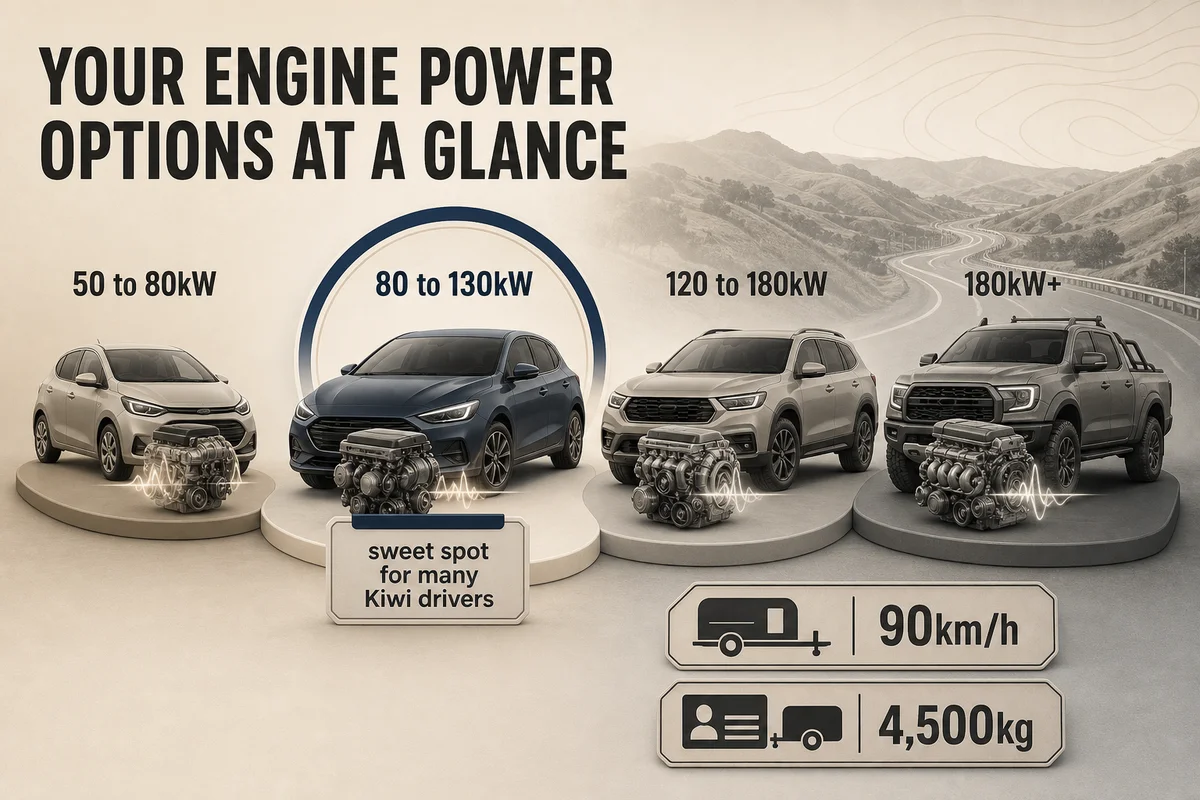
For small city cars and older compact hatchbacks, engine power often sits around 50 to 80kW. That is enough for urban driving, school runs, and short motorway trips, but it can feel breathless when the car is full or when you are climbing long hills such as the Kaimais or sections of SH1 through the central North Island.
Mainstream small and medium cars usually land around 80 to 130kW. This is the sweet spot for many Kiwi drivers. A modern Corolla, Mazda3, Cerato, or similar car in this band will generally feel comfortable in town and capable on the open road, without carrying the fuel penalty of a more powerful engine.
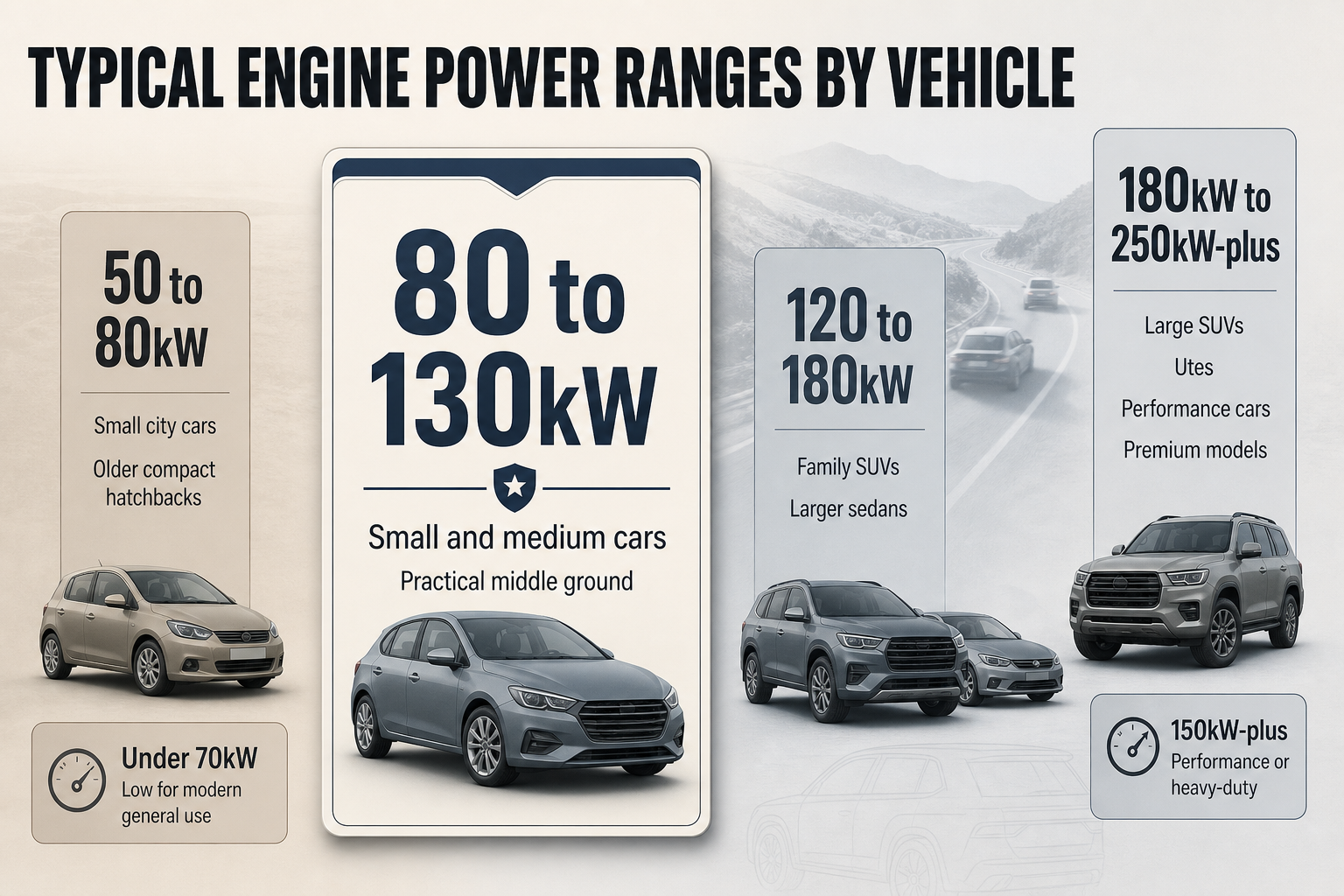
Family SUVs and larger sedans commonly sit between 120 and 180kW. That range suits buyers who regularly carry five people, luggage, or outdoor gear, and it gives you more reserve for overtaking and towing light loads. It is also where many hybrid SUVs now sit, with electric assistance helping deliver stronger real-world response than the raw kW figure might suggest.
Large SUVs, utes, performance cars, and premium models often start around 180kW and can run well past 250kW. At this point you are buying more than basic capability. You are paying for stronger acceleration, higher towing confidence, and in some cases a more effortless feel rather than outright speed. For heavy towing or frequent rural driving, that can be useful. For urban commuting, it is often unnecessary.
As a broad guide, under 70kW is low for modern general use, 80 to 130kW is the practical middle ground, and 150kW-plus is where performance or heavy-duty ability starts to become a selling point rather than a basic need.
Use-Case Guidance
If you mainly drive in cities such as Auckland, Wellington, or Christchurch, with occasional motorway use, around 70 to 110kW is usually enough in a small or medium car. That gives you decent traffic response and enough pace for merging without paying for power you rarely use. In a heavier compact SUV, you will usually want closer to 100 to 140kW for the same relaxed feel.
For regular open-road driving, especially on two-lane highways where overtaking windows can be short, a bit more power makes life easier. Around 100 to 140kW in a medium car, or 130 to 180kW in an SUV, tends to feel more comfortable. You do not need a fast car, but you do want enough reserve that overtaking a truck does not become a stressful exercise.
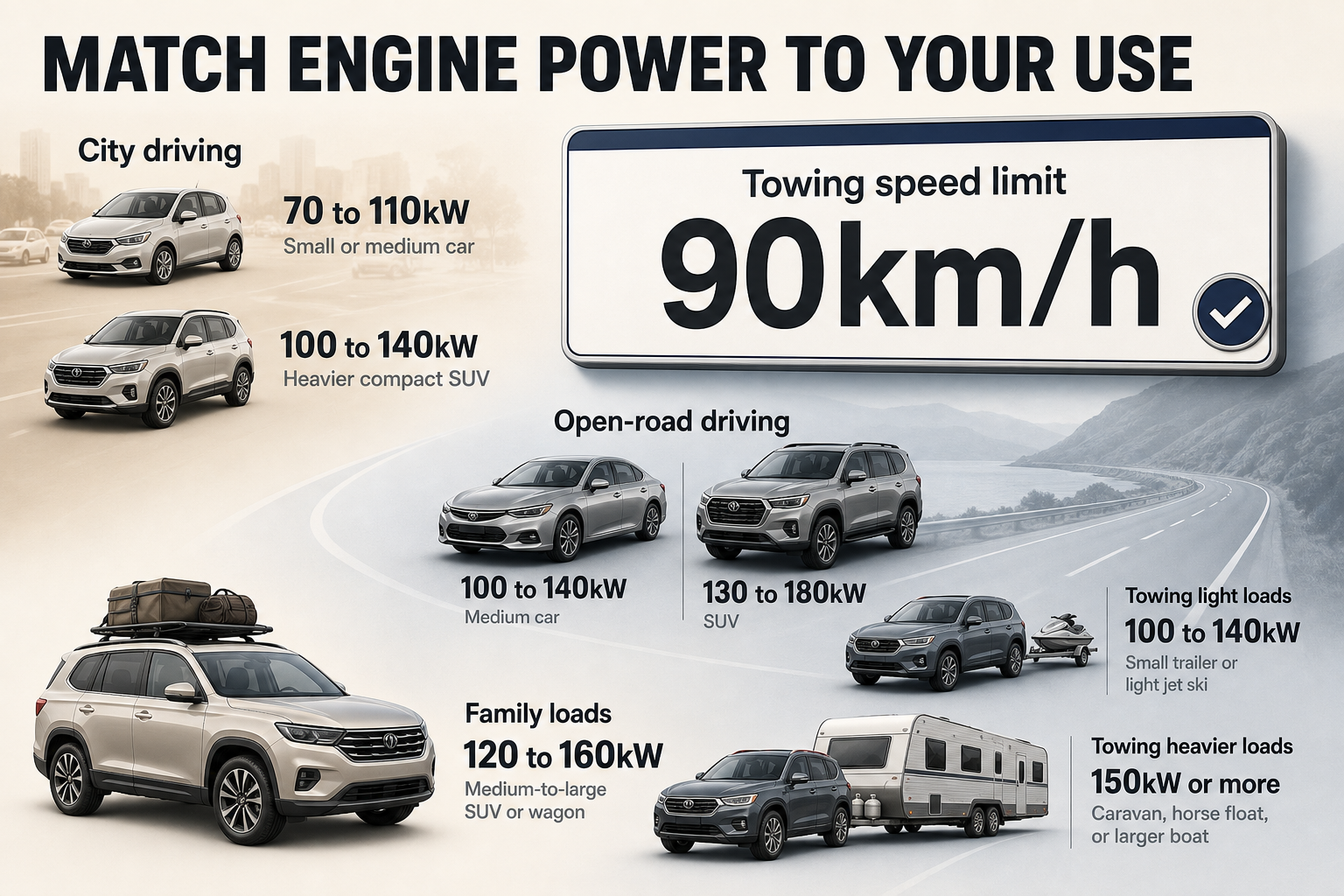
For family buyers carrying five people plus gear, power becomes more important than many expect. A fully loaded vehicle heading to Taupō, Queenstown, or the ski fields will expose an underpowered engine quickly. In that case, around 120 to 160kW is a sensible target for a medium-to-large SUV or wagon.
If you tow, engine power matters, but it is only part of the picture. You also need to check the braked towing rating, transmission, cooling, and vehicle mass. Still, as a rough guide, towing a small trailer or light jet ski is manageable with around 100 to 140kW in the right vehicle, while towing a caravan, horse float, or larger boat is usually more comfortable with 150kW or more. New Zealand’s open-road speed limit for light vehicles towing trailers is 90km/h, so towing performance is more about stability and pulling power than high-speed pace. (nzta.govt.nz)
For rural buyers, especially on hilly roads or gravel, extra power can be useful, but traction and tyres often matter more. You probably do not need 200kW for farm access tracks or unsealed roads. A well-matched AWD or 4WD vehicle with moderate power can be more effective than a high-power two-wheel-drive model.
NZ-Specific Factors
New Zealand roads make power feel different than it does in overseas brochures. We have plenty of steep grades, narrow passing lanes, chipseal surfaces, and changeable weather. A car that feels fine on flat urban roads can feel hard-worked on a holiday trip through the Desert Road or over Lindis Pass, especially with passengers and luggage on board.
Fuel cost is the obvious trade-off. More power often means a larger engine, and that usually means higher fuel use unless the vehicle is a well-designed hybrid. MBIE’s fuel monitoring shows New Zealand petrol and diesel prices are tracked weekly and remain a meaningful running-cost factor for buyers comparing engine sizes. (mbie.govt.nz) If you drive long distances every week, chasing extra kW you do not need can cost you hundreds or thousands of dollars over time.
Diesel utes and SUVs can offer strong towing performance with moderate peak power figures because they often produce high torque at low engine speeds. That is useful for towing and climbing, but diesel buyers in New Zealand also need to factor in road user charges, not just pump price. For some drivers, a petrol hybrid with less headline power can still be the cheaper and nicer daily driver.
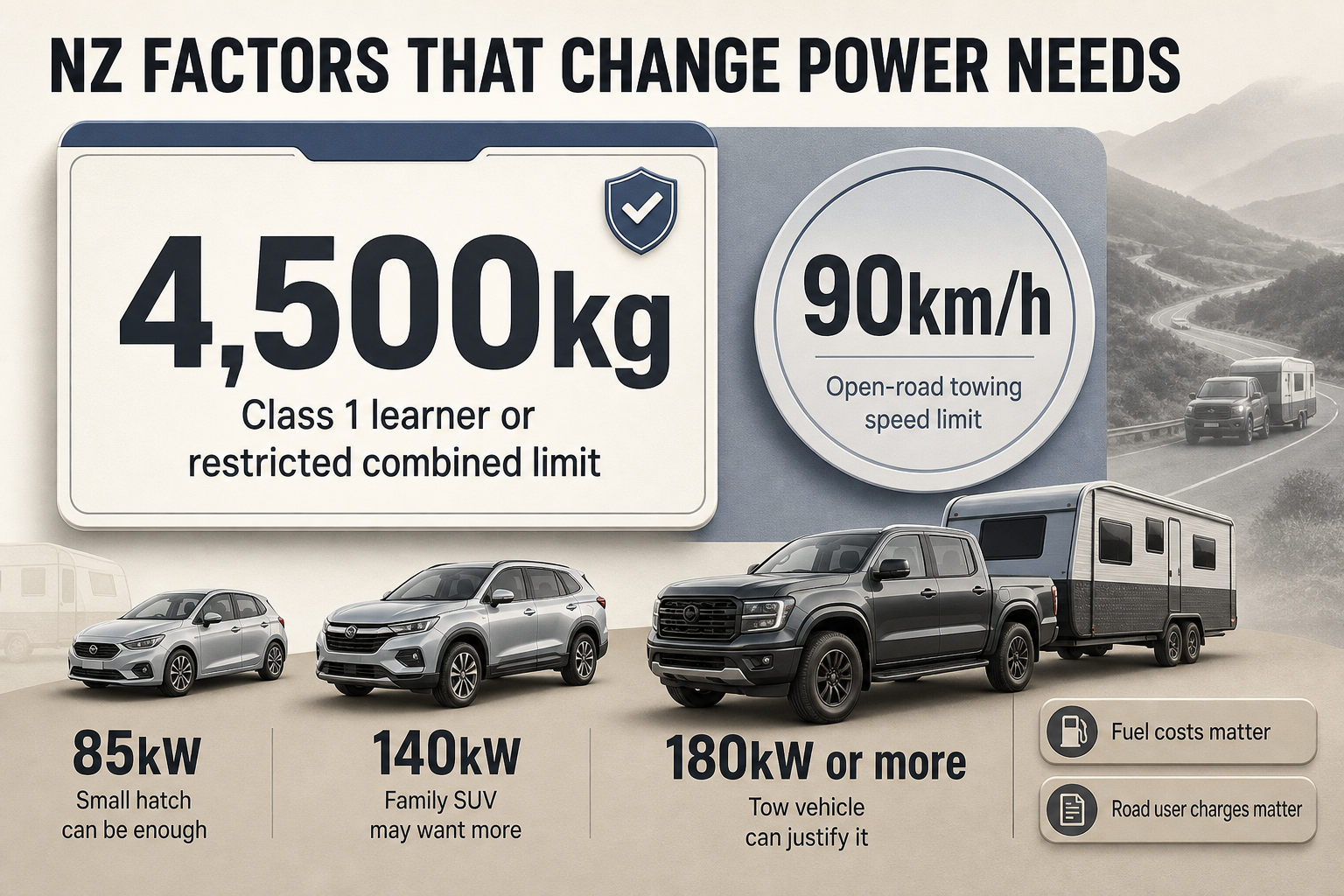
There is also a licensing and legal angle for towing. On a class 1 learner or restricted car licence, you can tow a trailer, but the combined weight of your vehicle, trailer, and load must not exceed 4,500kg. (nzta.govt.nz) That means buying a high-power vehicle for towing only makes sense if the rest of the vehicle’s ratings and your licence situation line up.
The main thing to remember is that engine power should be judged in context. A small hatch can be perfectly good at 85kW. A family SUV may want 140kW. A tow vehicle may justify 180kW or more. You are not buying the biggest number on the spec sheet. You are buying enough performance for the way you actually use New Zealand roads.
You may also be interested in these independent articles
Sources
© 2026 pyfoi. All rights reserved.