
How to Judge a Car’s Interior Space Rating
Learn what a car interior space rating really means, from rear legroom to child-seat fit and third-row comfort, before you buy in NZ.
Interior space sounds simple, but it affects your car every day. It shapes how comfortable you are in traffic, how easily child seats fit, whether adults can survive the back seat on a holiday run, and how useful a third row really is.
A 1 to 5 star interior space rating is a shortcut for how roomy a cabin feels and functions. The best ratings are not just about exterior size. A tall SUV can still be tight inside, while a well-packaged hatch or EV can feel surprisingly open because of clever design.
What Goes Into the Rating
A proper interior space rating looks at more than one measurement. Front and rear legroom matter because they tell you how much stretch-out space occupants actually get. Headroom matters if you are tall or regularly carry adults in the back. Shoulder room matters if you often use all three rear seats, and cabin volume helps show whether the interior feels airy or cramped rather than pinched in. These are the basics behind any sensible space score.
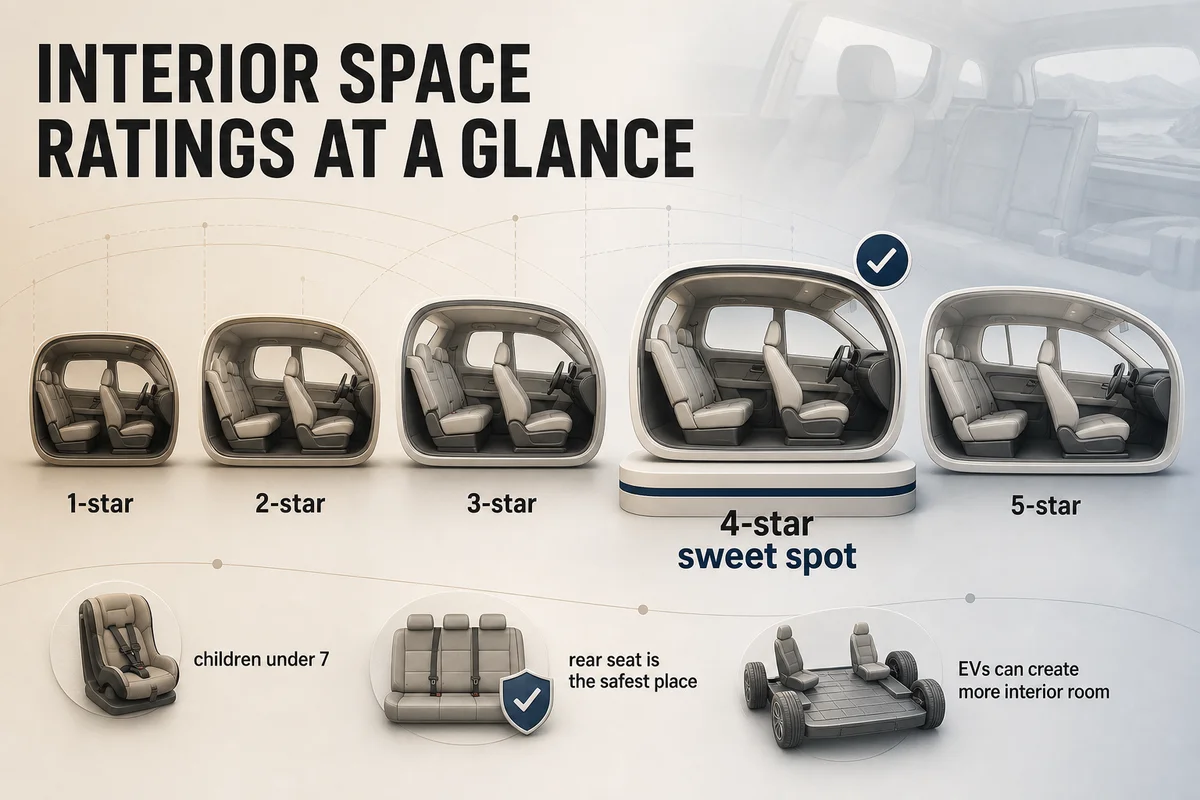
The jump from 1 star to 5 stars is mostly about how many people the car can carry in comfort, not just in theory. A 1-star vehicle is genuinely cramped, usually a tiny city car or a strict 2-seater with little to no meaningful rear accommodation. A 2-star vehicle is still below average, often fine for two adults up front but tight for rear passengers. A 3-star vehicle is the middle ground: acceptable for four to five adults on ordinary trips, though the middle rear seat may be a compromise. A 4-star vehicle offers clearly generous space, with rear legroom that works well for adults and a cabin that feels easy to live with. A 5-star vehicle is exceptional, usually a large SUV, people mover, luxury sedan, or a properly packaged three-row model with a third row adults can actually use.
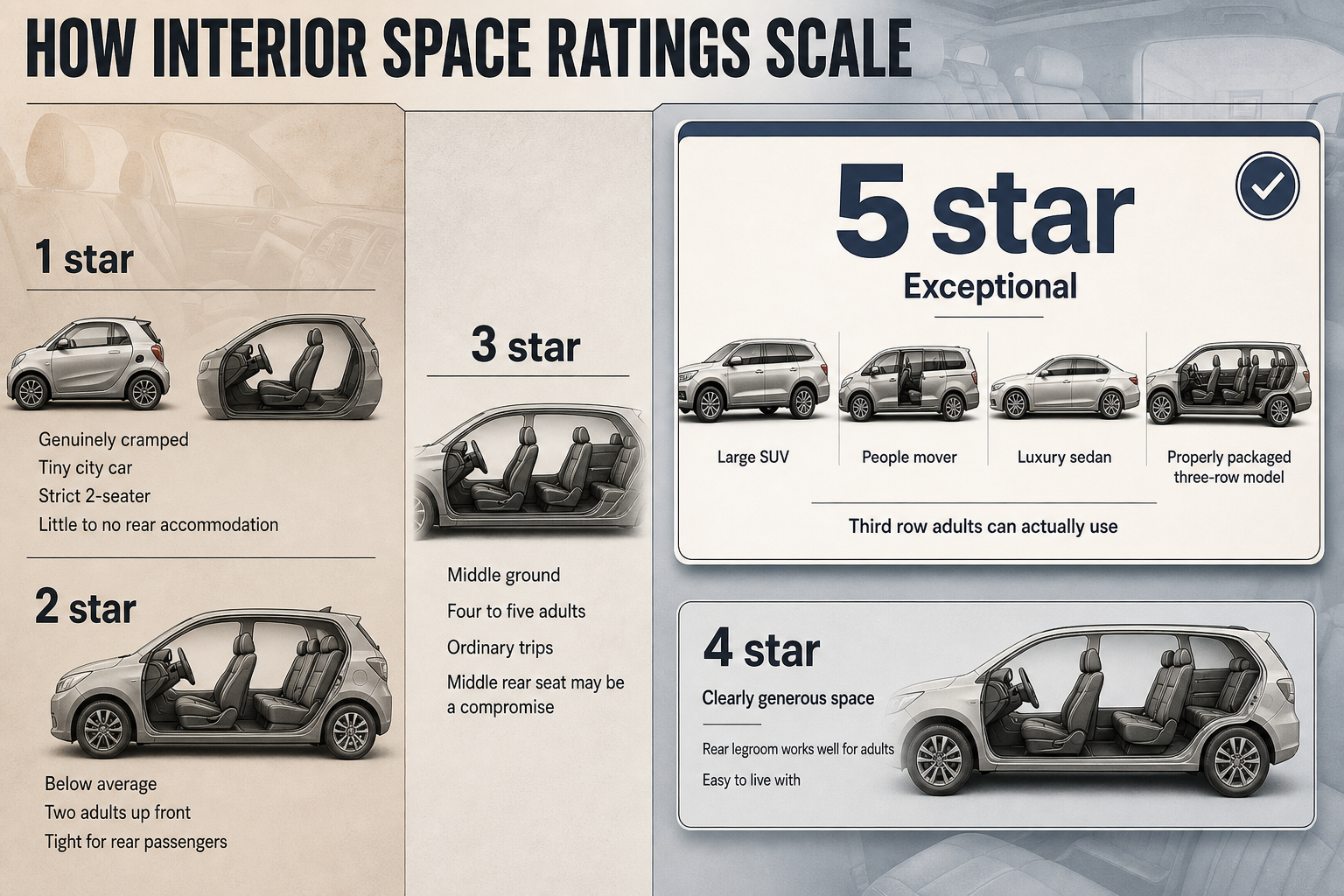
Seating layout also matters. A long wheelbase often helps rear legroom more than a long bonnet does. Flat floors, slim front seat backs, and clever battery placement in EVs can free up cabin space. If a vehicle has a third row, that row should only boost the score if adults can sit there without knees under their chin. Many seven-seat SUVs advertise capacity, but their rearmost seats are really occasional child seats.
What to Look For
Start with your own use, not the marketing label. If you mostly drive alone around Auckland, Wellington, or Christchurch, you may not need a 4-star or 5-star cabin. A tidy 3-star hatch or small SUV can be plenty. But if you do school runs, airport pickups, weekend sport, or long intercity trips, rear-seat comfort becomes much more important.
When you inspect a car, sit in every seat. Do not just adjust the driver’s seat for yourself and stop there. Set the front seats for the people who will actually use them, then climb into the second row. Check knee room, foot room under the front seats, toe space, and whether your head brushes the roof lining. If you carry adults to the Coromandel, Queenstown, or Northland, this matters more than brochure claims.
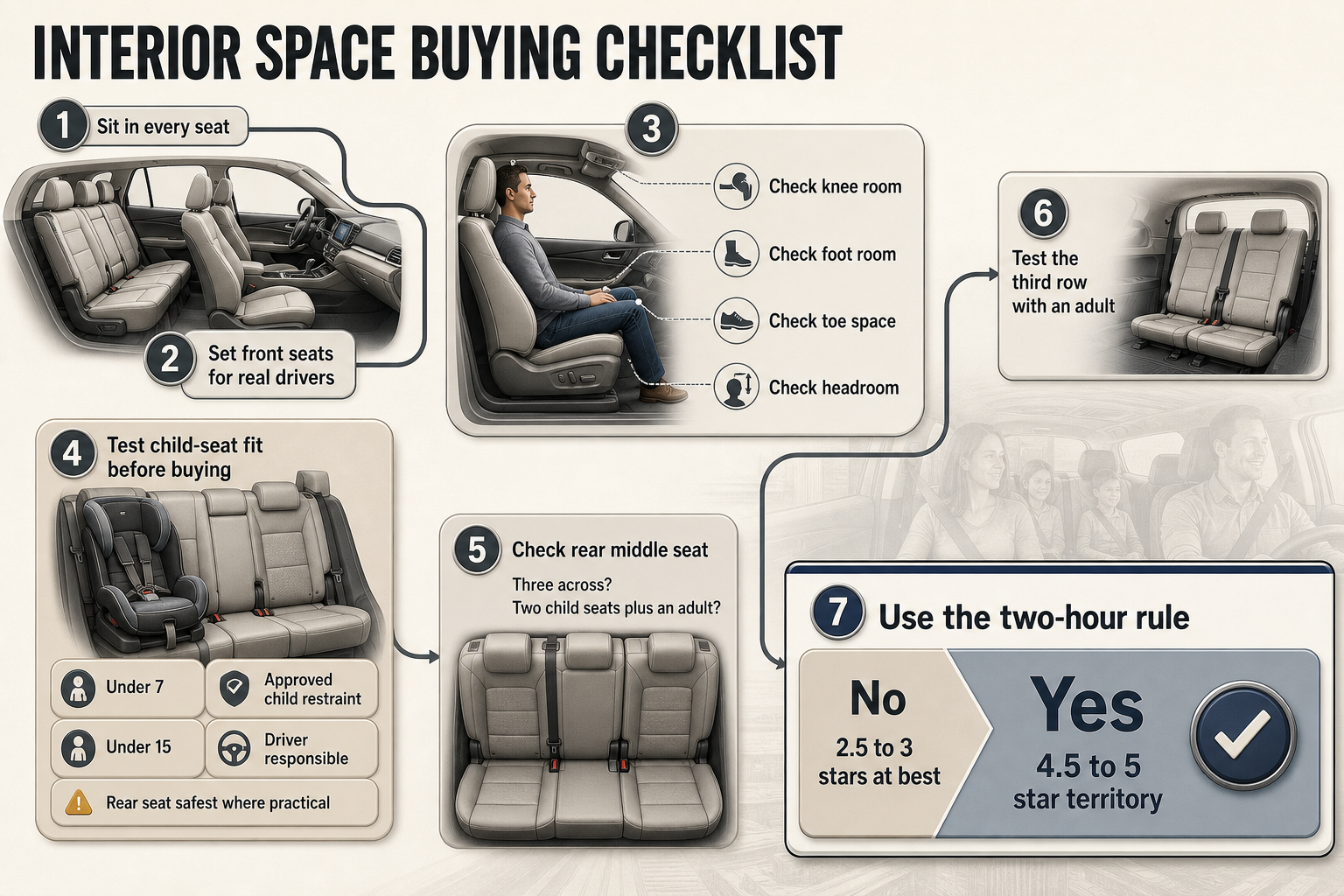
If you have children, test child-seat fit before buying. In New Zealand, children under 7 must be properly restrained in an approved child restraint, and the driver is responsible for passengers under 15 being correctly restrained. NZTA also notes the rear seat is the safest place for children under 15 where practical. That means interior space is not just about comfort. You need enough width and depth for child seats, enough clearance to load kids without banging heads, and enough front-seat travel so adults are not forced into the dashboard when a rear-facing seat is installed. (nzta.govt.nz)
Pay attention to the rear middle seat too. Many five-seat vehicles are really better described as four-plus-one. The centre seat may be narrow, raised, or compromised by a large transmission tunnel. If you need three children across the back, or two child seats plus an adult, shoulder room and seat shape matter just as much as legroom.
For seven-seaters, do the third-row test properly. Sit an adult back there, then check whether the second row still has usable space. A vehicle only deserves top marks if the whole layout works together. Some large SUVs offer seven seatbelts but not seven comfortable seats. Under NZTA rules and inspection standards, seating positions and seatbelts are defined and regulated, but legal seating capacity is not the same as real-world comfort. (vehicleinspection.nzta.govt.nz)
Review data helps, but use it carefully. Manufacturer dimensions can be useful, yet they do not always tell the full story because seat design, window line, and roof shape change how roomy a car feels. Independent reviews that compare rear legroom, headroom, and third-row usability are often more helpful than a single cabin-volume figure. If a seller claims “massive interior space”, ask for actual measurements or at least compare the car side by side with rivals.
A practical test is the two-hour rule. Ask yourself whether you would be happy to put four adults in the car for a two-hour drive. If the answer is no, the vehicle is probably 2.5 to 3 stars at best, no matter how fashionable it looks. If six or seven people can do that trip without complaints, you are into 4.5 to 5 star territory.
NZ Context
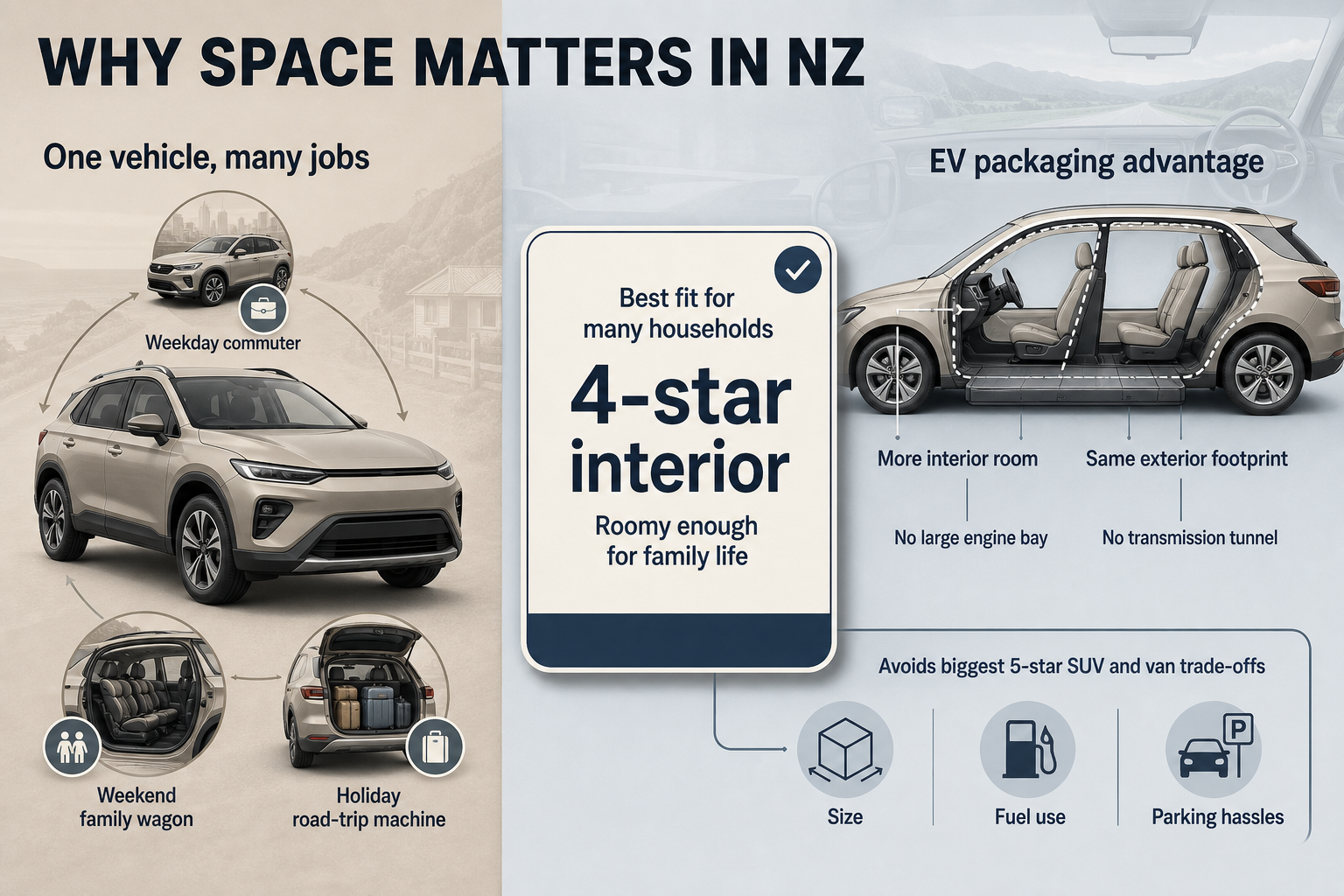
Interior space matters differently in New Zealand because many buyers use one vehicle for several jobs. Your car might be a weekday commuter, a weekend family wagon, and the holiday road-trip machine all at once. That makes usable rear space more important than it can be in markets where households commonly run multiple vehicles.
Our roads also make comfort more noticeable. Long distances, patchy surfaces, and winding state highways mean cramped seating becomes tiring quickly. A vehicle with only average space may feel fine on a short urban test drive, then feel much smaller on a run from Hamilton to Wellington or Christchurch to Dunedin.
If you are buying an EV, cabin packaging can be a real advantage. EV platforms often create more interior room for a given exterior footprint because they do not need a large engine bay or transmission tunnel. EECA notes that BEVs suit buyers who can charge at home or work and want low running costs, so for family buyers comparing an EV with a petrol SUV, it is worth checking whether the EV gives you more passenger space without taking up more room on the road. (eeca.govt.nz)
Buyer protection matters too. If a dealer describes a vehicle as suitable for your family needs and it clearly is not, New Zealand’s Consumer Guarantees Act sets minimum guarantees around acceptable quality and fitness for purpose when you buy from a business. That does not replace doing your own checks, but it does mean dealer claims about practicality should be taken seriously and documented in writing if they influence your purchase. (consumerprotection.govt.nz)
Safety overlaps with space more than many buyers realise. A roomy cabin makes it easier to fit restraints correctly, gives rear passengers a more natural seating position, and reduces the temptation to use a marginal third row or squeeze three adults into a space designed for two. For many NZ households, a genuine 4-star interior is the sweet spot. It is roomy enough for family life without forcing you into the size, fuel use, and parking hassles that often come with the biggest 5-star SUVs and vans.
You may also be interested in these independent articles
Sources
- [1]NZ Transport Agency Waka Kotahi - Seatbelts and child restraints
- [2]NZ Transport Agency Waka Kotahi - Child restraint technicians manual
- [3]NZ Transport Agency Vehicle Inspection Portal - Seats and seatbelt anchorages
- [4]NZ Transport Agency Vehicle Inspection Portal - Seatbelts and seatbelt anchorages
- [5]Consumer Protection New Zealand - Consumer Guarantees Act
- [6]Consumer Protection New Zealand - Warranties
- [7]Consumer Protection New Zealand - Solving issues with your car dealer
- [8]EECA - Compare electric vehicle types and benefits
- [9]EECA - How to charge your EV at home and on the road
© 2026 pyfoi. All rights reserved.