
How Vehicle Environmental Ratings Work in NZ
Learn how vehicle environmental ratings work in New Zealand, from CO2 and fuel use to EVs and hybrids, and avoid costly mistakes in 2026.
A vehicle environmental impact rating is a simple way to judge how much harm a car is likely to do through fuel use and emissions. For New Zealand buyers, it matters because it affects running costs, your carbon footprint, and how suitable a vehicle is for a future where low-emission transport is becoming more important. (rightcar.govt.nz)
What Goes Into the Rating
At its core, this rating is about how much carbon dioxide a vehicle produces and how efficiently it uses energy. In New Zealand, official consumer-facing environmental information commonly includes energy economy, carbon emissions and air pollution ratings, with more stars indicating better performance. A greener vehicle is usually one that uses less fuel, produces less CO2 per kilometre, or avoids tailpipe emissions altogether. (rightcar.govt.nz)
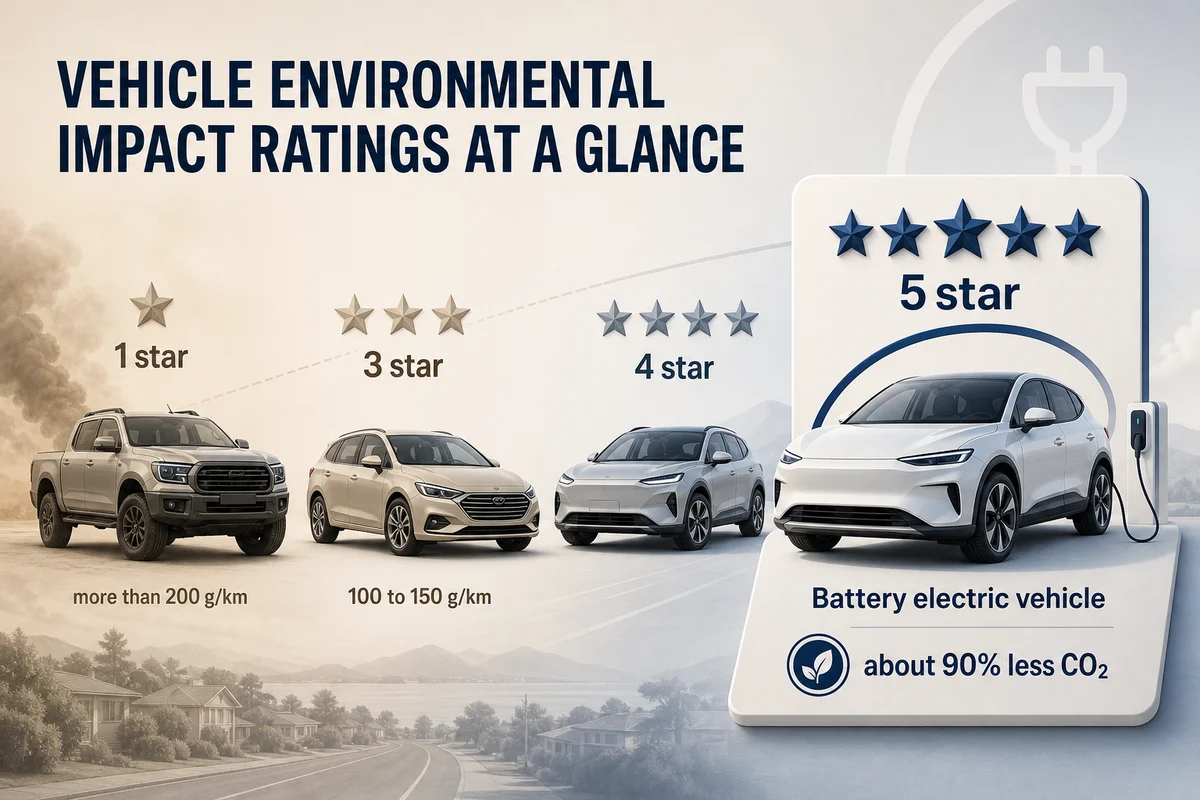
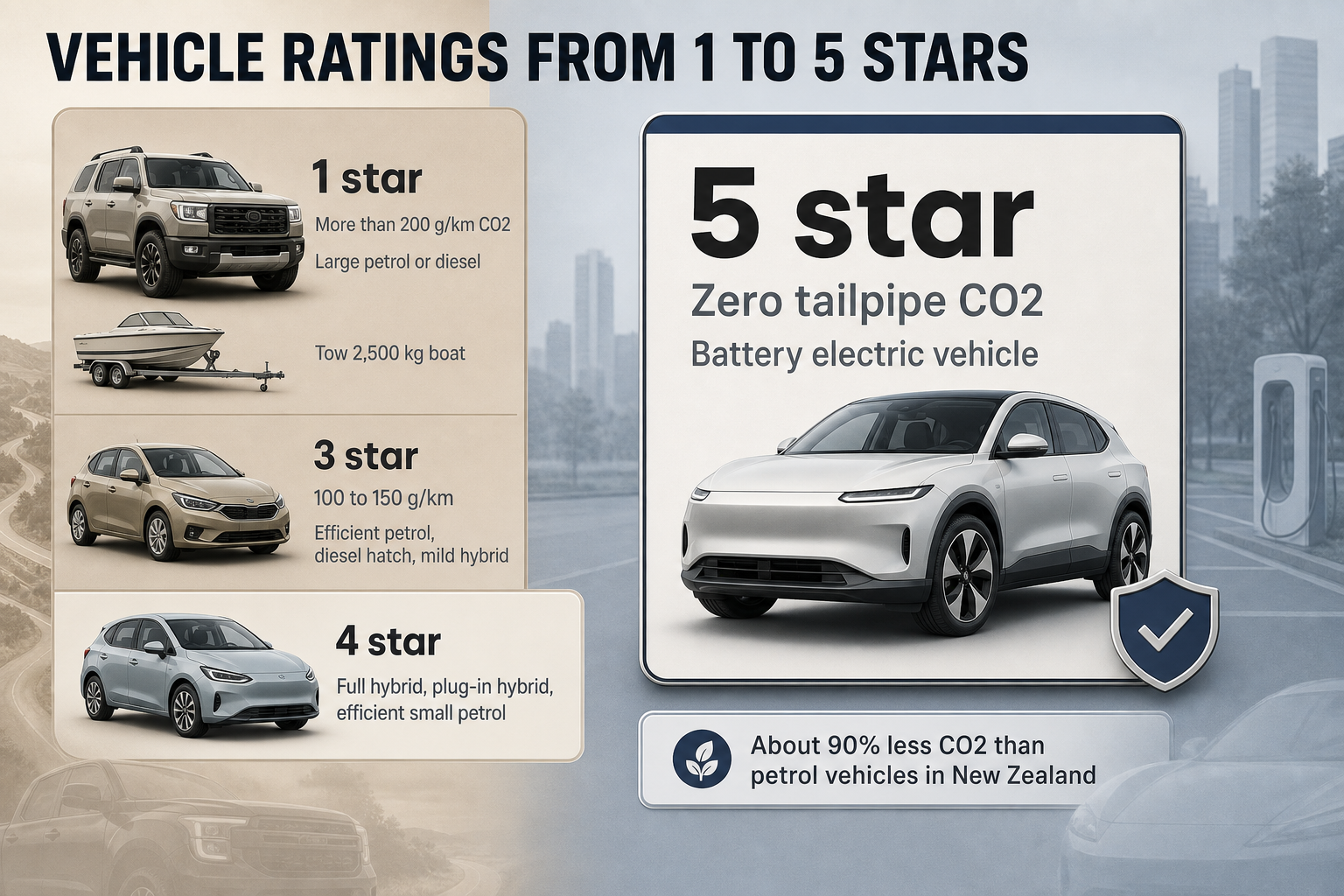
For a practical 1-to-5-star environmental impact score, the biggest factor is usually CO2. A vehicle at the bottom end of the scale will often be a large petrol or diesel model emitting more than 200 g/km of CO2 and using a lot of fuel. A mid-pack vehicle is more likely to be an efficient petrol car, diesel hatch, or mild hybrid in roughly the 100 to 150 g/km band. At the top end, battery electric vehicles sit closest to 5 stars because they have zero tailpipe CO2 emissions, while hydrogen fuel-cell vehicles would also belong in that top tier if available. (nzta.govt.nz)
The fuel type matters because each technology has a different emissions profile in real use. A standard petrol SUV and a diesel ute can have similar purchase prices, but their environmental impact may differ depending on official CO2 figures, fuel burn, weight, and how they are used. Full hybrids usually rate better than equivalent petrol-only cars because they recover energy under braking and use the engine more efficiently, especially in stop-start city driving. Plug-in hybrids can rate very well on paper, but only if you actually charge them and use their electric range regularly. (eeca.govt.nz)
A 1-star vehicle is usually one you buy for a very specific need rather than everyday economy. Think of a big petrol 4WD wagon, a thirsty performance car, or a heavy diesel ute used mainly as a private commuter. These vehicles can still make sense for towing a 2,500 kg boat, carrying tools to remote worksites, or regular high-country travel, but you should go in knowing the environmental cost is high. (nzta.govt.nz)
A 3-star vehicle is where a lot of sensible used-car buyers land. This is the territory of efficient non-plug-in petrol cars, many mild hybrids, and some well-matched diesels. If you live in Hamilton, commute on open roads, and need one car for family duties and weekend trips, this can be a realistic sweet spot between affordability and lower emissions. (rightcar.govt.nz)
A 4-star vehicle is usually a full hybrid, a plug-in hybrid used properly, or a very efficient small petrol car. This level suits buyers who want clearly lower emissions without fully committing to EV ownership. It works well for Auckland or Wellington commuting, school runs, and mixed urban driving where hybrid systems save the most fuel. (eeca.govt.nz)
A 5-star vehicle is generally a battery electric vehicle. BEVs have no exhaust pipe, fewer moving parts, and the lowest tailpipe environmental impact. In New Zealand they also benefit from a highly renewable electricity system, so the gap between EVs and petrol vehicles is especially meaningful in real-world emissions terms. EECA says EVs emit about 90% less CO2 than petrol vehicles when driven in New Zealand. (eeca.govt.nz)
What to Look For
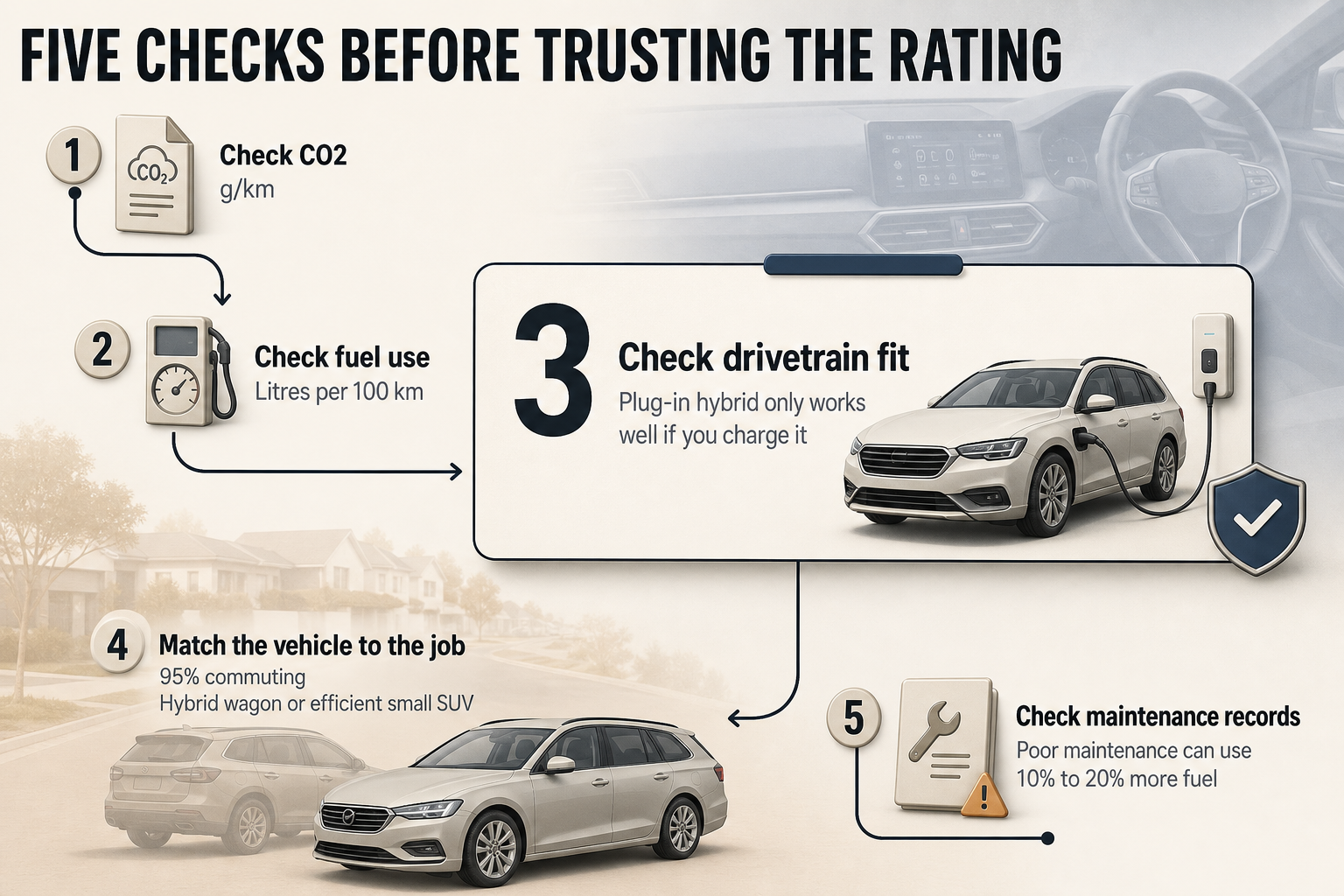
Start with the official CO2 figure in g/km and the fuel-consumption number. These tell you much more than marketing terms like "eco" or "efficient". If two cars are similar in size and price, the one with lower g/km and lower litres per 100 km will almost always deserve the better environmental score. (nzta.govt.nz)
Next, look at the drivetrain honestly. A plug-in hybrid can look excellent on paper, but if you live in an inner-city flat without off-street charging and mostly drive with the battery empty, its real impact can be closer to an ordinary petrol car. By contrast, a conventional hybrid asks nothing special of you and often delivers its promised savings in normal Auckland traffic or Christchurch suburban use. (eeca.govt.nz)
For EVs, check how and where you will charge. EECA says a BEV suits buyers who travel within the vehicle’s range most days and can charge off-street overnight at home or at work. If that sounds like your routine, a high environmental rating is likely to translate into real savings and lower emissions, not just a nice label on paper. (eeca.govt.nz)
You should also check whether the vehicle’s rating lines up with its actual role. Many buyers assume they need a diesel SUV or dual-cab ute for occasional camping trips, but if the car spends 95% of its life commuting in Tauranga or doing supermarket runs in Dunedin, a hybrid wagon or efficient small SUV may be the lower-impact choice without much sacrifice. (eeca.govt.nz)
Documentation matters too. Review the rightcar label or listing data, compare the official emissions and energy economy information, and ask for service history. A poorly maintained vehicle can use 10% to 20% more fuel than a well-maintained one, which means its real environmental impact can be worse than the brochure suggests. (rightcar.govt.nz)
NZ Context
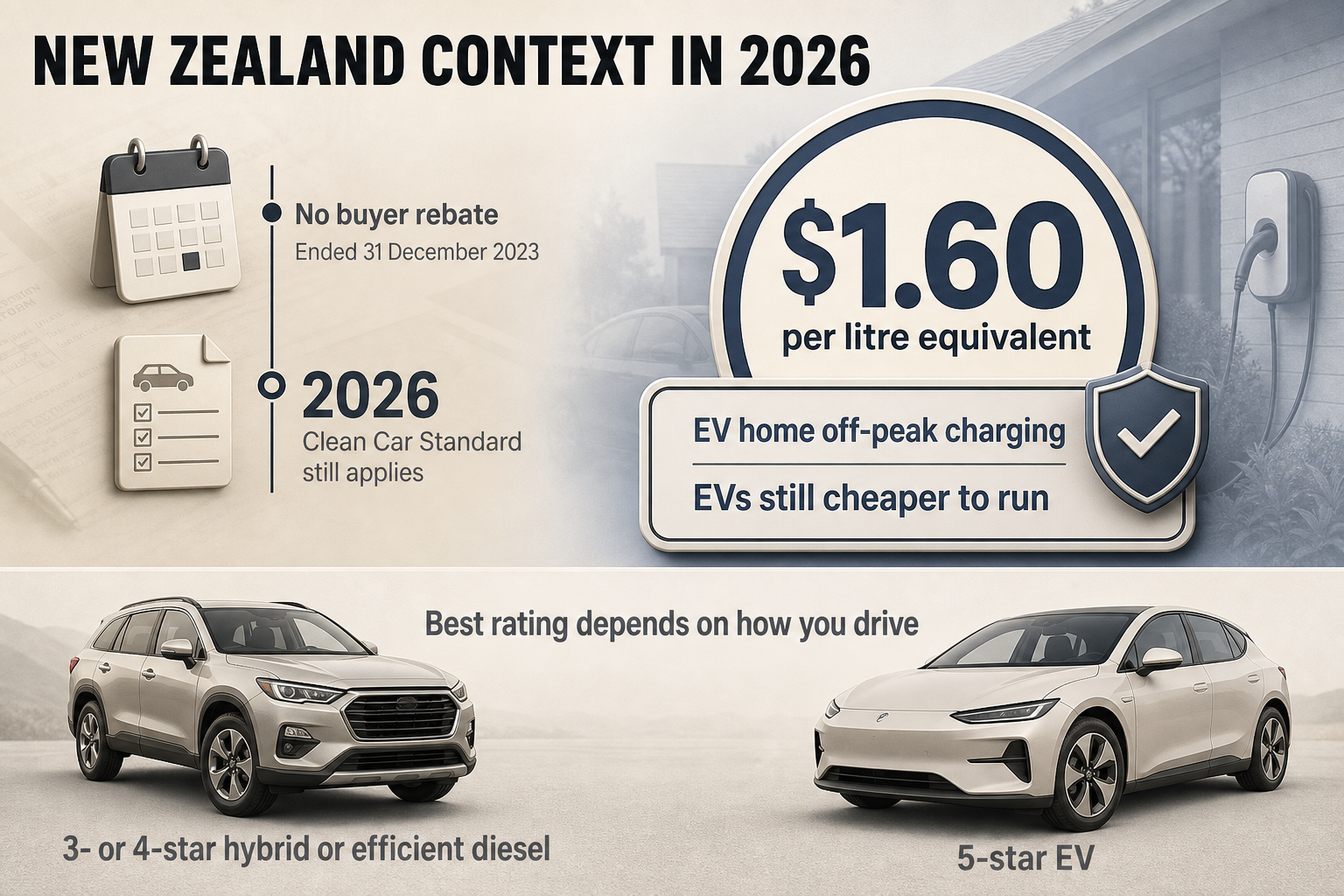
New Zealand’s policy settings have changed, so buyers should be careful with older advice. The Clean Car Discount ended on 31 December 2023, so there is no current buyer rebate to rely on when assessing whether a vehicle is green or cheap to own. However, the Clean Car Standard still applies to imported light vehicles and continues to push the market toward lower-CO2 models. (nzta.govt.nz)
That means you should treat old references to a rebate or fee as historical unless the seller can show current evidence. For 2026, the more relevant question is whether the model sits on the lower-emissions side of the market and how that affects supply, resale appeal, and long-term running costs in New Zealand. (nzta.govt.nz)
Running costs are a big part of environmental impact in the real world because fuel use and emissions usually move together. EECA says EVs charged at home off-peak cost about the equivalent of $1.60 per litre to "fill up", including road user charges, and notes they are cheaper to run than fossil-fuel alternatives. That matters in New Zealand, where fuel prices are high enough that a thirsty vehicle quickly becomes expensive as well as dirty. (eeca.govt.nz)
Road user charges also need context. Diesel vehicles pay RUC, and EVs now have RUC as well, so low emissions do not automatically mean the lowest per-kilometre tax burden. Even so, EECA’s current guidance still finds EVs significantly cheaper to run than equivalent petrol vehicles, which strengthens the case for giving them the highest environmental scores when your driving pattern suits them. (eeca.govt.nz)
Finally, think about how New Zealand conditions affect the score you should aim for. If you live in central Auckland and have home charging, a 5-star EV makes obvious sense. If you live in Southland, tow regularly, or spend weekends on gravel roads and long open-road stretches, a 3- or 4-star hybrid or efficient diesel may be the more realistic low-impact option. The best environmental rating is not the one that looks best in a database. It is the one that matches how you actually drive on New Zealand roads. (eeca.govt.nz)
You may also be interested in these independent articles
Sources
- [1]Rightcar NZ - Vehicle ratings
- [2]NZ Transport Agency Waka Kotahi - Clean Car Programme
- [3]NZ Transport Agency Waka Kotahi - Data, values and formulas
- [4]EECA - Compare electric vehicle types and benefits
- [5]EECA - Benefits of electric work vehicles for your business
- [6]EECA - Benefits of electric vehicles for your home
- [7]EECA - How to charge your EV at home and on the road
© 2026 pyfoi. All rights reserved.