
How Car Resale Value Works in New Zealand
Learn what drives car resale value in New Zealand, from brand trust to EV battery health, and avoid costly depreciation when you buy.
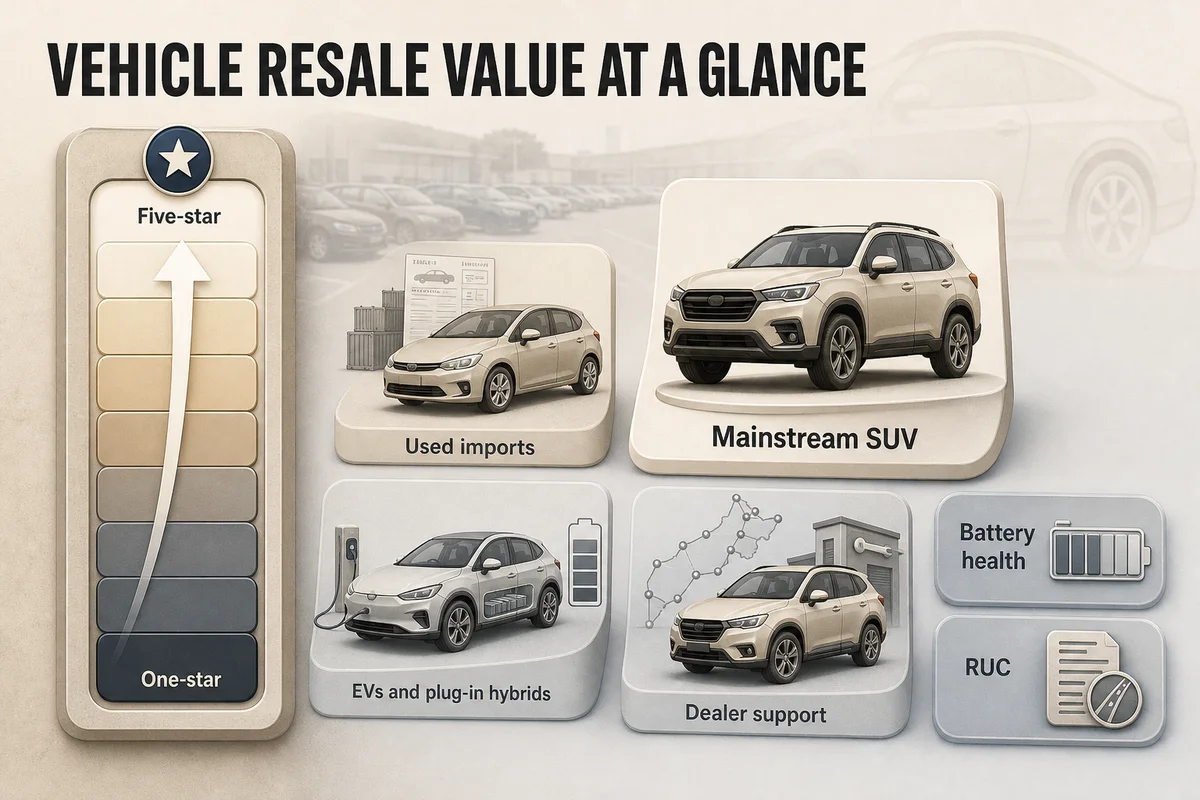
Resale value is a simple idea with a big effect on what your car really costs you. A vehicle that holds its value well can save you thousands when you sell or trade it in, even if its purchase price was higher to begin with.
For New Zealand buyers, resale value matters because our market is shaped by used imports, strong demand for proven brands, and real differences in dealer support around the country. A five-star resale rating is not just about popularity. It reflects how easy the car is to sell later, how much demand it is likely to attract, and how steep the depreciation curve is expected to be.
What Goes Into the Rating
A resale value rating is really a judgement about future demand. A one-star car is expected to lose value quickly, while a five-star car is likely to stay desirable and depreciate slowly. Half-star steps help separate cars that sit between those broad groups.
Brand reputation is usually the first influence. In New Zealand, brands with a long record for reliability, easy servicing, and strong parts supply tend to hold value better. Toyota is the obvious example. The AA notes that the Toyota Aqua has become one of New Zealand’s favourite used-import hybrids, and popularity on that scale usually supports stronger resale because there are always buyers looking for one. The AA also says the Mazda Demio tends to hold its value well because it is a popular Japanese hatch with a good reliability record. (aa.co.nz)
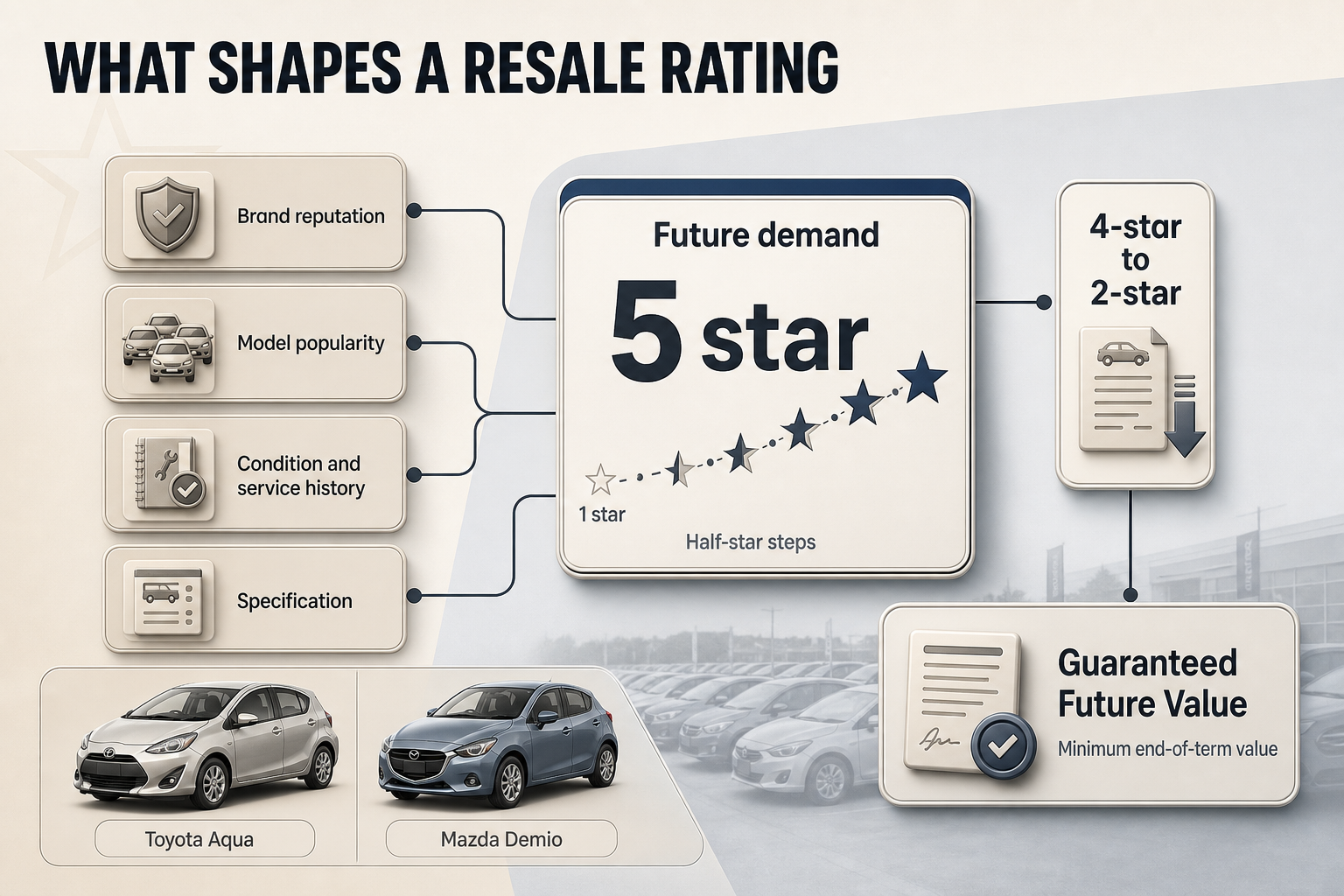
Model popularity matters just as much as the badge on the nose. A mainstream ute, small SUV, or hybrid hatch with broad appeal will usually rate higher than a niche coupe, ageing luxury sedan, or low-volume EV from a brand with a thin dealer network. The easier it is for the next buyer to understand the car, insure it, finance it, and service it, the stronger the resale case tends to be.
Condition, mileage, service history, and specification also shape the rating. Even a strong-resale model can slide from a four-star outcome to a two-star one if it has patchy servicing, poor paint, accident history, worn tyres, or an unpopular spec. The AA notes that condition and maintenance have a major effect on used vehicle value, and its valuation service is built around current market pricing for specific makes and models in New Zealand. (aa.co.nz)
Finance products can provide another clue. If a manufacturer offers Guaranteed Future Value finance, that suggests it is confident enough in future residuals to set a minimum end-of-term value. Toyota New Zealand offers GFV and says it guarantees the minimum future value of the vehicle at the end of the finance term. That does not automatically make every Toyota a five-star resale car, but it is a useful signal that residual value is being actively managed. (toyota.co.nz)
What to Look For
Start by asking how easy the car will be to sell in three to five years, not just how much you like it today. In NZ, that usually means checking whether the model is common, whether buyers know it, and whether there is still strong demand in the used market. If you are choosing between a familiar RAV4-sized SUV and a more obscure alternative from a lesser-known brand, the mainstream option often has the safer resale profile.
Look closely at servicing and support. A vehicle with nationwide dealer coverage and easy access to independent repairers is more attractive on the used market than one that depends on a small number of specialists. This is especially relevant if you live outside Auckland, Wellington, or Christchurch. Buyers in provincial NZ often favour vehicles they know can be serviced locally.
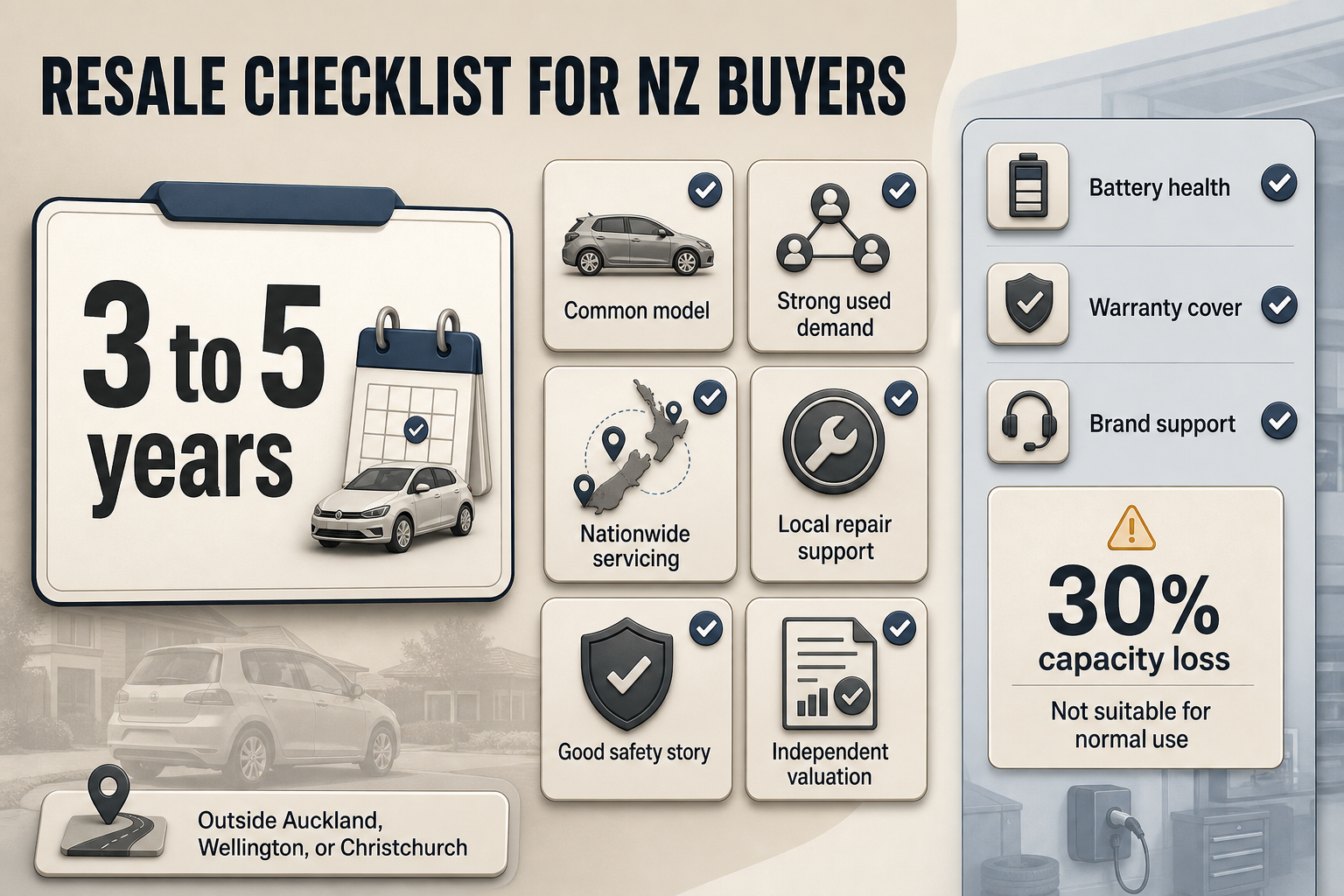
You should also check whether the car has a strong safety story. Safety ratings do not directly measure resale, but they affect buyer confidence. A newer or stronger ANCAP result can make a used car easier to move on than a model with an outdated or mediocre safety record. That effect is especially clear for family cars, where parents are often filtering listings by safety first. (cdn.ancap.com.au)
For used cars, compare asking prices against an independent valuation rather than trusting the seller’s optimism. The AA offers vehicle valuation reports based on NZ market data, which can help you judge whether a model is holding value unusually well or simply being advertised too high. If a car looks cheap compared with the market, there is usually a reason, and that reason may hurt resale again when you become the seller. (aa.co.nz)
Battery condition and long-term confidence matter more for EVs and plug-in hybrids. New Zealand’s EV market is maturing, but used buyers still pay close attention to battery health, warranty cover, and brand support. EECA says an EV battery that has lost about 30 percent of its capacity is no longer suitable for powering a vehicle in normal use, and it notes that a repair and refurbishment industry is emerging as the market matures. That is encouraging, but it also means battery state remains a major resale factor in a way it is not for a Corolla or Hilux. (eeca.govt.nz)
NZ Context
New Zealand has a distinctive used-car market, and that changes how resale value should be judged. Used Japanese imports are common, and many hold value well because Kiwi buyers trust them, parts are available, and mechanics know them. That is why cars like the Toyota Aqua and Mazda Demio can perform strongly on resale even when they were not originally sold new here in large numbers. (aa.co.nz)
Fuel type also affects future value. Diesel vehicles can still make sense for towing or high-distance driving, but they face road user charges, and that can narrow the buyer pool for some private purchasers. Light EVs and plug-in hybrids also require RUC in New Zealand, while ordinary non-plug-in petrol hybrids do not. That difference can influence future demand, especially among buyers comparing total running costs rather than just fuel economy. (nzta.govt.nz)
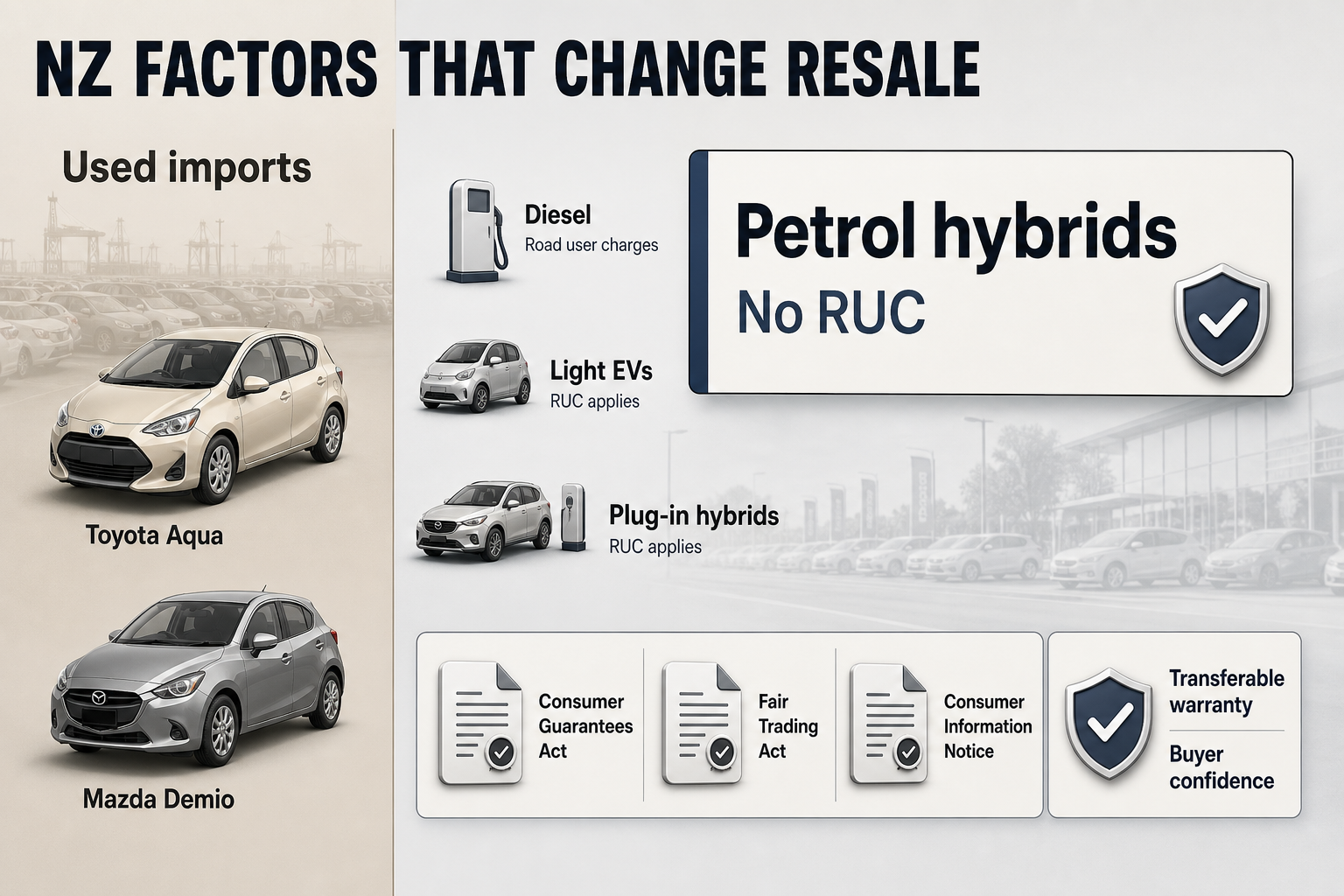
Consumer protection matters too, especially if you are thinking about resale from the next owner’s point of view. If you buy from a dealer, the Consumer Guarantees Act applies to new and used vehicles sold in trade, and dealers must also comply with the Fair Trading Act and display an accurate Consumer Information Notice on used vehicles. A car with clear paperwork, proper disclosure, and a traceable dealer history is easier to sell later than one with a vague private-sale backstory. (consumerprotection.govt.nz)
Warranty coverage can support resale, but do not confuse warranty with value retention. Consumer Protection says the CGA applies regardless of store or manufacturer warranties, and manufacturer or extended warranties only add protection on top of your legal rights. In practice, though, a transferable factory warranty or battery warranty can still make a used vehicle more attractive and lift buyer confidence. (consumerprotection.govt.nz)
A practical NZ rule is this: buy the car that the next owner will also want. That usually means proven reliability, broad service support, sensible running costs, good safety credentials, and a spec that suits real Kiwi use. You probably do not need to chase a five-star resale rating at all costs, but if two cars suit your needs equally well, the one with stronger resale will often be the cheaper one to own over time.
You may also be interested in these independent articles
Sources
- [1]Consumer Protection NZ - Consumer Guarantees Act
- [2]Consumer Protection NZ - Solving issues with your car dealer
- [3]Consumer Protection NZ - Researching cars and sellers
- [4]AA New Zealand - Used Car Review: Toyota Aqua
- [5]AA New Zealand - Used Car Review: Mazda Demio
- [6]AA New Zealand - Vehicle Valuations
- [7]NZ Transport Agency - RUC for electric vehicles
- [8]NZ Transport Agency - About RUC
- [9]EECA - EV range and batteries
- [10]Toyota New Zealand - Guaranteed Future Value
© 2026 pyfoi. All rights reserved.