
Vehicle Height Guide for NZ Drivers
Learn how vehicle height affects parking, handling, fuel use and garage fit in NZ. Compare SUV, hatchback and van heights before you buy.
Vehicle height is the car’s overall measurement from the ground to its highest fixed point, usually the roof or roof rails, stated in millimetres. It sounds simple, but height affects far more than looks. It changes how easy a car is to get into, how stable it feels on the open road, whether it fits your garage or parking building, and how well it suits New Zealand’s mix of city streets, gravel roads and holiday trips.
What the Numbers Mean
When you see height listed as 1,450mm or 1,780mm, that is the vehicle’s total standing height, not the cabin headroom inside. A difference of 100mm might not sound like much on paper, but in practice it can noticeably change your driving position, how much body roll you feel in corners, and whether the car clears a low carpark entrance.
Lower vehicles usually feel more planted because their centre of gravity sits closer to the road. That helps with cornering and motorway stability, especially in crosswinds. Taller vehicles tend to give you a higher seating position and easier access, which many buyers prefer for school runs, family duties and long drives.
Height also affects aerodynamics. All else being equal, a taller vehicle pushes more air and usually uses more fuel or energy at motorway speeds than a lower one. That matters in New Zealand, where open-road travel is common and fuel costs remain a live issue for household budgets. MBIE continues to publish weekly fuel price monitoring and energy price data, which is useful context when comparing vehicle types with very different shapes and heights. (mbie.govt.nz)
Typical Ranges
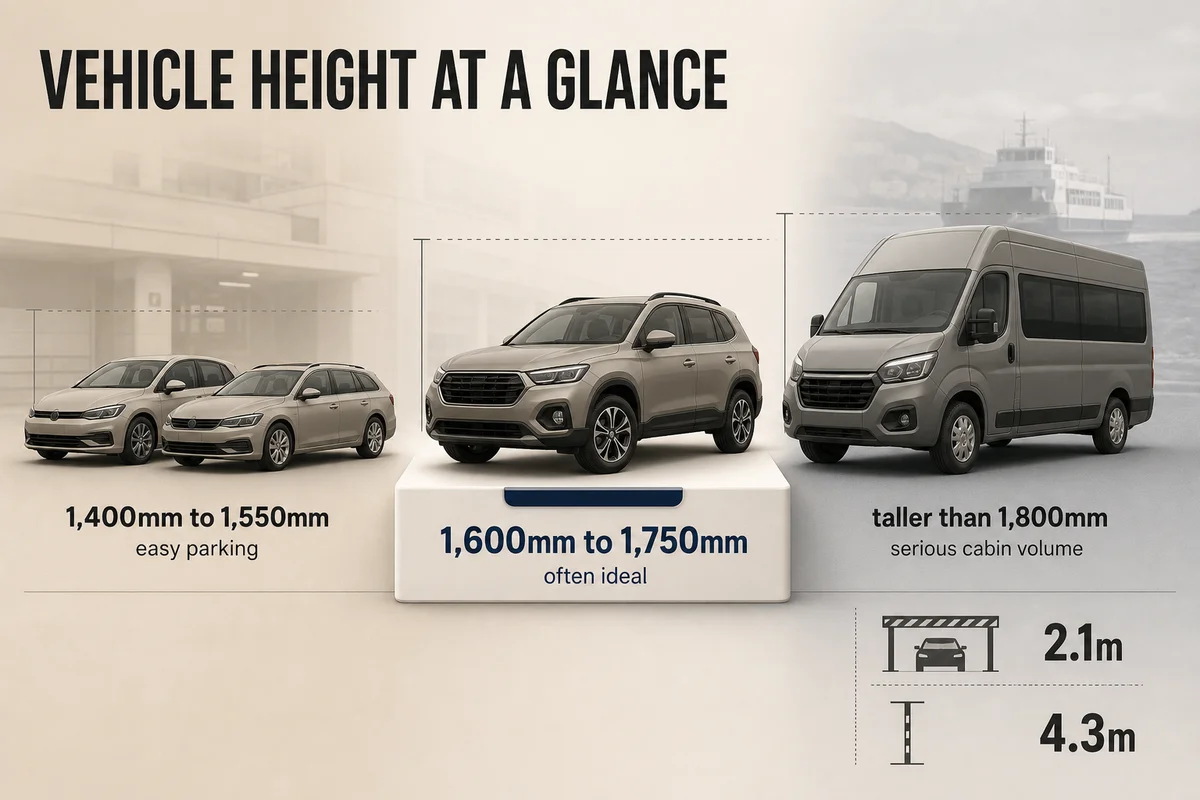
For small hatchbacks and many sedans, height is often around 1,400mm to 1,500mm. Think of cars designed mainly for urban commuting and sealed-road use. These are easy to park, usually more aerodynamic, and often feel tidy and settled on winding roads.
Wagons and some liftbacks commonly sit around 1,450mm to 1,550mm. They are still relatively low, but the extra roofline can improve practicality without moving fully into SUV territory. For many Kiwi buyers, this is a useful middle ground if you want luggage space for sports gear, buggies or a dog crate without the bulk of a tall SUV.
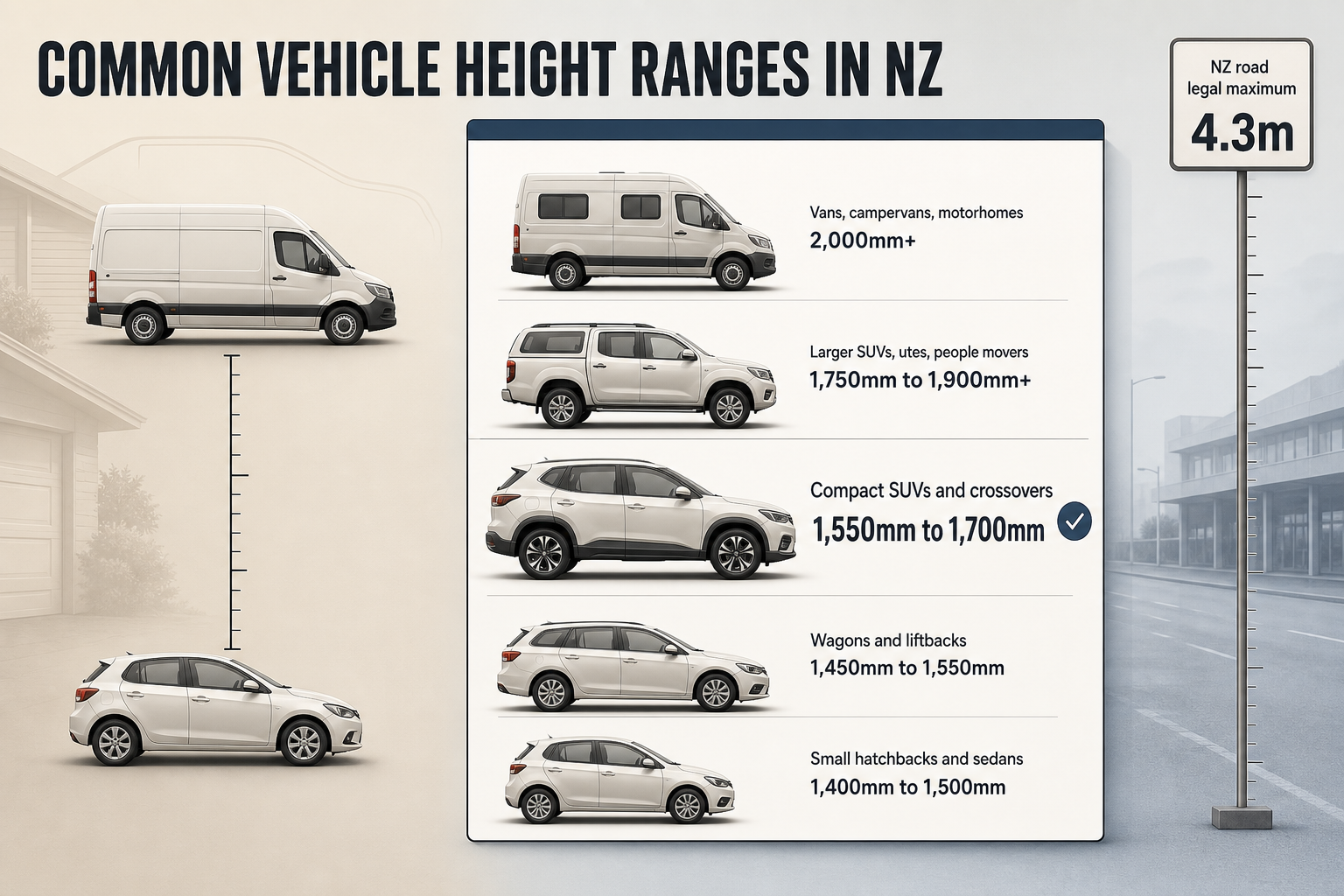
Most compact SUVs and crossovers land roughly between 1,550mm and 1,700mm. This is now one of the most common height bands in the NZ market. It gives you that higher hip point for easier entry and exit, plus a better view in traffic, while still fitting most suburban garages and parking buildings.
Larger SUVs, utes with canopies, and some people movers often measure about 1,750mm to 1,900mm or more. These vehicles suit buyers who need cabin space, towing ability, rough-road confidence or seven seats. The trade-off is that they can feel bulkier in city parking, more affected by side winds, and less efficient on long motorway runs.
At the top end, vans, campervans and motorhomes can be well over 2,000mm. New Zealand’s standard legal maximum vehicle height on the road is 4.3m under Waka Kotahi rules, but that is a commercial and specialist-vehicle limit, not something relevant to ordinary passenger cars. It does show, though, that height is a regulated dimension with real-world consequences. (nzta.govt.nz)
Use-Case Guidance
If your driving is mostly Auckland, Wellington or Christchurch commuting, a lower vehicle height often makes more sense than buyers expect. A hatchback or wagon around 1,450mm to 1,550mm is usually easier to park, cheaper to run, and less cumbersome in tight parking buildings. You also get less body movement in corners and often better motorway efficiency.
For families with young children or older passengers, a vehicle around 1,600mm to 1,750mm can be a sweet spot. The seats are easier to slide into rather than drop down into, and loading kids into car seats is less back-breaking. That is one reason compact and medium SUVs are so popular here. You gain convenience without jumping to the size of a full ladder-frame 4WD.
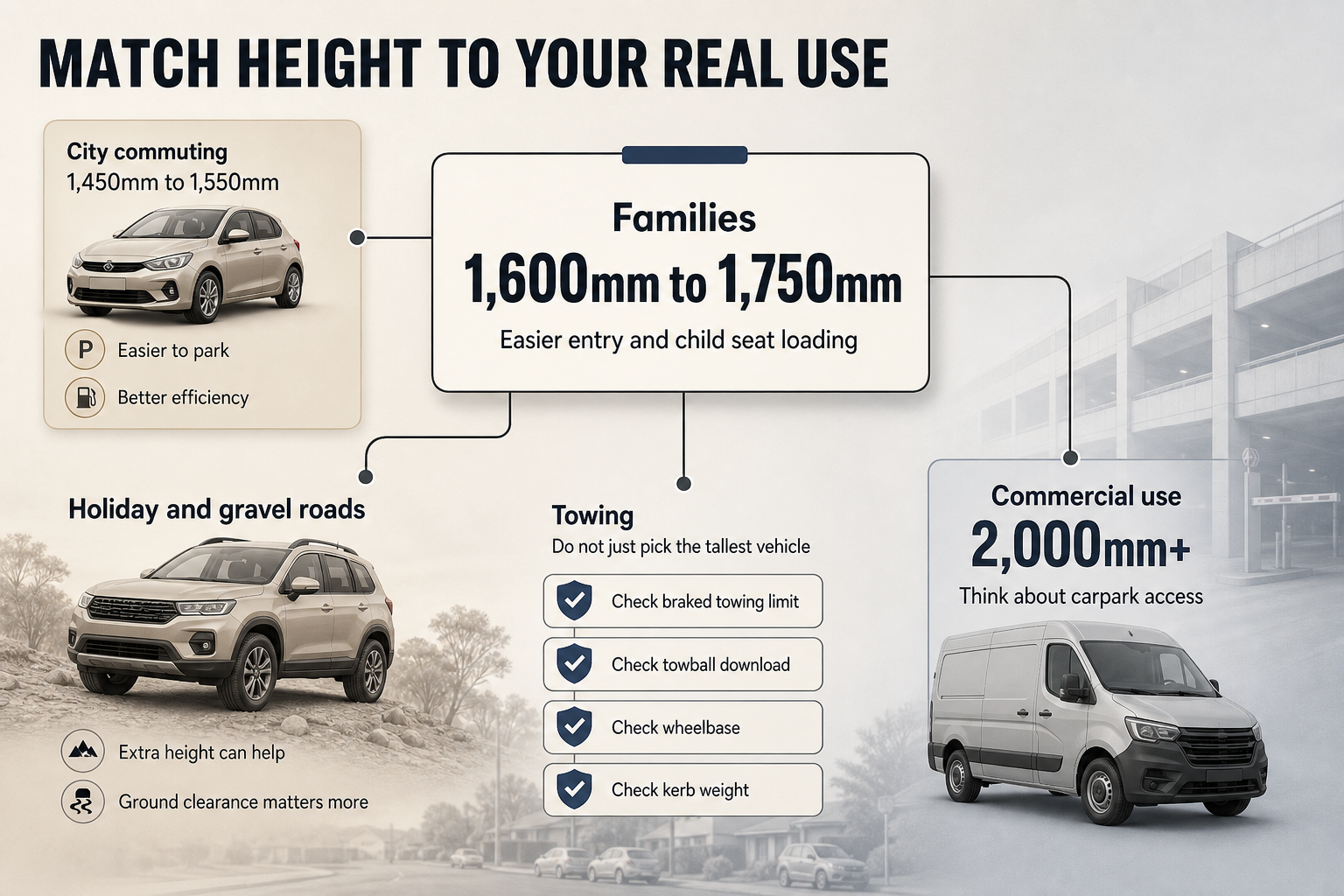
If you regularly head to ski fields, baches, boat ramps or gravel rural roads, extra height can be helpful, but only up to a point. Height itself does not guarantee off-road ability. Ground clearance, tyre choice and drivetrain matter more. A taller SUV may feel more suitable for South Island trips or rougher Northland roads, but you probably do not need a very tall vehicle just for occasional holiday use.
For towing, height can help if it comes with a more upright body, stronger suspension and a commanding driving position. But do not assume the tallest vehicle is automatically the best tow car. You still need to check the braked towing limit, towball download, wheelbase and kerb weight. A lower but well-engineered wagon or SUV can tow more confidently than a tall vehicle with soft suspension.
For commercial use, trades and delivery work, taller vans make sense because interior load volume matters more than cornering sharpness. But once you move into anything above about 2,000mm, you need to think carefully about carpark access, home garages, ferry loading and drive-through height barriers.
NZ-Specific Factors
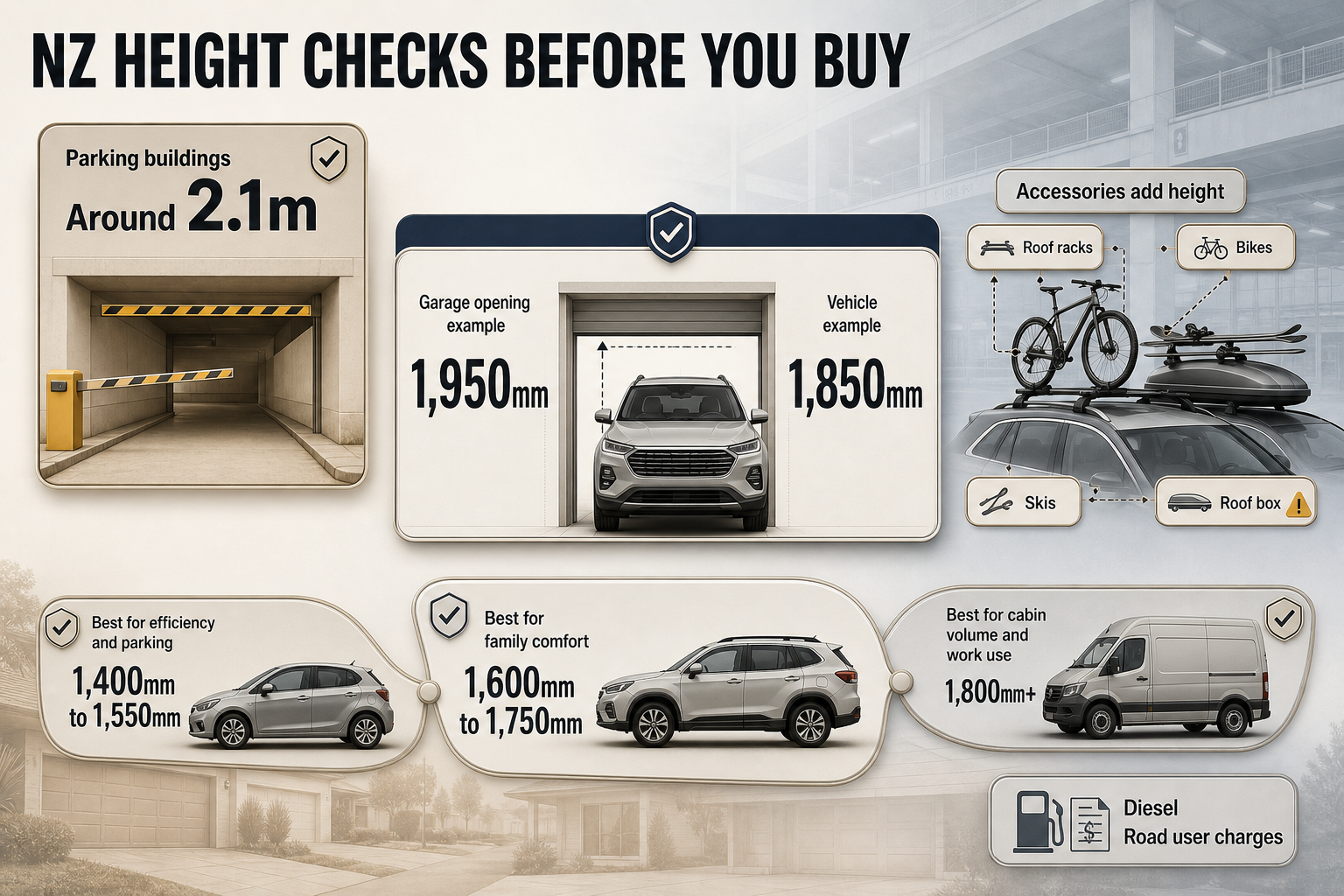
The most immediate NZ issue is parking clearance. Many public and private parking buildings have height limits around 2.1m, and some are lower. A normal passenger car or SUV will usually fit, but a ute with roof racks, a canopy, or accessories can get close enough that you should check the posted limit before entering. This matters even more if you add bikes, skis or a roof box, because the official vehicle height figure does not include whatever you strap on later.
Garage fit is another common trap. Older Kiwi homes often have tighter garage openings than modern SUVs really like, especially once mirrors, roof rails and a steep driveway approach are involved. If your garage opening is, say, 1,950mm, a vehicle that is 1,850mm tall on paper may still feel uncomfortably close once suspension movement and accessories are factored in.
Height also affects how a vehicle behaves on our roads. New Zealand has plenty of exposed motorways, uneven chipseal surfaces and twisty rural sections. A lower car usually feels calmer on the Desert Road or in Canterbury crosswinds. A taller SUV may give you better visibility, but it can also lean more through corners on roads like the Takaka Hill or the Coromandel loops.
If you are shopping for a diesel SUV, ute or van, remember that running costs in New Zealand are not just about pump price. Diesel vehicles pay road user charges, while fuel price data from MBIE shows pump prices can move weekly. That means a tall diesel SUV that looks cheap to fuel may not actually cost less overall than a lower petrol hybrid for many households. (mbie.govt.nz)
The practical takeaway is to match height to your real life, not the image a vehicle projects. If you want easy access and family comfort, around 1,600mm to 1,750mm is often ideal. If you want efficiency, stable handling and easy parking, 1,400mm to 1,550mm is usually the smarter range. If you need serious cabin volume or worksite practicality, taller than 1,800mm can make sense, but only if you are ready for the compromises that come with it.
You may also be interested in these independent articles
Sources
- [1]Waka Kotahi NZ Transport Agency: Vehicle dimensions and mass
- [2]Land Transport Rule: Vehicle Dimensions and Mass 2016 (as at 3 November 2025)
- [3]Waka Kotahi NZ Transport Agency: Motorhomes, caravans, light trailers
- [4]Ministry of Business, Innovation and Employment: Energy prices
- [5]Ministry of Business, Innovation and Employment: Weekly fuel price monitoring
© 2026 pyfoi. All rights reserved.