
How to Rate a Car Warranty in New Zealand
Learn how to rate a car warranty in New Zealand by checking kilometre caps, battery warranty, roadside assistance and servicing terms.
A vehicle warranty rating is a quick way to judge how strong a car maker’s backup really is once you own the car. For New Zealand buyers, that matters because the headline number on the brochure can hide big differences in kilometre caps, battery cover, roadside assistance, and the conditions you must meet to keep the warranty valid.
What Goes Into the Rating
A warranty rating is not just about how many years are printed in large type. A proper rating looks at the full package: the main vehicle warranty, any kilometre limit, powertrain cover, EV or PHEV battery warranty, corrosion or perforation cover, roadside assistance, and how the offer compares with the rest of the New Zealand market. (kia.co.nz)
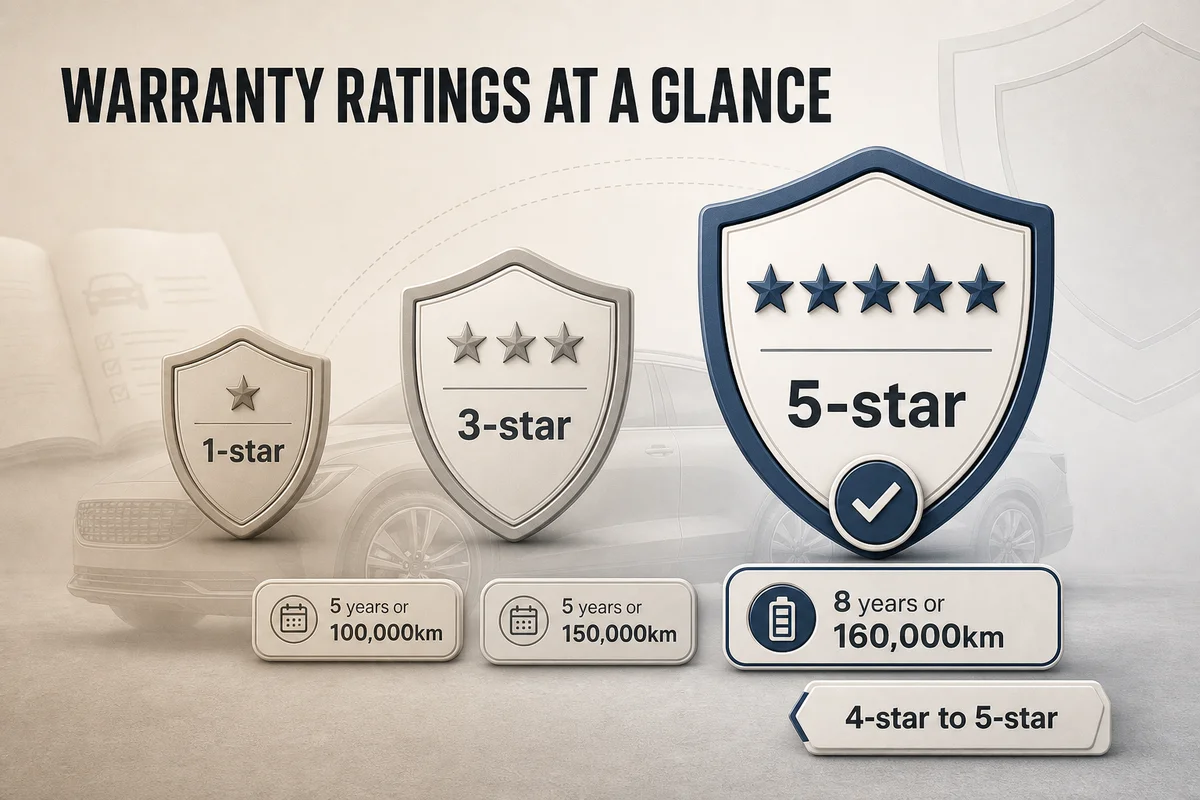
At the low end, a 1-star warranty is the sort of cover that gives you little confidence once the first year or two has passed. That usually means short time-based cover, a tight kilometre cap, no roadside assistance, and no meaningful extra protection for expensive components. In practice, that can be poor value if you drive a lot, keep your car for several years, or live well away from a main dealer.
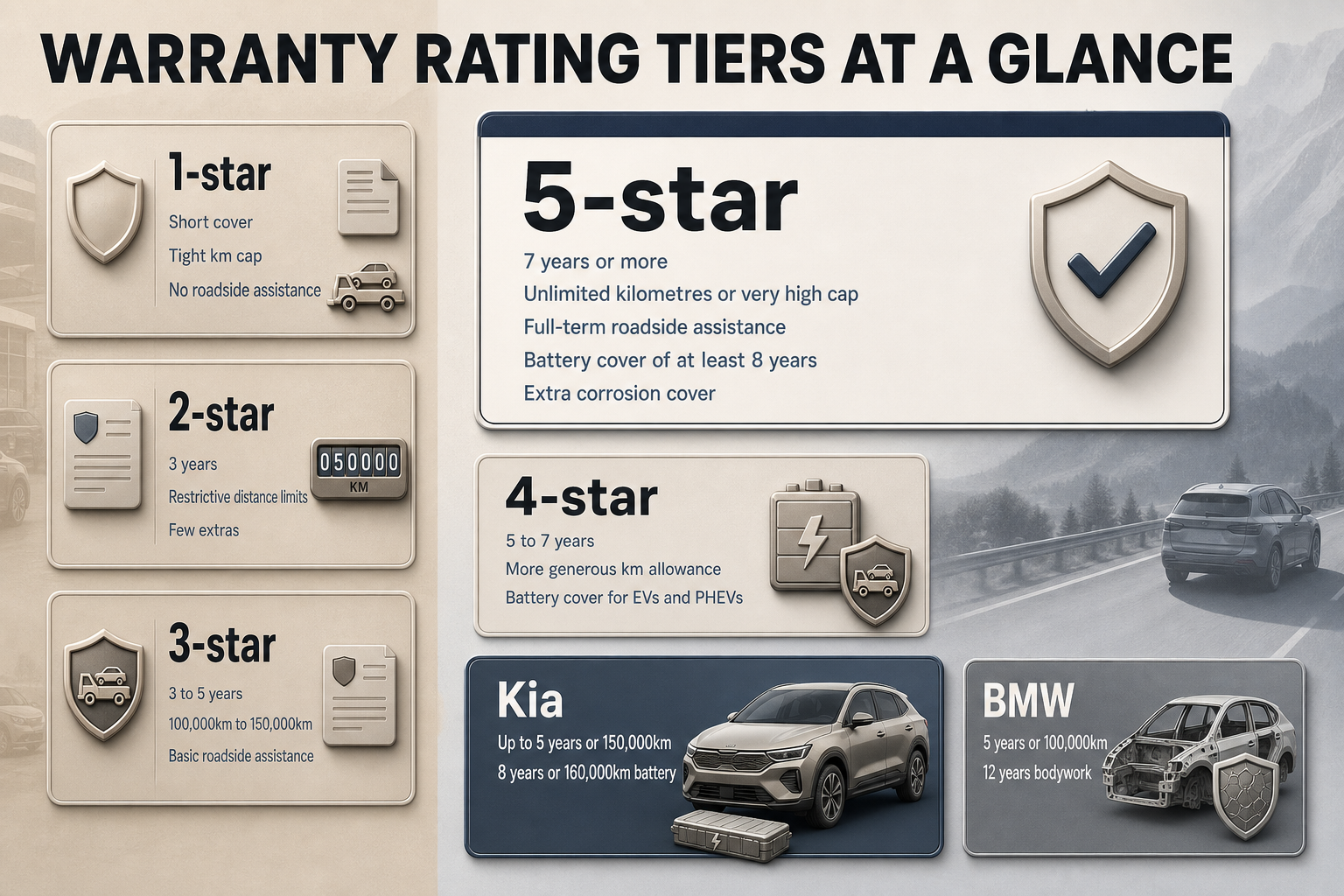
A 2-star warranty is below average rather than terrible. Think of a basic 3-year plan with restrictive distance limits and few extras. This may still be acceptable on a discounted vehicle, but it is no longer impressive in New Zealand where several mainstream brands have pushed beyond the old 3-year norm. Toyota’s standard new vehicle warranty is 3 years or 100,000km, for example, although it can be extended under its Service Advantage programme if servicing conditions are met. (toyota.co.nz)
A 3-star warranty is average in the current NZ market. That usually means around 3 to 5 years of cover, often with a 100,000km to 150,000km cap, and basic roadside assistance. Hyundai’s standard new vehicle warranty is 3 years or 100,000km with roadside assistance included, while some selected models can reach 5 years or 150,000km if you buy a service plan and keep to Hyundai’s dealer servicing requirements. (hyundai.co.nz)
A 4-star warranty is where things start to look genuinely strong. You are usually getting 5 to 7 years of cover, a more generous kilometre allowance, roadside assistance, and, for electrified vehicles, battery cover that gives some reassurance about the most expensive component in the car. Kia’s NZ programme is a good example of a stronger package because it combines up to 5 years or 150,000km on many models, 5 years of roadside assistance, and an 8-year or 160,000km high-voltage battery warranty for EV, HEV, and PHEV models. (kia.co.nz)
A 5-star warranty is exceptional. In NZ terms, that usually means 7 years or more, either unlimited kilometres or a very high cap, roadside assistance that lasts for the full term, and, on EVs and PHEVs, battery cover of at least 8 years. Extra body corrosion cover also helps lift a package into this top tier. BMW, for instance, offers 5 years or 100,000km new vehicle cover with 12 years for bodywork, but the kilometre cap keeps it from feeling as generous as the very best mainstream offers for high-mileage drivers. (bmw.co.nz)
What to Look For
The first thing to check is the kilometre cap. A 5-year warranty sounds strong, but 5 years or 100,000km is very different from 5 years or 150,000km, and both are less generous than unlimited-kilometre cover. If you commute long distances, travel between centres, or use your vehicle for work, you can burn through 100,000km surprisingly quickly. For a buyer doing 25,000km a year, a 100,000km cap is effectively a 4-year warranty, not a 5-year one.
The second thing to check is whether the warranty is unconditional or tied to dealer servicing plans. This matters more than many buyers realise. Hyundai’s extended 5-year cover on selected models depends on buying a service plan and continuing servicing through authorised dealers, while Toyota’s extension from 3 years or 100,000km to up to 5 years or 150,000km also depends on servicing through the authorised network. That does not make these warranties bad, but it does mean the real value depends on how and where you intend to maintain the car. (hyundai.co.nz)
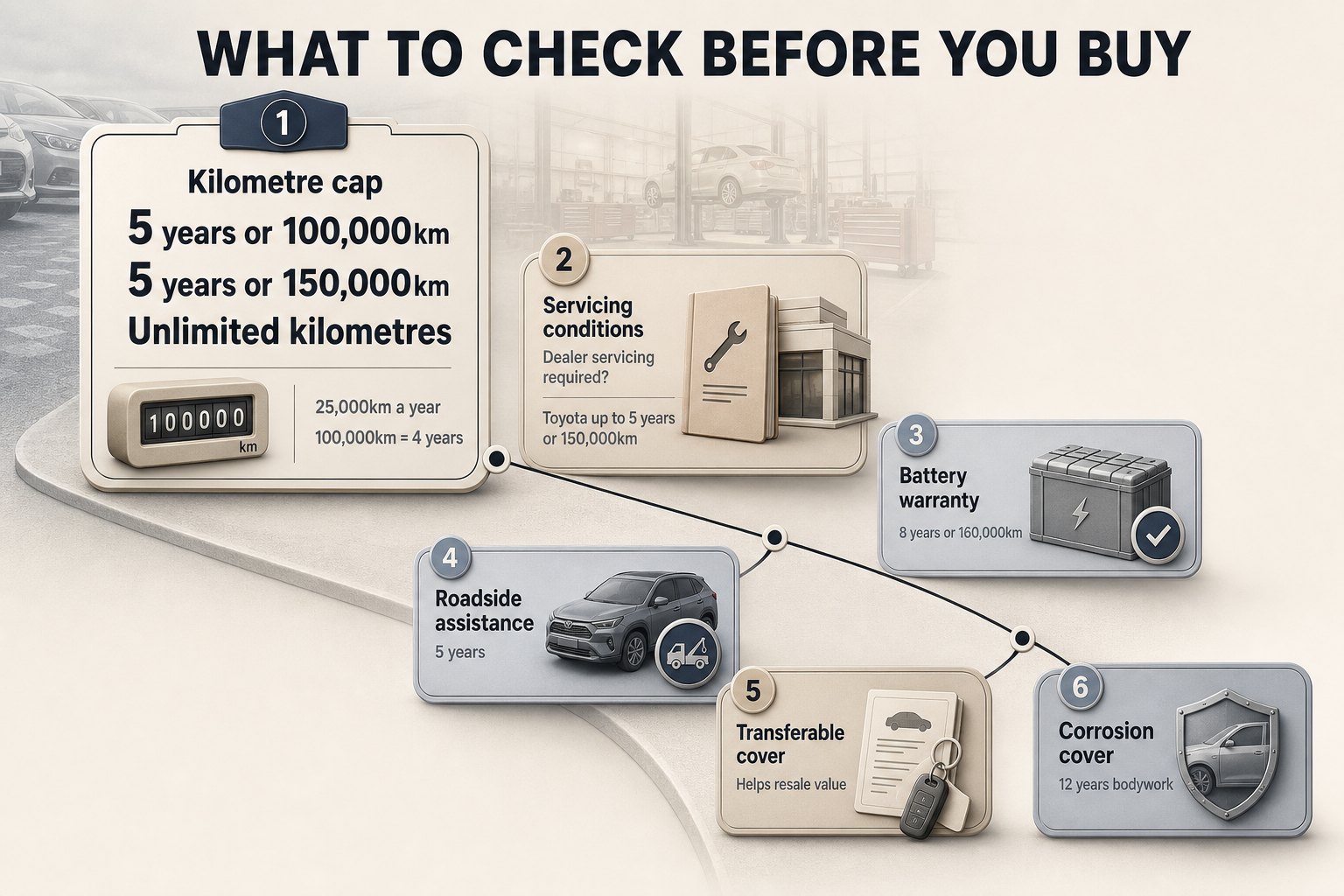
If you are buying an EV or PHEV, battery warranty deserves its own look. A good battery warranty should state both time and distance limits clearly. Kia’s high-voltage battery cover runs to 8 years or 160,000km, which is the sort of figure buyers should expect from a competitive electrified vehicle package in 2026. If an EV has a long vehicle warranty but only modest battery cover, the overall rating should be marked down. (kia.co.nz)
Roadside assistance is another detail that can shift a rating by half a star or more. In New Zealand, where people regularly drive long rural stretches, head to ski fields, tow boats to the ramp, or travel between towns with patchy mobile coverage, roadside support has real value. Toyota includes roadside assistance with its warranties, and Kia includes 5 years of roadside assistance through the AA. Hyundai includes roadside assistance during its standard warranty period, with longer cover attached to eligible extended warranty plans. (toyota.co.nz)
You should also ask whether the warranty transfers to the next owner. Transferable cover can help resale value, especially if you sell the vehicle within the first few years. BMW and Kia both state that their new vehicle warranty coverage is transferable, which is useful if you trade frequently. (bmw.co.nz)
Then look at corrosion and body cover. This is easy to ignore on day one, but it matters if you keep a vehicle near the coast, use it around boat ramps, or spend winters on salted alpine roads overseas. BMW’s 12-year bodywork warranty is a good example of an extra layer that improves the package even if the main mechanical warranty is more ordinary by class standards. (bmw.co.nz)
NZ Context
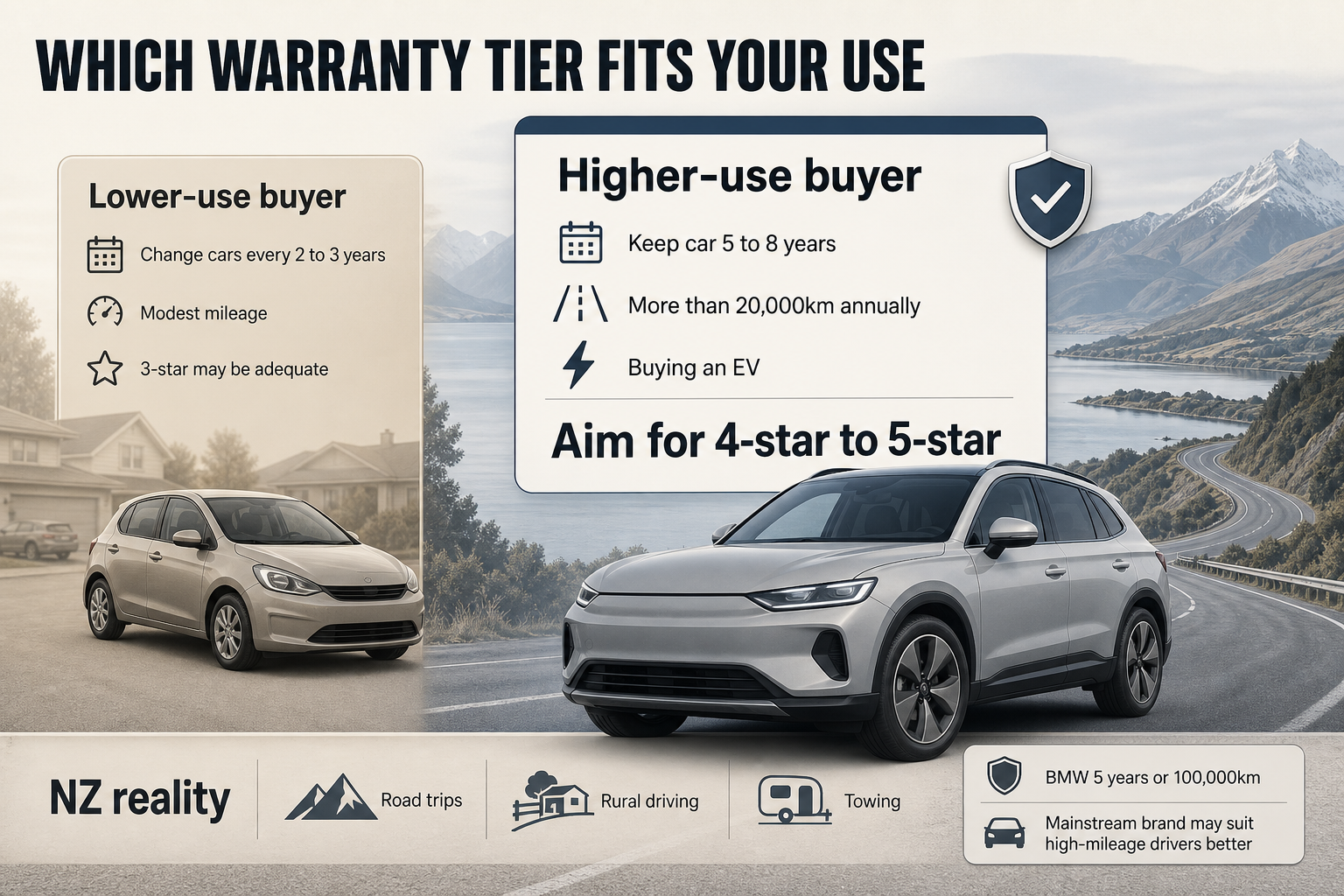
Warranty ratings matter in New Zealand because our driving patterns are hard on kilometre-limited cover. Many owners do more than simple urban commuting. A family in Christchurch might do regular South Island road trips. A buyer in Waikato may mix motorway driving with rural roads. A ute or SUV owner might tow a trailer, horse float, or small boat. In those cases, a generous kilometre cap can be more valuable than one extra year on paper.
You also need to remember that a manufacturer’s warranty sits alongside your rights under the Consumer Guarantees Act. In NZ, the CGA applies to goods bought from businesses for personal or household use and sets minimum guarantees around acceptable quality, durability, and fitness for purpose. That means a short written warranty does not erase your legal rights if a vehicle fails earlier than a reasonable buyer would expect. Still, the CGA is not a substitute for a strong factory warranty, because making a claim can be less straightforward than using a clear manufacturer-backed warranty programme. (consumerprotection.govt.nz)
For used-car buyers, the rating should also reflect what remains, not just what the car had when new. A 5-year warranty on launch means little if the car you are considering is already four and a half years old and close to its kilometre cap. Always ask for the warranty start date, current odometer reading, servicing history, and whether any extended cover is still valid and transferable.
New Zealand buyers should be sceptical of badge-based assumptions too. Some premium brands do not necessarily offer better warranty cover than mainstream rivals. BMW’s 5 years or 100,000km warranty is respectable, but a high-mileage private buyer may find a mainstream brand with a higher kilometre cap and longer roadside assistance package more useful in the real world. (bmw.co.nz)
The practical test is simple. If you plan to keep the car for 5 to 8 years, drive more than 20,000km annually, or buy an EV, aim for a 4-star to 5-star warranty package. If you change cars every 2 to 3 years and do modest mileage, a 3-star warranty may be perfectly adequate. Just make sure you are comparing the real terms, not the marketing headline.
You may also be interested in these independent articles
Sources
© 2026 pyfoi. All rights reserved.