
Freezer Capacity Guide for NZ Homes
Freezer capacity affects storage, energy use and fit. See what freezer litres suit NZ homes, from flats to family kitchens, before you buy.
Freezer capacity tells you how much usable frozen storage a fridge, fridge-freezer, or standalone freezer actually gives you. Measured in litres, it sounds simple, but the number matters a lot once you start comparing compact apartment fridges, family French-door models, and big chest freezers sold for bulk storage.
For New Zealand buyers, freezer litres affect more than just how many bags of peas fit inside. They shape how often you shop, whether you can store homekill or fish, how well the appliance suits a flat or family home, and how much floor space and power use you are likely to take on. Consumer NZ’s buying guides also note that fridge and freezer choices should match your space, layout, and household needs, not just the sticker price. (consumer.org.nz)
What the Numbers Mean
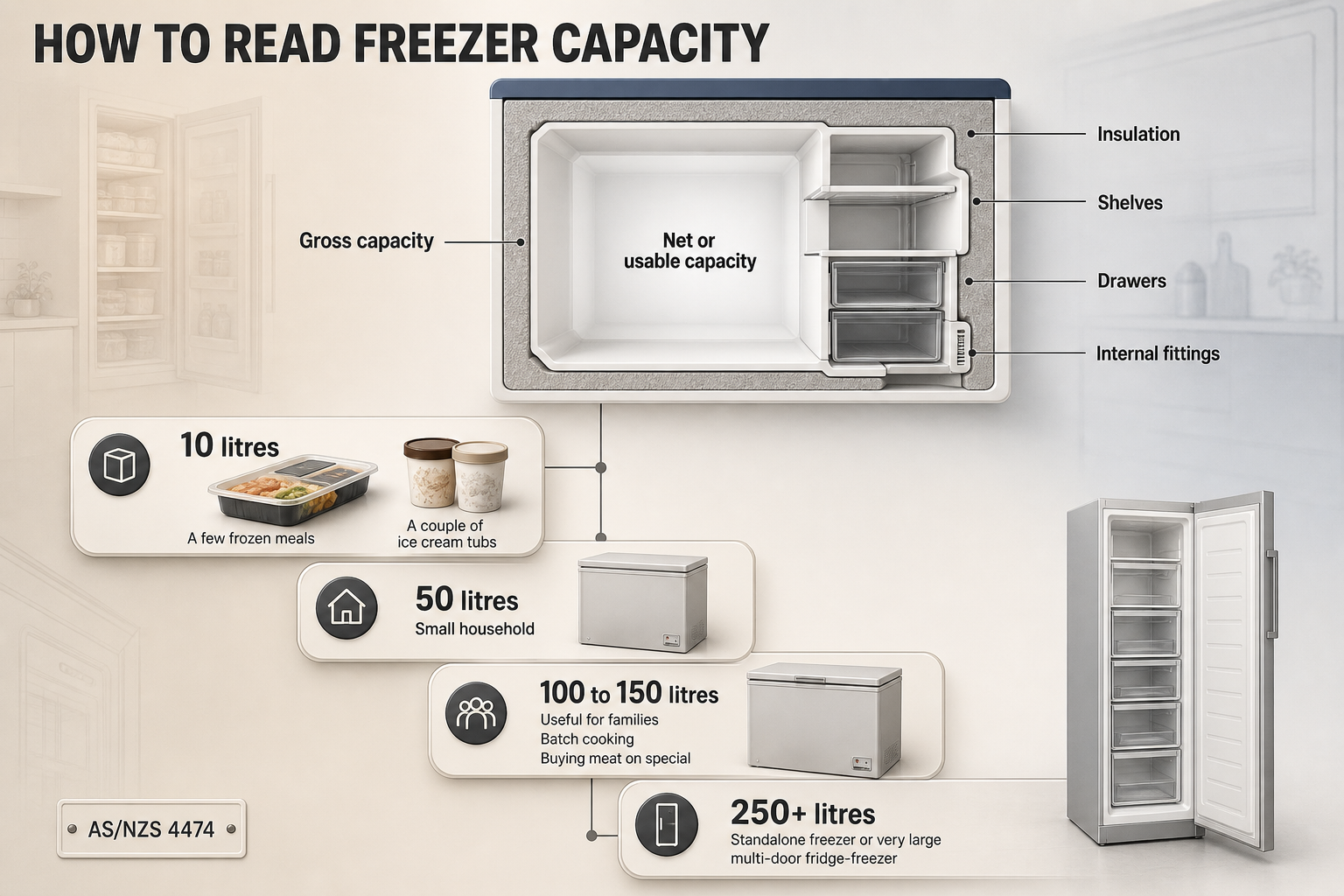
A freezer capacity figure is the internal volume of the freezer section, measured in litres. The most useful number is the net or usable capacity, rather than gross capacity. That matters because net capacity reflects the space you can actually use once insulation, shelves, drawers, and internal fittings are accounted for. The AS/NZS 4474 standard is the trans-Tasman framework tied to testing and energy labelling for household refrigerating appliances. (standards.govt.nz)
In practical terms, 10 litres is not much. It is roughly the space taken by a few frozen meals and a couple of ice cream tubs. A 50-litre freezer compartment is enough for a small household that shops often. A 100 to 150-litre freezer starts to feel genuinely useful for families, especially if you like batch cooking or buying meat on special. Once you get beyond 250 litres, you are usually looking at a serious standalone freezer or a very large multi-door fridge-freezer.
The litre figure does not tell the whole story, though. Two freezers with the same quoted capacity can feel very different inside. Deep chest freezers use volume efficiently but can be harder to organise. Upright freezers and freezer drawers are easier to sort, but shelves, bins, and ice makers can eat into usable space. Consumer NZ specifically highlights interior layout as a key part of choosing both freezers and fridge-freezers. (consumer.org.nz)
Typical Ranges
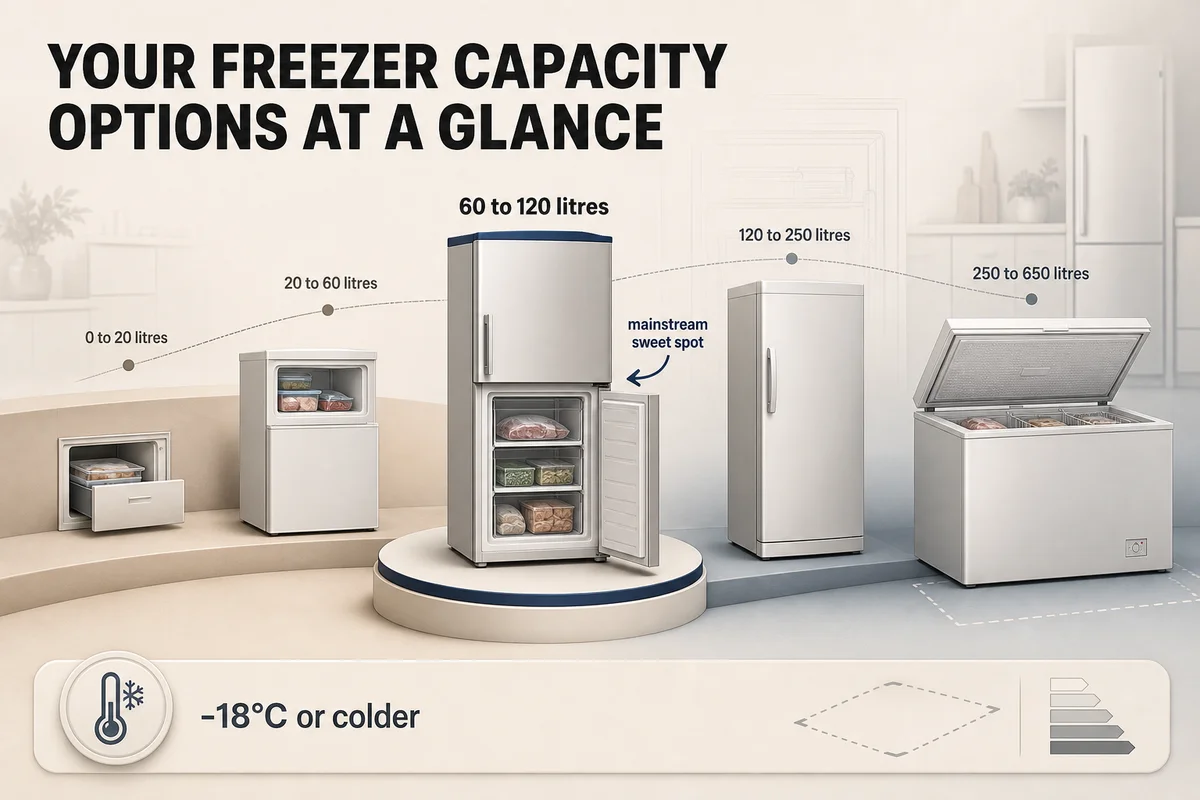
0 to 20 litres
This is the tiny end of the scale. You will see it in bar fridges, compact office fridges, and some very small apartment models. In some appliances, especially fridge-only models, the freezer capacity is legitimately 0 litres. That is not an error. It simply means there is no freezer section.
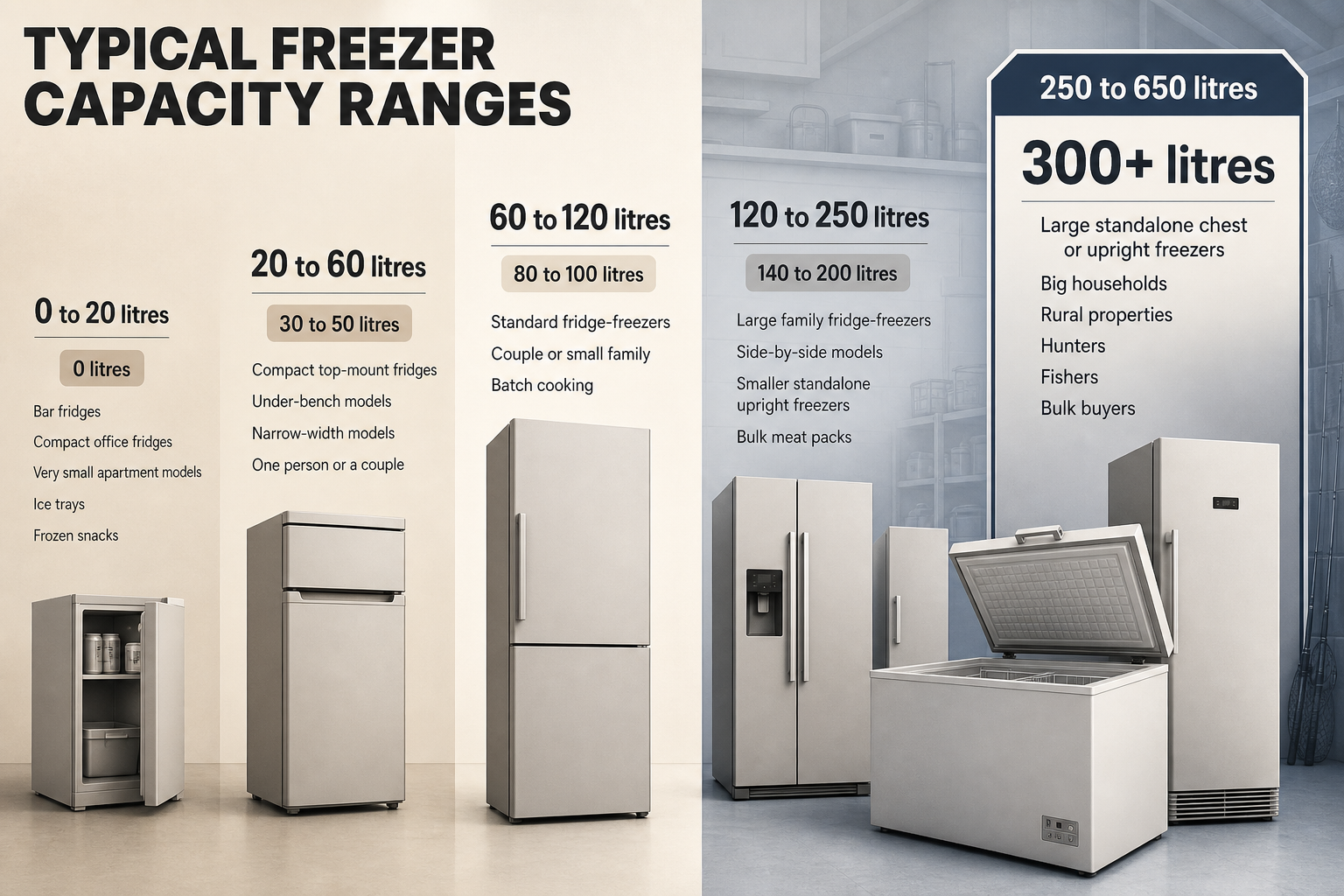
This range suits a bedroom, office, sleepout, or holiday setup where you only need ice trays, a few frozen snacks, or no freezer at all. It is not enough for a normal household grocery cycle.
20 to 60 litres
This is common in compact top-mount fridges and smaller under-bench or narrow-width models. For one person or a couple who shops every few days, 30 to 50 litres can work well. It covers basics like frozen vegetables, bread, a few meat portions, and leftovers.
For many Auckland and Wellington apartment buyers, this is the practical minimum if you want a freezer but do not have room for a larger cabinet. If you rely on supermarket specials, Costco-style bulk buying, or once-a-fortnight shopping, it will feel tight quickly.
60 to 120 litres
This is the mainstream sweet spot for many New Zealand households. You will find it in many standard bottom-mount and top-mount fridge-freezers. Around 80 to 100 litres is often enough for a couple or small family with regular grocery shops and some batch cooking.
If you have school-age kids, like to freeze leftovers, or keep a steady supply of meat, frozen fruit, and lunchbox items, this range is usually the most balanced. It gives useful storage without pushing you into the size, weight, and power demands of a much larger appliance.
120 to 250 litres
This is large freezer territory. It includes bigger family fridge-freezers, side-by-side models, and smaller standalone upright freezers. For a busy household, 140 to 200 litres gives breathing room for bulk meat packs, pre-cooked meals, and seasonal storage.
This range also starts to make sense in rural New Zealand, where shopping trips may be less frequent and you may want room for home baking, garden produce, or extra frozen food through winter. If you regularly store fish, venison, or homekill, the extra litres are genuinely useful.
250 to 650 litres
At this point you are mostly looking at large standalone chest or upright freezers. These are for big households, rural properties, serious bulk buyers, hunters, fishers, or anyone storing large volumes for long periods. Consumer NZ notes that standalone freezers are a strong option if you want much more storage than a standard fridge-freezer can offer. (consumer.org.nz)
A 300-litre-plus freezer is far more than most urban households need. It can make sense if you split meat purchases, preserve produce from a lifestyle block, or need long-term storage for a large family. But empty space is not always a win if it means a bigger footprint and higher running costs than your lifestyle justifies.
Use-Case Guidance
If you live alone or with a partner and shop once or twice a week, aim for about 30 to 80 litres of freezer capacity. That gives enough room for daily essentials without paying for excess size. In a small flat, even 20 to 40 litres may be fine if you mostly eat fresh food and have easy supermarket access.
For a small family, 80 to 140 litres is usually the sensible target. That range handles frozen vegetables, meat, bread, lunchbox supplies, leftovers, and a few convenience meals. If you batch cook on Sundays or stock up during supermarket promotions, stay toward the upper end.
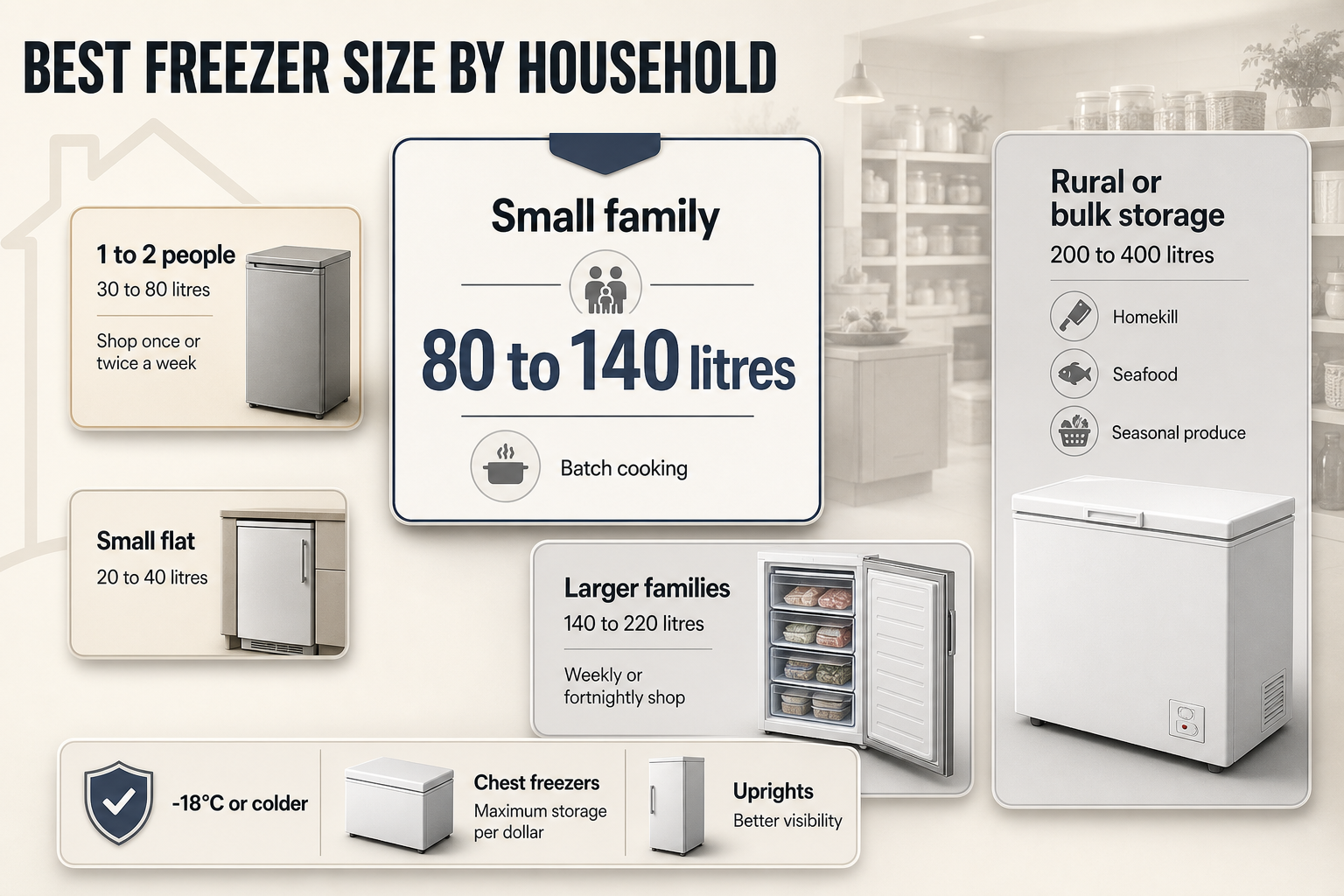
For larger families, or households that do one big weekly or fortnightly shop, 140 to 220 litres is a safer bet. It gives room to spread food out properly, which helps airflow and organisation. That matters because New Zealand food safety guidance says your freezer should be at -18°C or colder, and overloading or poor arrangement can affect temperature performance. (mpi.govt.nz)
For rural homes, holiday homes with irregular shopping access, or buyers storing homekill, seafood, or seasonal produce, a standalone freezer of 200 to 400 litres can be justified. Chest freezers are often best if maximum storage per dollar matters. Uprights are easier if you want better visibility and less digging.
If you are choosing a fridge-freezer for everyday use and wondering whether bigger is always better, the answer is usually no. A family in Christchurch or Hamilton may benefit from a 100-litre freezer section, but a couple in a central-city apartment probably does not need a 200-litre freezer built into a huge French-door unit. You are paying for cabinet size, kitchen space, and often extra electricity use whether you fill it or not.
NZ-Specific Factors
The first New Zealand-specific issue is food habits. Many households here freeze bread, meat, leftovers, fish, and seasonal produce more heavily than buyers in some overseas markets. If you shop at Pak'nSave, buy meat in bulk from a butcher, or stock up before heading to a bach, freezer litres matter more than glossy door finishes.
The second is food safety. MPI guidance says a freezer should be -18°C or colder, and research cited in a New Zealand domestic food practices report found many household freezers were warmer than that recommended storage temperature. That means capacity should be matched with decent temperature performance and sensible loading, not just the biggest number on the spec sheet. (mpi.govt.nz)
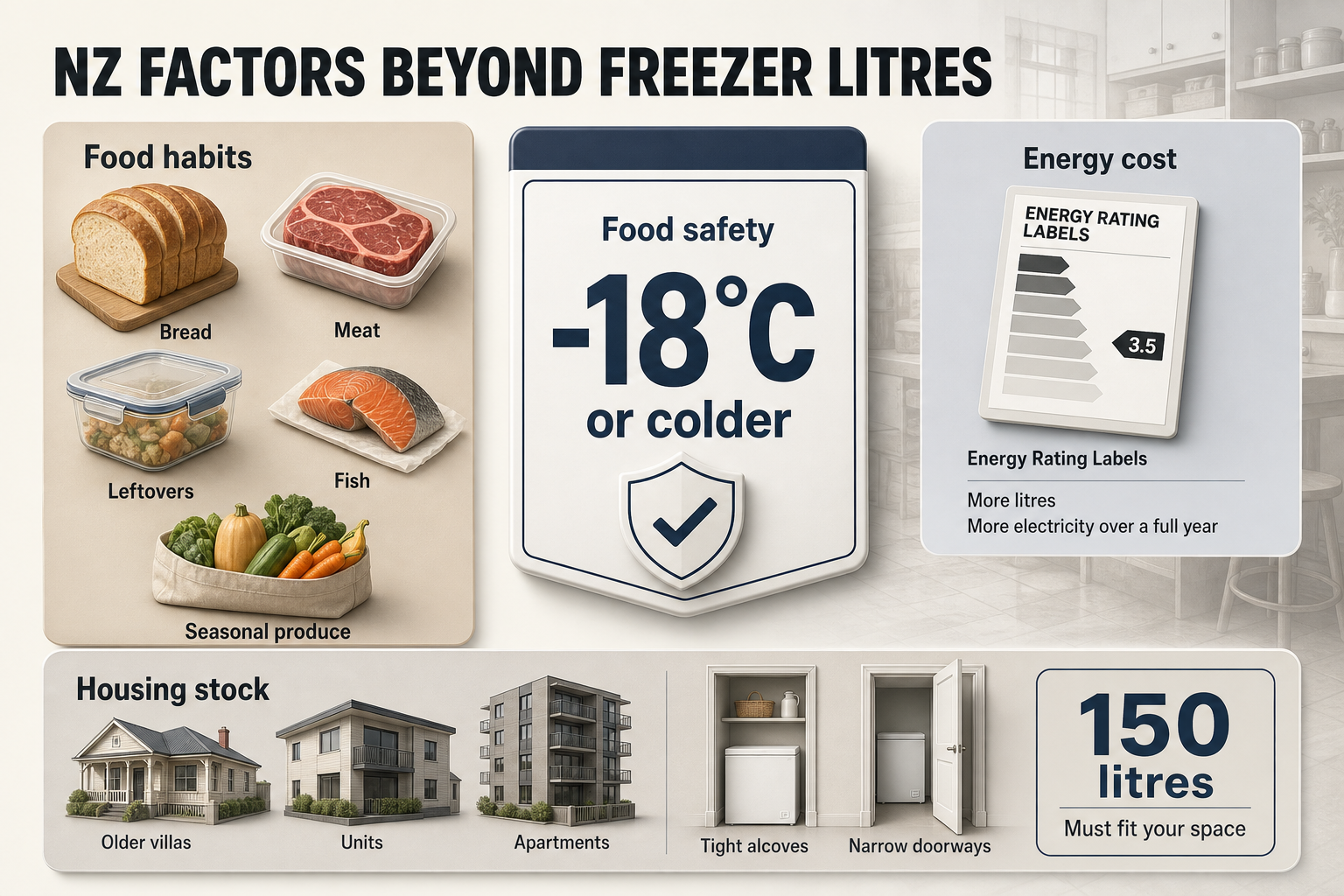
The third is energy cost. In New Zealand, Energy Rating Labels let you compare efficiency between appliances of the same size or capacity, which is important because larger freezers generally use more electricity over a full year. Consumer NZ notes that annual energy consumption for fridges and freezers is based on standards testing and assumes the appliance runs all day, every day. When you compare two similar models, check both freezer litres and the energy label rather than assuming the larger one is better value. (consumer.org.nz)
The fourth is housing stock. Many New Zealand kitchens, especially in older villas, units, and apartments, have tight alcoves, narrow doorways, and limited pantry overflow. A freezer with 150 litres of capacity is no bargain if it cannot fit through the front door or forces awkward kitchen compromises. Consumer NZ’s guides repeatedly point buyers back to available space and layout before choosing a model. (consumer.org.nz)
You may also be interested in these independent articles
Sources
- [1]Consumer NZ: How to buy the best freezer
- [2]Consumer NZ: How to buy the best fridge
- [3]Consumer NZ: How we test freezers
- [4]Consumer NZ: How we test fridges
- [5]Standards New Zealand: AS/NZS 4474.2:2001
- [6]Standards New Zealand: AS/NZS 4474.1:2007
- [7]MPI New Zealand Food Safety guidance
- [8]MPI Domestic Food Practices report
© 2026 pyfoi. All rights reserved.