
Fridge Prices NZ: What You Should Really Pay
Fridge prices in NZ range from $80 to $13,000, but value depends on size, energy efficiency, warranty and use. Learn what is worth paying for.
Price is usually the first number people look at when they shop for a fridge, and it is also the number that hides the most. A $600 fridge and a $6,000 fridge both keep food cold, but the price difference reflects a long list of things you may or may not actually care about: capacity, layout, build quality, warranty length, energy efficiency, noise, and brand. This guide is about how to read fridge prices in New Zealand without getting talked into more, or less, than you really need.
What the Numbers Mean
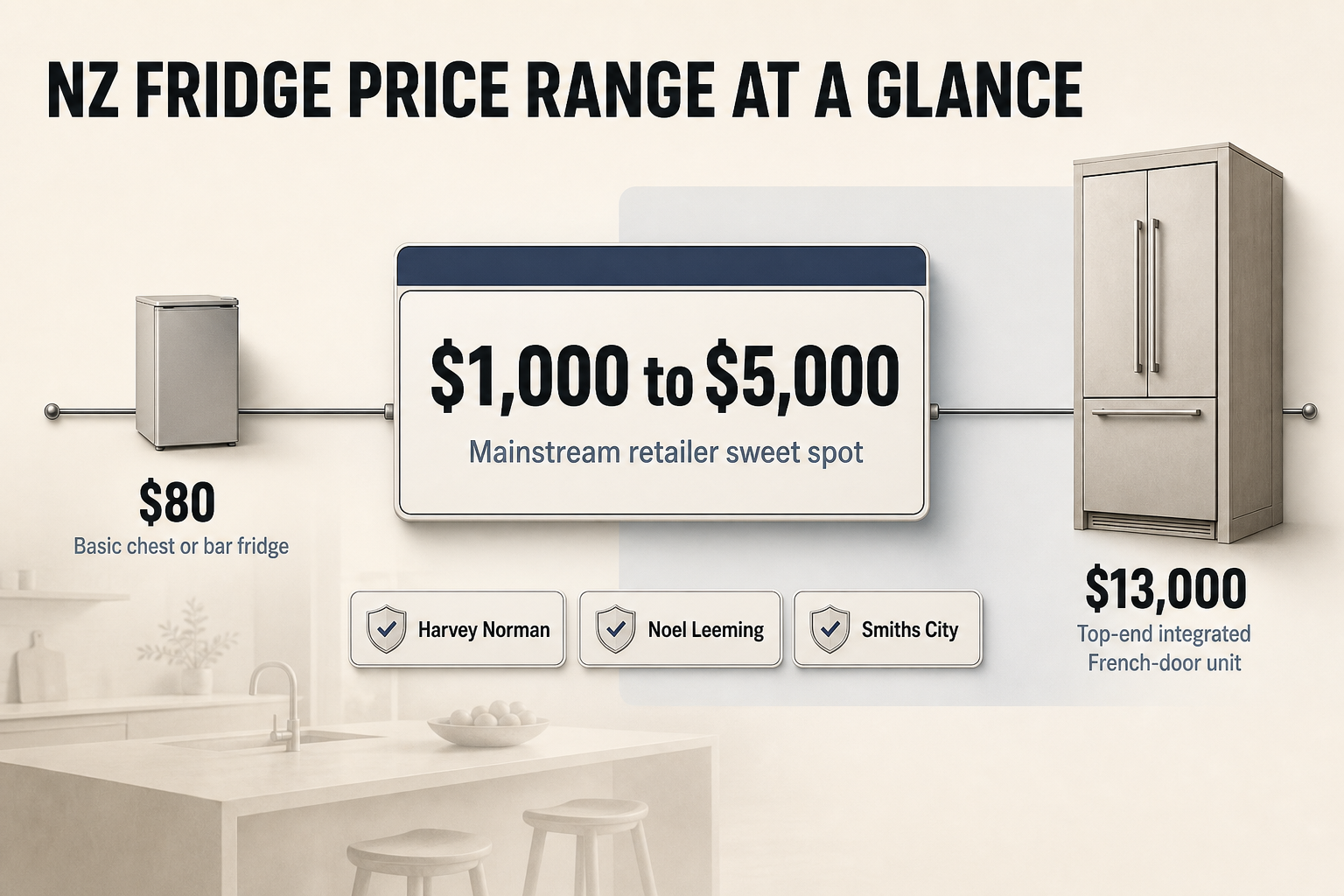
Refrigerator prices in NZ run from about $80 for a basic chest or bar fridge up to roughly $13,000 for a top-end integrated French-door unit. The bulk of what you will see in mainstream retailers like Harvey Norman, Noel Leeming, and Smiths City sits between $1,000 and $5,000. That mid-band is where the vast majority of household decisions are made.
The price you see is not just the price of the appliance. It also reflects what comes with it: the warranty terms, the retailer's delivery and removal options, sometimes installation, and sometimes a manufacturer rebate or trade-in. When comparing models, look past the sticker and check what is included so you are comparing like for like.
It is also worth noting that the same model can swing in price by hundreds of dollars between retailers, and again across the year. Public holiday sales, end-of-financial-year clearances, and Black Friday weekends in November tend to be the biggest discount windows. If your fridge has not died yet, timing a purchase around one of these can save real money.
Typical Ranges
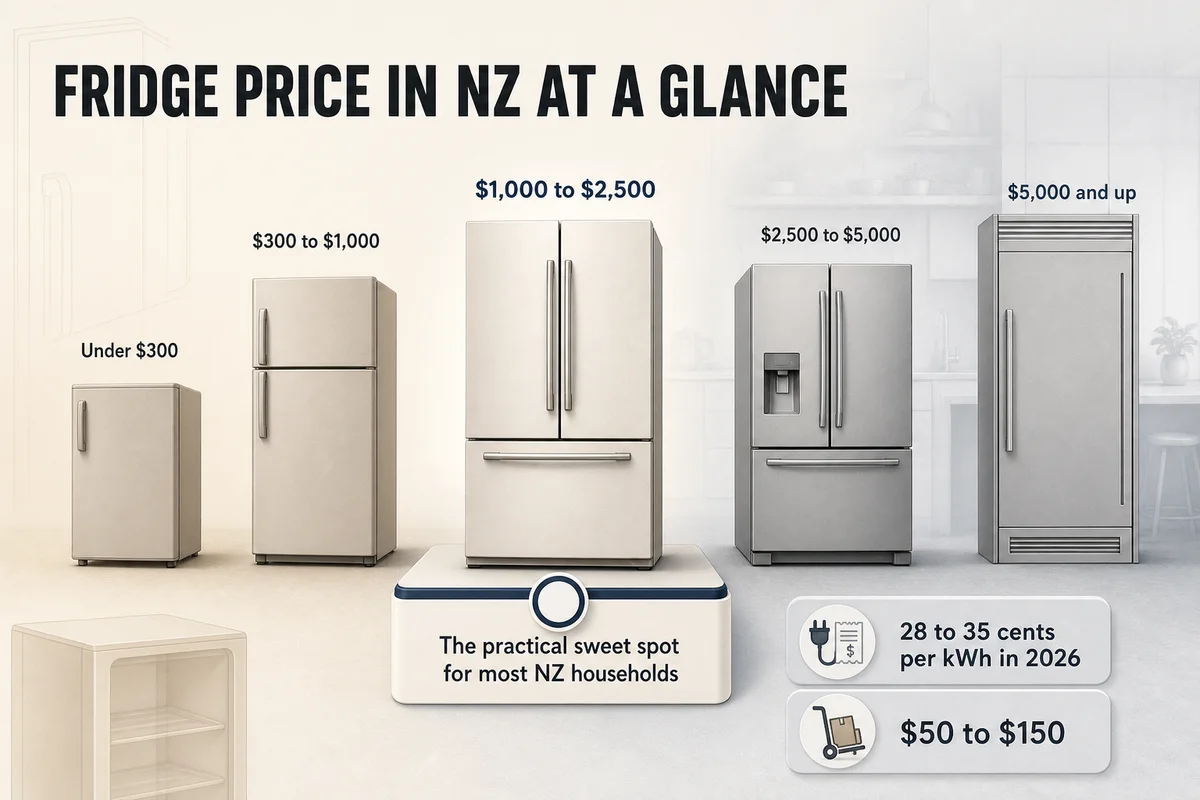
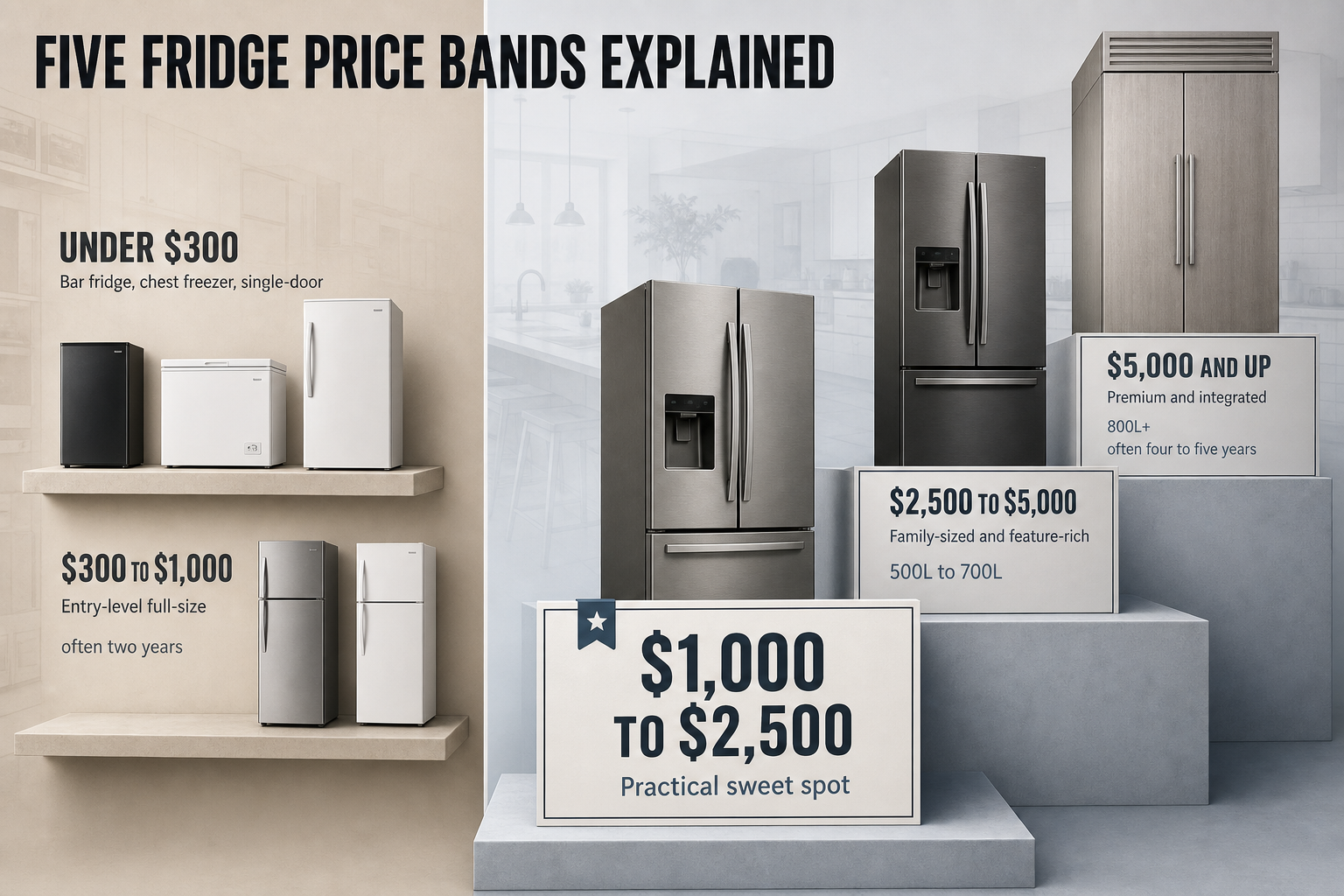
Under $300
This is the budget end of the market. Expect a small bar fridge, a basic chest freezer, or a single-door fridge built for a sleepout, garage, office, or rental top-up. Build quality is functional rather than refined: thinner shelves, basic seals, simple thermostats, and shorter warranties.
These units make sense as a secondary fridge, for a flat, or as a low-stakes purchase you do not expect to keep for a decade. They are a poor choice as the main fridge for a household that cooks, entertains, or relies on the appliance for weekly grocery storage.
$300 to $1,000
Entry-level full-size fridges live here. You can get a single-door fridge with a small freezer compartment, a basic top-mount fridge-freezer, or a slim apartment-friendly model. Brands at this end tend to be the cheaper imports and the lowest tier of bigger names.
This range works for a couple, a small flat, or a first home where budget matters more than features. Expect modest energy-efficiency ratings, basic interior fittings, and short manufacturer warranties (often two years). The big trade-off is running cost: a less efficient fridge running 24/7 for a decade can quietly cost more in electricity than you saved on the sticker price.
$1,000 to $2,500
The practical sweet spot for most NZ households. This is where mainstream brands like Fisher & Paykel, Westinghouse, Mitsubishi, LG, Samsung, and Haier put their mid-range top-mount, bottom-freezer, and smaller French-door models. You start to see better insulation, quieter compressors, more shelf options, and longer warranties (often four to five years).
A couple or family of three to four can usually find a fridge that genuinely suits them in this band. You will not get integrated styling or the largest capacities, but you do get a balance of cost, efficiency, and longevity that tends to age well.
$2,500 to $5,000
Family-sized and feature-rich. French-door, quad-door, and larger side-by-side fridges dominate this range, often with inverter compressors, dual cooling systems, water and ice dispensers, and improved energy ratings. Capacities of 500L to 700L are common.
This is where households that cook a lot, freeze ahead, or entertain regularly tend to land. The energy savings of a more efficient unit can also help justify the spend over a typical 10 to 15 year fridge life. Watch for genuine feature value, not gimmicks: a smart-screen door is rarely worth hundreds of dollars; a better compressor or longer warranty usually is.
$5,000 and up
Premium and integrated territory. Fisher & Paykel column refrigeration, Liebherr, Miele, Bosch built-in units, and larger American-style smart fridges sit here. Integrated models that disappear into kitchen joinery, double-door designer fridges, and large-format units pushing 800L+ are the norm.
These are appliances you choose to specify into a renovation or a new build, not impulse purchases. They reward households that genuinely value the design integration or capacity. They punish anyone who pays the premium without using the extra capability, because day-to-day food storage works just as well in a $2,000 fridge.
Use-Case Guidance
If you are buying a second fridge for the garage or a sleepout, stay under $400 unless you specifically need the capacity. The marginal benefit of a more expensive secondary fridge is usually low.
For a flat, a couple, or a small first home, $700 to $1,500 covers most genuine needs. Prioritise energy efficiency over features at this price point - a four-star fridge can save $50 to $100 a year in power compared with a two-star, and that adds up over a decade.
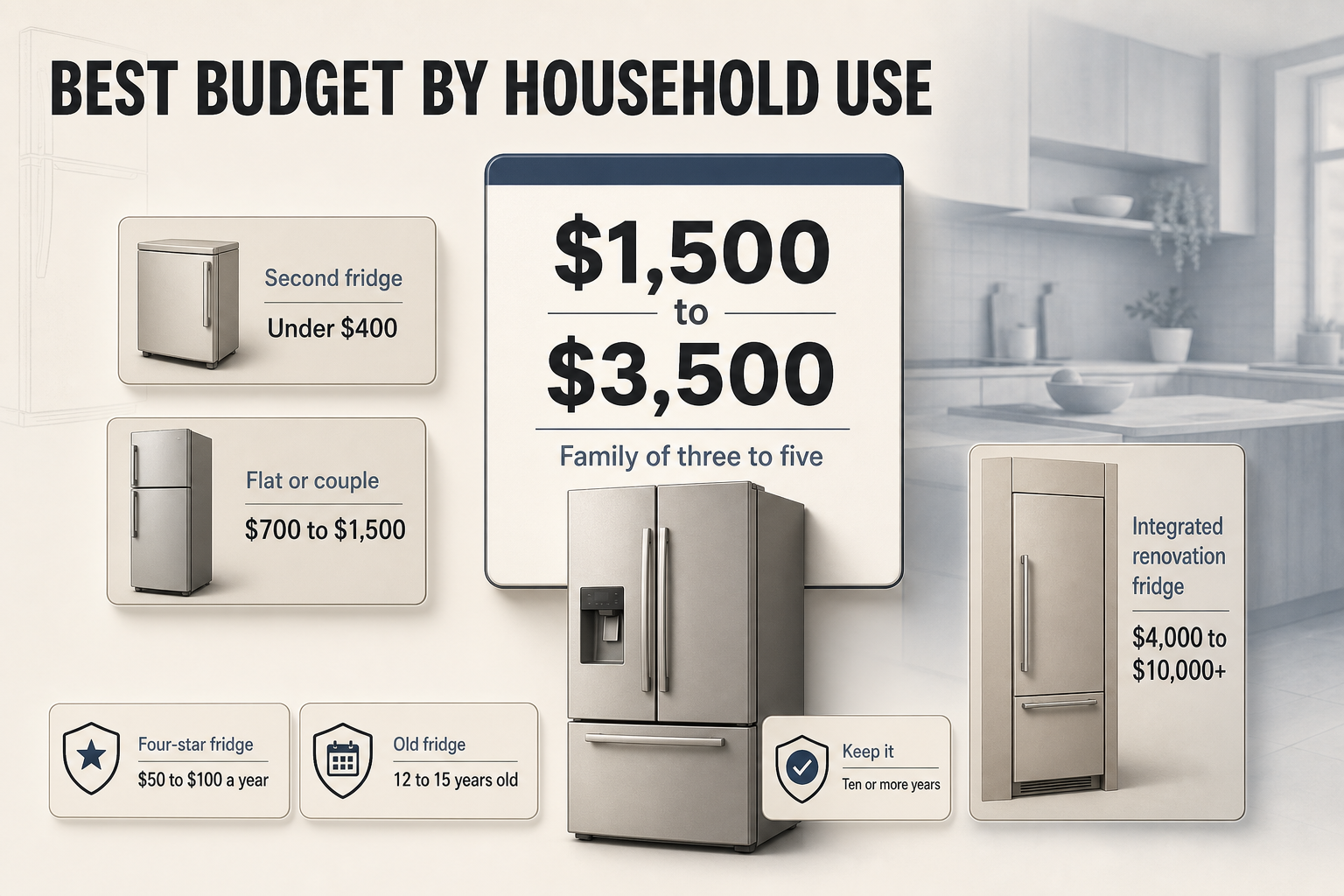
For a family of three to five, $1,500 to $3,500 is the practical zone. Spend at the upper end of that band if you want a French-door or larger bottom-freezer model and plan to keep it for ten or more years. Check warranty length carefully: a five-year warranty effectively prices in part of the cost-of-ownership.
If you are doing a kitchen renovation or new build and want integrated refrigeration, expect to spend $4,000 to $10,000 or more. Treat this as a joinery decision as much as an appliance decision. Get the cavity specs and door panel requirements from your installer before you commit, because integrated units have far less flexibility once the kitchen is built.
If you are replacing an old fridge that still works but is more than 12 to 15 years old, an upgrade often pays for itself partly through energy savings. Fridges from the late 2000s and early 2010s are typically twice as expensive to run as modern equivalents of the same capacity.
NZ-Specific Factors
Prices in New Zealand tend to be higher than equivalent models in the US or even Australia, partly because of the smaller market, partly because of shipping, and partly because of GST. The same Samsung or LG fridge can list 10 to 20 percent above the Australian price. That is not a retailer rort - it is the structural reality of buying appliances in a small, distant market. Imported direct-to-consumer brands have started to narrow this gap but rarely eliminate it.
Energy cost matters more in NZ than it does in countries with cheaper power. With residential electricity averaging 28 to 35 cents per kWh in 2026, an inefficient fridge costs noticeably more to run here than in the US. When comparing two similar-priced fridges, the one with the better energy rating is almost always the better long-term buy.
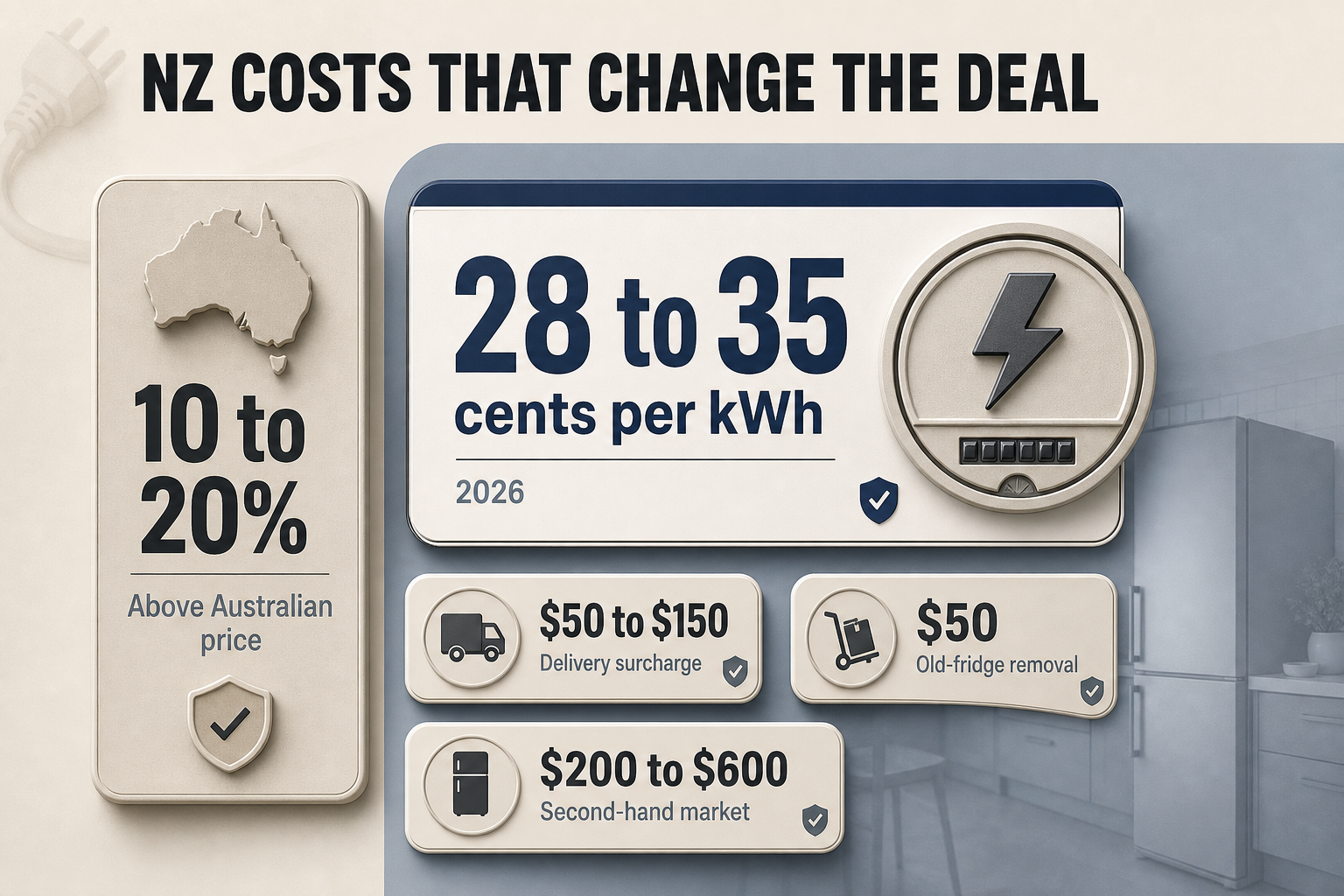
Delivery, installation, and old-fridge removal are usually separate line items, and the costs vary by retailer and location. Outside the main centres, delivery surcharges can add $50 to $150. Removal of your old fridge is sometimes free, sometimes $50, and worth asking about explicitly. If you are in a rural area, factor in that not all retailers deliver every model to every region.
Finally, watch the second-hand market with care. Facebook Marketplace and Trade Me have plenty of fridges in the $200 to $600 range, and that can be genuinely good value for a secondary unit or short-term flat setup. For your main household fridge, the lack of warranty, unknown service history, and energy-efficiency uncertainty usually make new-but-cheap a smarter bet than older-and-cheaper.
You may also be interested in these independent articles
Sources
Pricing ranges in this guide reflect typical NZ retail data observed across Harvey Norman, Noel Leeming, Smiths City, Appliances Online NZ, and major manufacturer NZ sites as of mid-2026. Energy cost figures are derived from Electricity Authority and Consumer NZ published averages. Specific model pricing changes constantly - confirm current pricing with the retailer before purchase.
© 2026 pyfoi. All rights reserved.