
What Fridge Service Ratings Mean in NZ
Fridge Parts & Service ratings in New Zealand reveal repair support, warranty limits and parts access. Learn what matters before you buy.
A refrigerator’s Parts & Service rating is a quick way of judging how easy it should be to keep the appliance running if something goes wrong. For New Zealand buyers, that matters more than many spec sheets suggest, because a fridge is not optional for long and a cheap model can become expensive fast if parts are slow to arrive or authorised repairers are thin on the ground.
What Goes Into the Rating
A Parts & Service rating is not a government star label like the energy label on a fridge. It is usually a retailer or review-site assessment of how practical ownership will be after purchase, based on the brand’s service network, spare-parts support, warranty terms, and how likely the appliance is to be repaired rather than written off. In plain English, it asks: if your refrigerator fails in Hamilton, Nelson or Invercargill, how easy is it to get help?
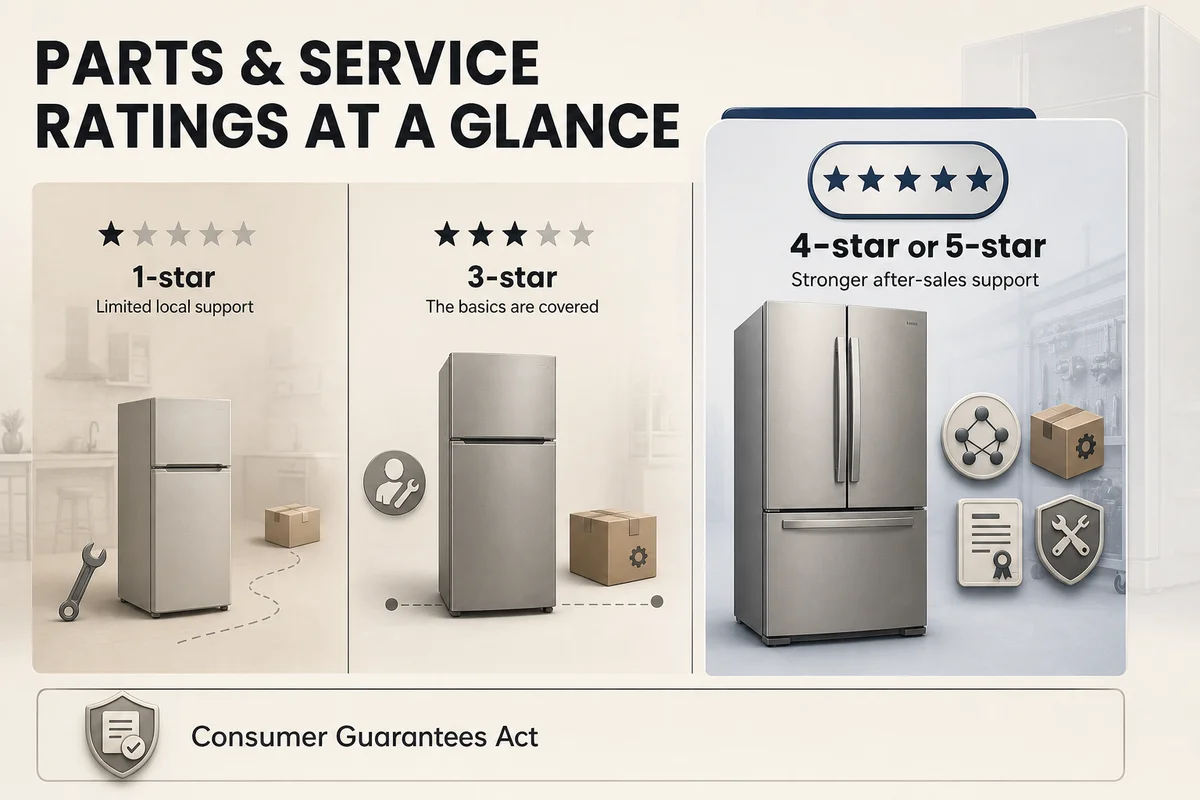
At the low end, a 1-star rating usually points to limited local support. That can mean few authorised technicians in New Zealand, longer waits for parts, more dependence on overseas supply, or warranty terms that look generous until you notice labour is excluded after the first couple of years. It can also reflect niche or parallel-import models where the retailer can sell the fridge, but the support chain is not as strong once the box is in your kitchen.
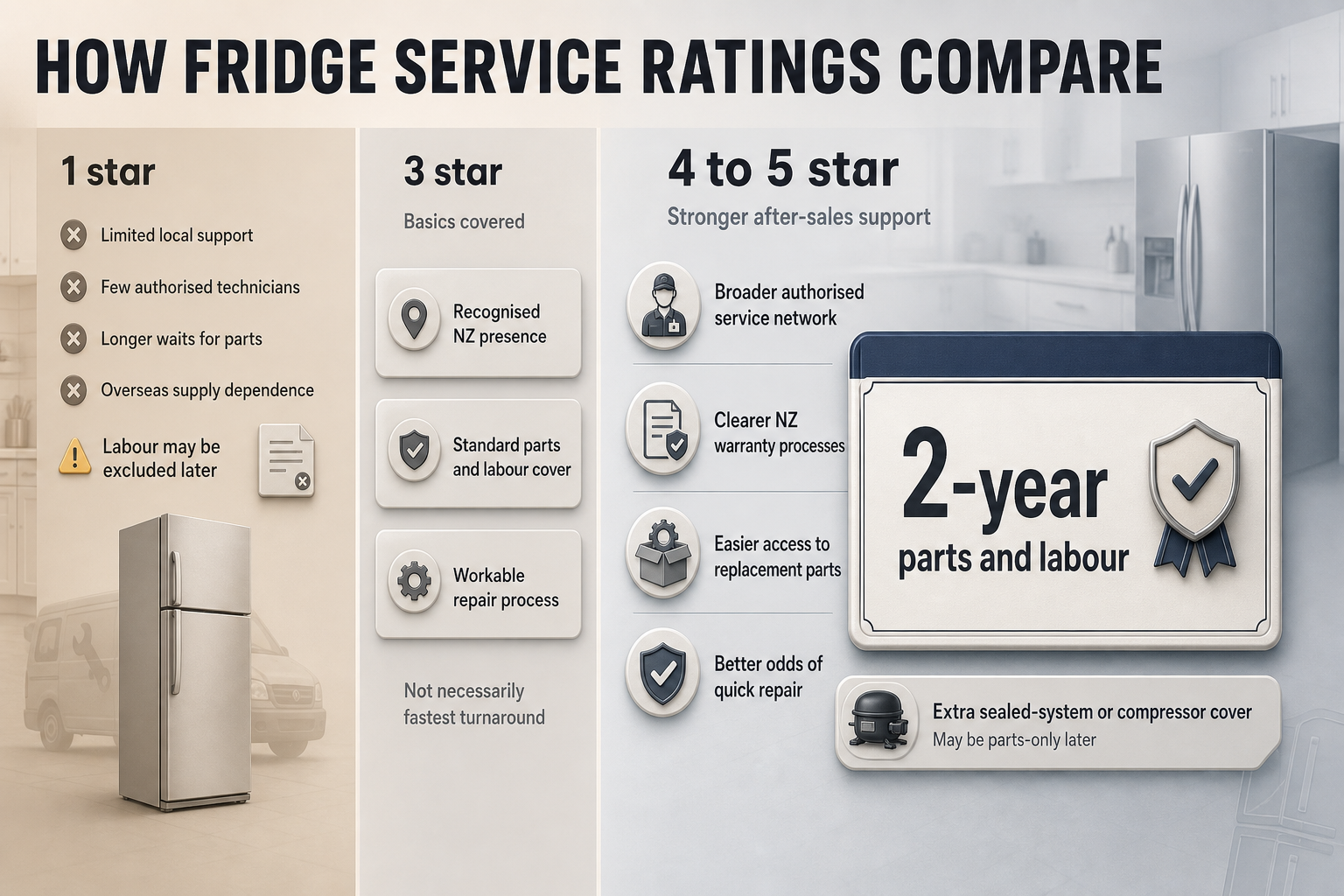
A mid-range 3-star rating often means the basics are covered. The brand may have a recognised NZ presence, standard parts-and-labour cover for the first two years, and a workable repair process, but not necessarily the fastest turnaround or the deepest stock of local spare parts. For many households this is acceptable, especially if the model is simple and widely sold.
A 4-star or 5-star rating usually suggests stronger after-sales support. That often includes a broader authorised service network, clearer NZ warranty processes, easier access to replacement parts, and better odds that common faults can be repaired quickly. Well-established brands in New Zealand often sit here because they have local customer-care systems and trained technicians already in place. Fisher & Paykel says its refrigerators come with a two-year manufacturer’s warranty covering parts and labour in New Zealand, plus extra parts-only cover on the sealed system for some models. Haier also offers a two-year parts-and-labour warranty in New Zealand, with additional compressor cover on eligible refrigerators. LG New Zealand lists two years parts and labour on refrigerators, with extra sealed-system cover after that, though later cover may be parts-only. (fisherpaykel.com)
One thing that separates a good rating from a weak one is the difference between “parts available” and “repair practical”. A compressor warranty that runs for many years sounds reassuring, but if labour, refrigerant, transport, or regional callout costs are excluded, your out-of-pocket bill can still be significant. Samsung’s NZ support material, for example, highlights long compressor parts coverage on some refrigerators, but that does not automatically mean full no-cost repair for the whole period. (samsung.com)
What to Look For
Start with the warranty document, not the marketing tile on the product page. You want to know the exact NZ terms for the refrigerator model you are considering: how many years of parts and labour are included, what happens after that, and whether sealed-system or compressor cover is parts-only. A fridge with two years full cover and then parts-only compressor cover is common, but that is not the same as five or ten years of full repair cover. (fisherpaykel.com)
Next, check whether the brand has an established New Zealand service pathway. A good sign is a dedicated NZ support page, local phone support, online booking, and named authorised service partners. Fisher & Paykel directs owners to its NZ help and support service network, which is the sort of infrastructure that usually lifts a Parts & Service rating. (fisherpaykel.com)
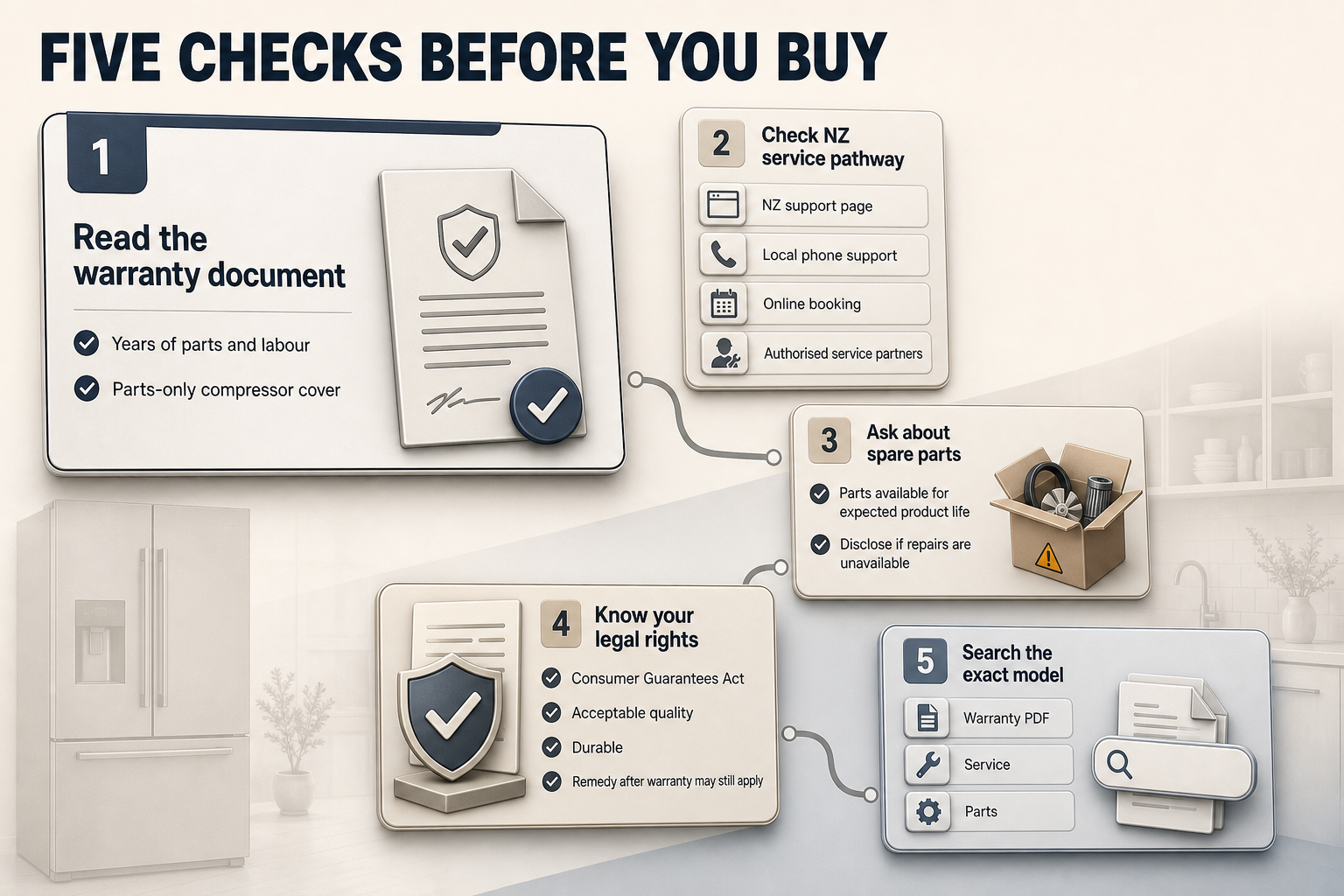
Then look at spare-parts expectations. New Zealand consumer guidance says manufacturers should keep spare parts for about as long as the model is expected to last, and businesses must tell you before sale if spare parts and repairs will not be available. That matters because refrigerators are long-life appliances, not throwaway purchases. If a seller cannot clearly explain parts support, treat that as a warning sign. (consumerprotection.govt.nz)
You should also ask how faults are handled outside the manufacturer warranty. Under the Consumer Guarantees Act, goods sold in New Zealand must be of acceptable quality and durable, and you may still be entitled to a remedy even after the written warranty ends. Consumer Protection and Consumer NZ both make this point clearly. For a major appliance like a refrigerator, that legal backstop matters, but it is still easier if the brand has a strong local repair network and parts supply. (consumerprotection.govt.nz)
A practical check is to search the exact refrigerator model plus terms like “warranty PDF”, “service”, and “parts” before you buy. If you find clear NZ documents, model-specific terms, and easy service booking, that is a good sign. If all you find are overseas manuals or vague marketplace listings, the rating should be viewed more cautiously.
NZ Context
New Zealand’s geography makes service quality more uneven than in bigger, denser markets. Buyers in Auckland, Wellington and Christchurch usually have better access to authorised refrigerator technicians than buyers in smaller centres or rural areas. That means a Parts & Service rating has a real day-to-day value here, not just a theoretical one. A strong rating can mean the difference between a same-week repair and waiting while a part is sourced from offshore.
The Consumer Guarantees Act is central to this category. It gives you rights to repair, replacement, or refund when a product fails to meet guarantees such as acceptable quality and durability. It also places obligations on sellers and importers, not just manufacturers. If spare parts and repairs are not available, that must be disclosed before the sale is completed. (consumerprotection.govt.nz)
Do not confuse this rating with energy efficiency. Refrigerator energy labels in New Zealand are governed separately under AS/NZS 4474, and EECA notes that fridge and freezer energy ratings are calculated under standardised test conditions at 22°C ambient temperature. A fridge can score well on energy use and still be mediocre for service support, or the reverse. They are different buying questions. (eeca.govt.nz)
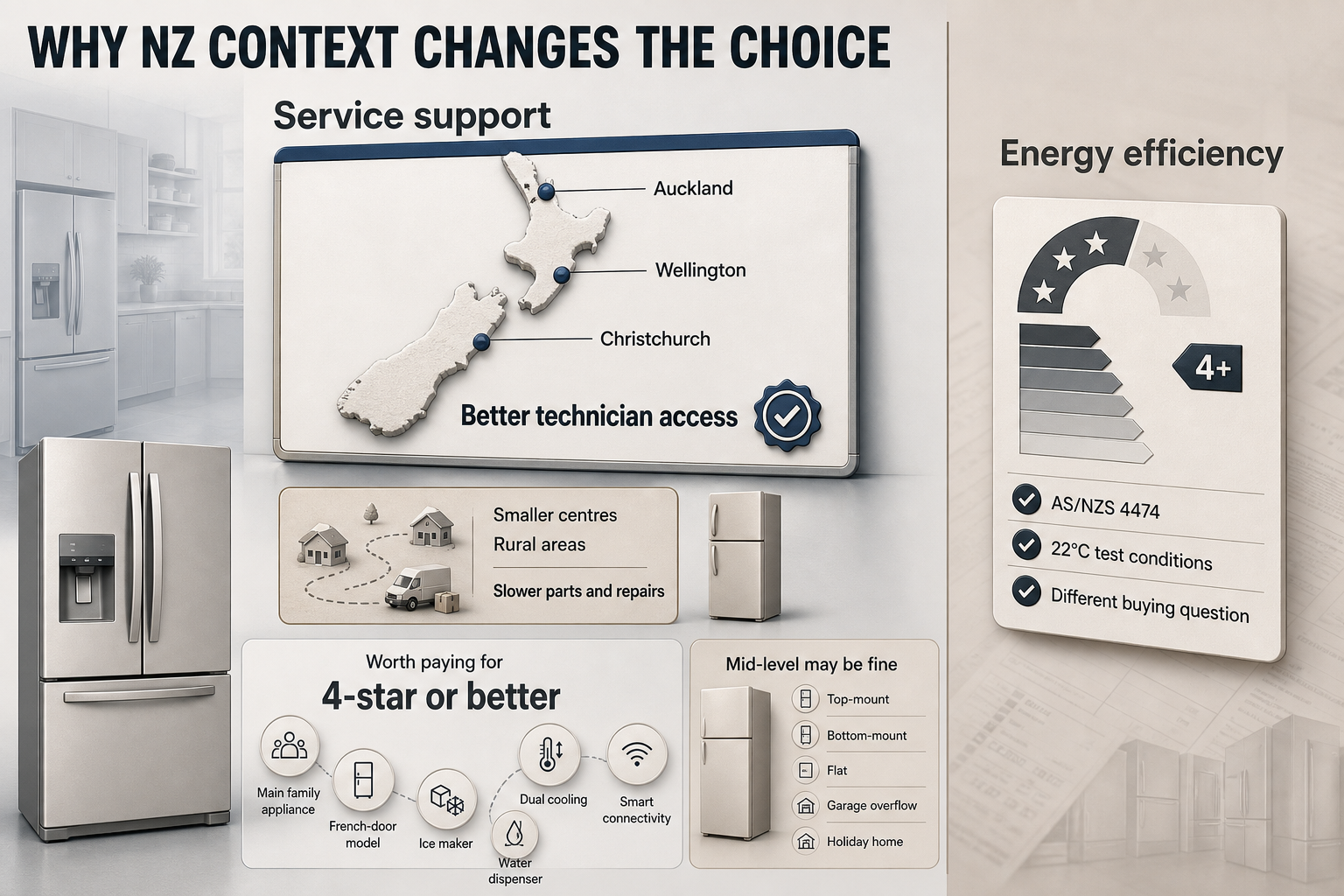
For most NZ households, a 4-star or better Parts & Service rating is worth paying for if the refrigerator is a main family appliance, a large French-door model, or a unit with complex features such as ice makers, water dispensers, dual cooling systems, or smart connectivity. These designs can be excellent, but they also have more components that may need specialist diagnosis. If you are buying a simple top-mount or bottom-mount fridge for a flat, garage overflow use, or a holiday home, a mid-level rating may be fine if the purchase price is sharp and the seller is reputable.
The safest approach is to judge the rating alongside three things: the written NZ warranty, the brand’s local service footprint, and your own tolerance for downtime. If losing your fridge for a week would be a serious problem, Parts & Service deserves almost as much attention as capacity and energy use.
You may also be interested in these independent articles
Sources
- [1]Consumer Protection NZ - Consumer Guarantees Act
- [2]Consumer Protection NZ - Product life, maintenance and care
- [3]Consumer Protection NZ - Obligations under the Consumer Guarantees Act
- [4]Consumer NZ - Consumer Guarantees Act
- [5]Fisher & Paykel NZ - Warranty Information
- [6]Haier NZ - Warranty Information
- [7]LG New Zealand - Manufacturer Warranty Information
- [8]Samsung New Zealand - Refrigerator FAQ
- [9]EECA - Fridges and Freezers Energy Rating Labels
- [10]Standards New Zealand - AS/NZS 4474:2018
© 2026 pyfoi. All rights reserved.