
How to Read a Fridge Warranty Rating in NZ
Learn how fridge warranty ratings work in New Zealand, what parts and labour cover really means, and where CGA rights can save you money.
A refrigerator warranty rating is a quick way to judge how well a fridge is backed if something goes wrong. For New Zealand buyers, that matters because a fridge runs all day, every day, and a good warranty can save you real money, hassle, and food spoilage if there is a fault.
What Goes Into the Rating
A warranty rating for a refrigerator is usually not just about the number of years on the box. A proper rating should reflect how much cover you actually get, how easy it is to claim, and whether the long-term promise applies to the whole appliance or only to one expensive part such as the compressor or sealed system. In New Zealand, the legal backdrop matters too, because your rights under the Consumer Guarantees Act sit alongside any manufacturer warranty. (consumerprotection.govt.nz)
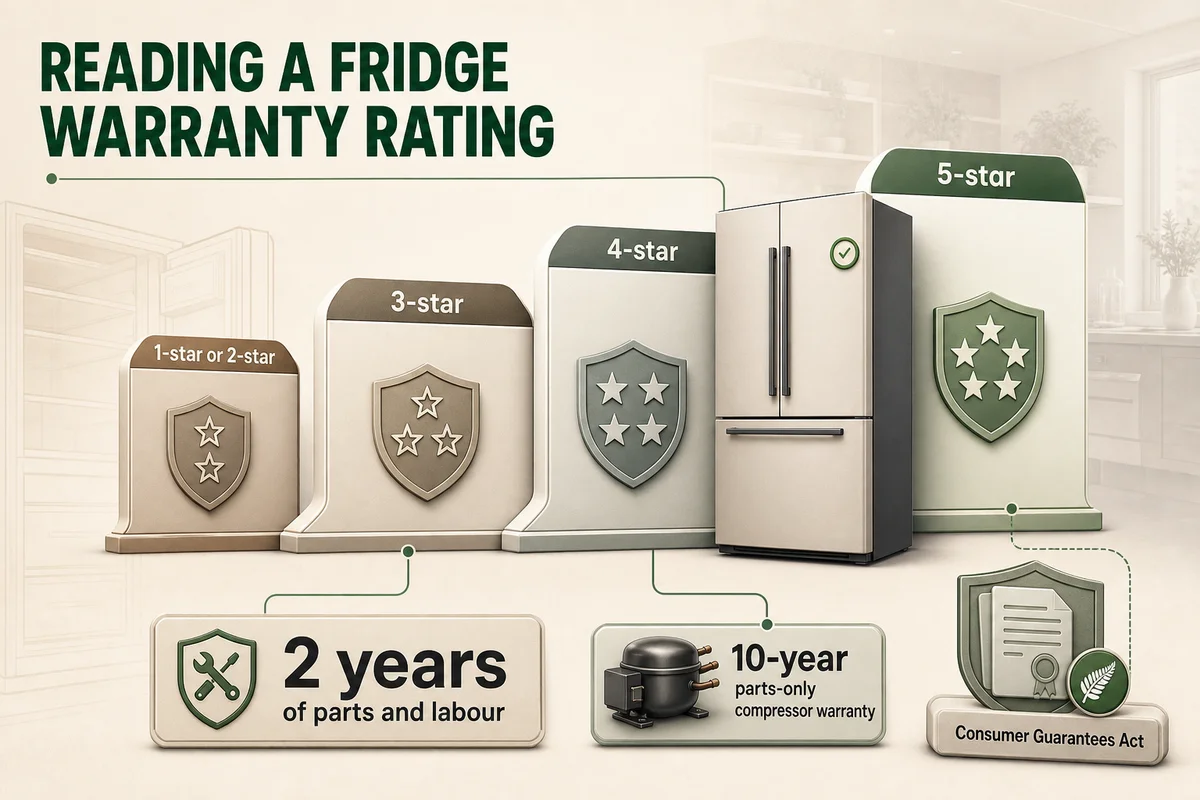
At the low end, a 1-star or 2-star warranty rating usually means the cover is basic. That often looks like a short standard warranty, tighter exclusions, more limits around freight or service call costs, and weaker long-term parts support. It may still be acceptable on a cheap bar fridge or secondary garage fridge, but it is not ideal for a main household refrigerator that you depend on every day.
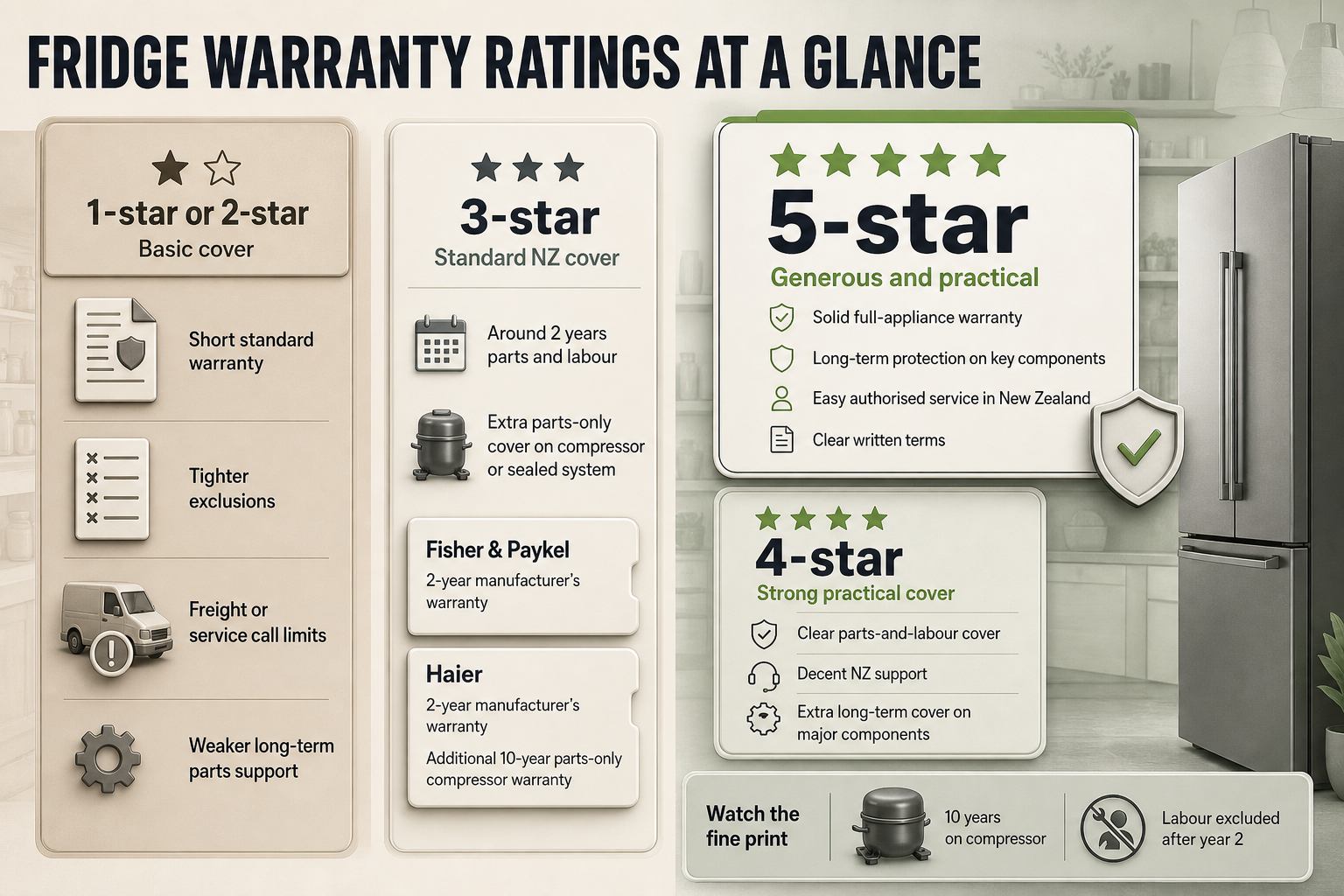
A mid-range 3-star rating usually means the fridge has the standard level of cover you would expect in NZ. For many mainstream models, that is around 2 years of parts and labour, sometimes with extra parts-only cover on the compressor or sealed system. Fisher & Paykel states a 2-year manufacturer’s warranty for appliances in New Zealand and additional parts-only cover on the refrigerator sealed system, while Haier says its refrigerators come with a 2-year manufacturer’s warranty plus an additional 10-year parts-only compressor warranty. (fisherpaykel.com)
A 4-star rating usually means the warranty is strong in the areas that matter most. You would expect clear parts-and-labour cover, decent support in New Zealand, and extra long-term cover on major refrigeration components. The difference between 3 and 4 stars is often not the headline years, but the fine print. If the compressor has 10 years of cover but labour is excluded after year 2, that is better than nothing, but not as strong as full cover.
A 5-star warranty rating should mean the cover is both generous and practical. That means a solid full-appliance warranty, long-term protection on key components, easy access to authorised service in New Zealand, and terms that are clearly written. A top rating should also reflect whether the brand has a reliable local service network and whether claims are likely to be straightforward rather than a battle over exclusions. This is partly an inference based on how NZ consumer protection works and how appliance makers structure fridge warranties. (consumerprotection.govt.nz)
What to Look For
Start by separating full-appliance cover from component-only cover. A refrigerator may advertise a 10-year compressor warranty, but that does not always mean 10 years of free repair. LG’s NZ warranty terms, for example, note that sealed system and linear compressor warranties are parts-only and do not include labour, refrigerant, or other consumables. That can turn a reassuring headline into a more limited benefit if a repair is needed in year 6 or 8. (lg.com)
Next, check how long parts and labour are covered for the whole fridge. For a family refrigerator, 2 years is common in the NZ market, but a better rating goes to brands that are transparent about what happens after that period and what support remains for major components. If two models cost a similar amount, the better warranty rating often belongs to the one with clearer full-cover terms rather than the one making the biggest claim about a single part. (haier.co.nz)
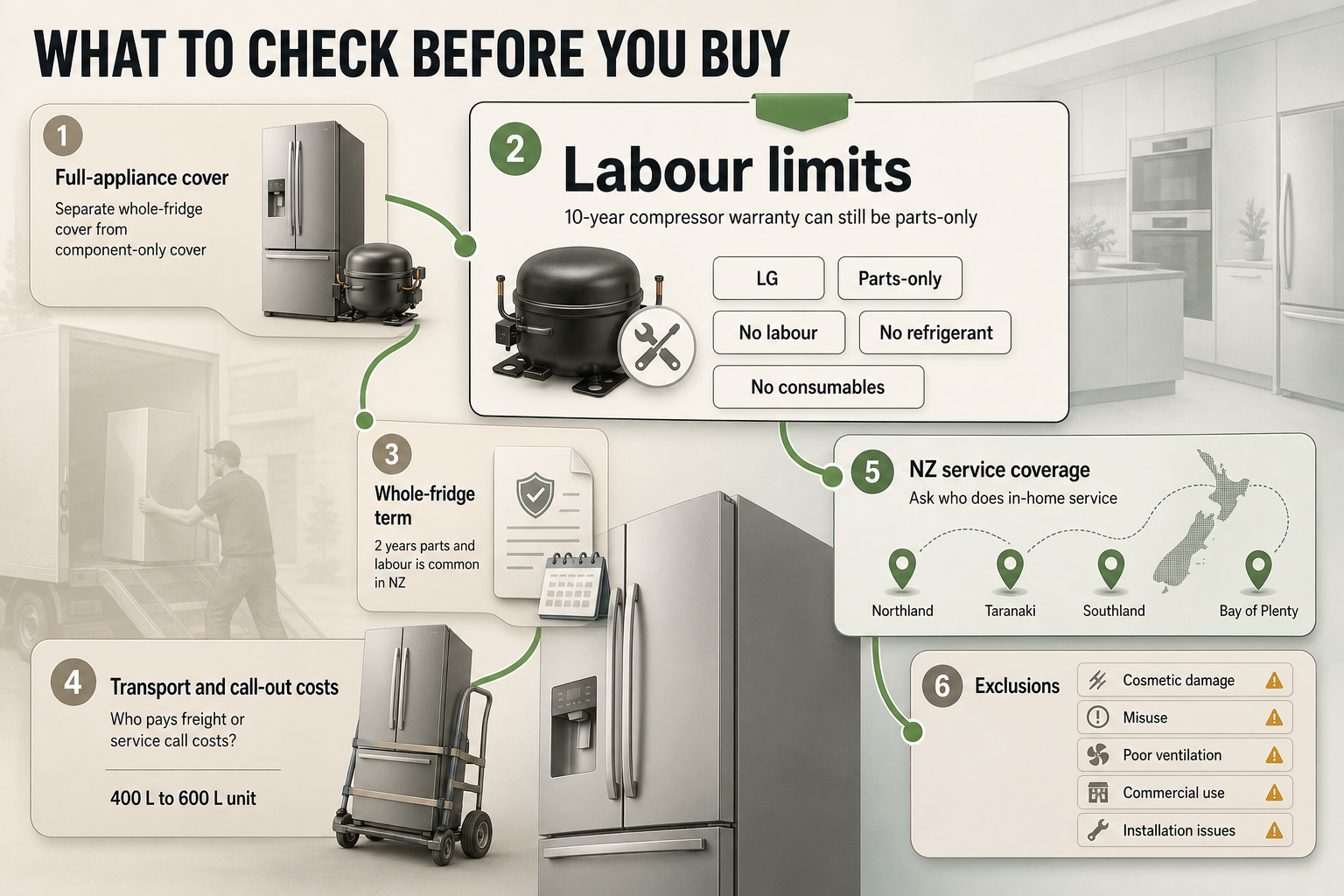
You should also check who pays transport or call-out costs. Consumer Protection advises reading warranty terms carefully to see who pays freight on returned products and what other conditions apply. With refrigerators, this matters more than with small appliances because moving a 400 L to 600 L unit is inconvenient and can be expensive. (consumerprotection.govt.nz)
Service coverage in New Zealand is another big factor. A warranty rating should be higher if the brand has established NZ servicing and parts support, especially outside Auckland, Wellington, and Christchurch. If you live in regional areas such as Northland, Taranaki, Southland, or the Bay of Plenty, ask the retailer who performs in-home service, how quickly parts are sourced, and whether there are extra charges for remote locations. That practical support can matter more than an extra few years of parts-only cover.
It also pays to ask what is excluded. Common exclusions can include cosmetic damage, misuse, poor ventilation around the cabinet, commercial use, or damage from not following installation instructions. A refrigerator pushed tightly into cabinetry without enough airflow may run hotter and fail earlier, and that can complicate a claim if the installation did not meet the maker’s requirements.
NZ Context
New Zealand buyers have stronger protection than the manufacturer warranty alone suggests. Consumer Protection states that the Consumer Guarantees Act applies regardless of store guarantees or warranties, and that goods must be of acceptable quality, fit for purpose, and last a reasonable time. If a refrigerator fails earlier than a reasonable consumer would expect, you may still have rights to a repair, replacement, or refund even after the written warranty has ended. (consumerprotection.govt.nz)
That is why an extended warranty often deserves a lower rating boost than retailers imply. Consumer Protection says you do not usually need an extended or manufacturer’s warranty unless it offers more protection than you already get by law. For refrigerators, an extended warranty may still be worth considering if it clearly adds benefits such as full labour cover beyond the standard term, loan appliances, food-loss cover, or easier in-home service, but you should compare that against your CGA rights first. (consumerprotection.govt.nz)
Running costs also affect how you should think about warranty value. EECA notes that fridges and freezers are always on, and its consumer guidance uses an electricity price assumption of $0.25 per kWh. If a cheap fridge has a weak warranty and fails early, you are not just facing repair risk. You may also be stuck with higher power bills during the years you own it. A stronger warranty rating often pairs well with a better-quality, more efficient appliance, though that depends on the specific model rather than the warranty alone. (eeca.govt.nz)
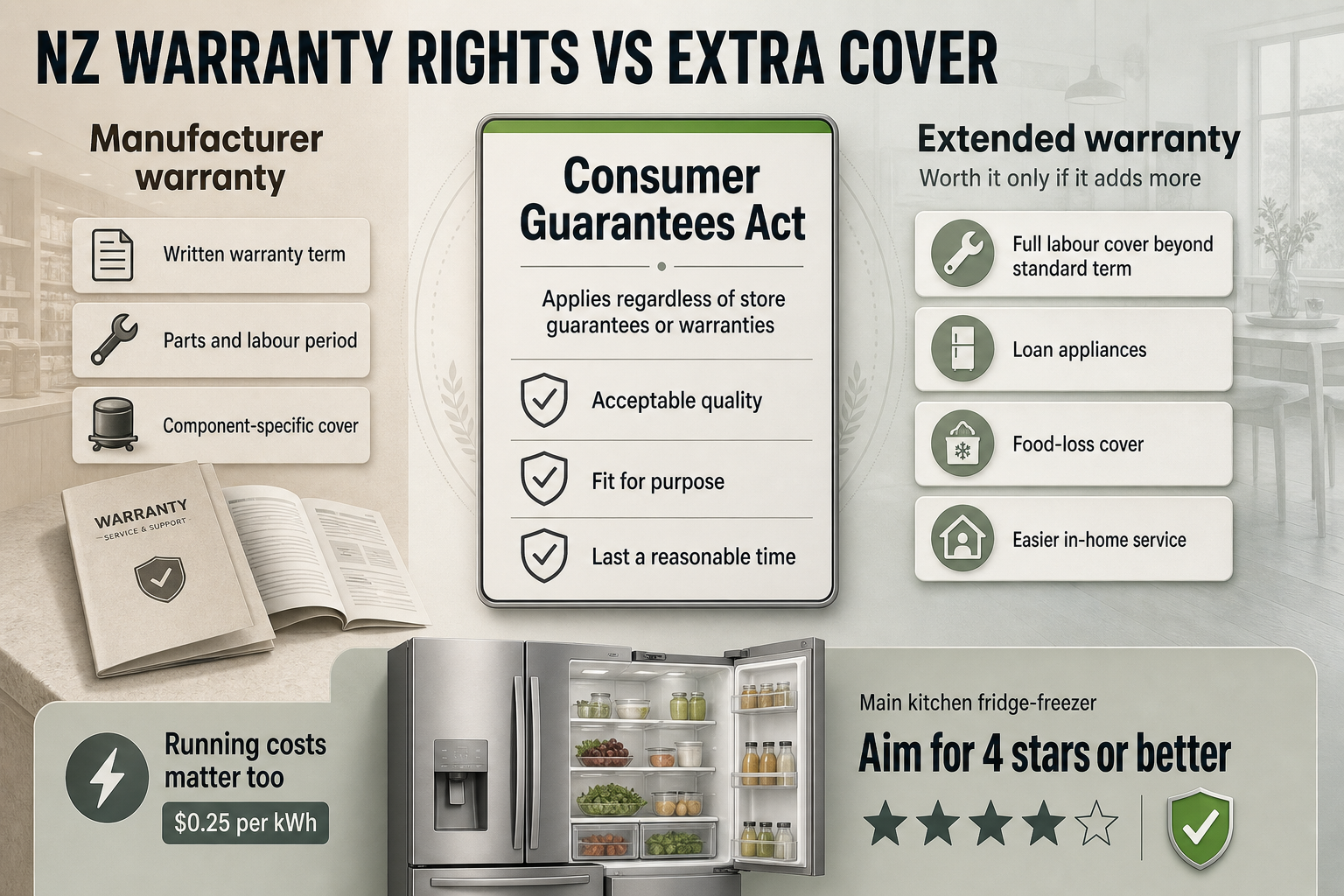
A good rule for NZ households is to be stricter with warranty ratings on larger and pricier refrigerators. For a compact beer fridge in the rumpus room, a mid-level rating may be fine. For a main kitchen fridge-freezer, French door model, or large bottom-mount unit that stores a week’s groceries for a family, aim for the equivalent of 4 stars or better. The cost of failure is higher, and the inconvenience is much worse.
If you are comparing two fridges in a shop, ask for the actual warranty document before you buy. The better warranty rating usually belongs to the refrigerator with clear full-appliance cover, realistic long-term support on the sealed system, straightforward NZ servicing, and fewer hidden costs. The star score only helps if it reflects the real terms you can rely on in your own home.
You may also be interested in these independent articles
Sources
- [1]Consumer Protection NZ - Warranties
- [2]Consumer Protection NZ - Consumer Guarantees Act
- [3]Consumer Protection NZ - Your rights compared
- [4]Haier NZ - Warranty Information
- [5]Fisher & Paykel NZ - Warranty Information
- [6]LG New Zealand - Warranty Terms
- [7]EECA - Choose an efficient fridge or freezer to cut costs
© 2026 pyfoi. All rights reserved.