
Best Fridge Depth for NZ Kitchens
Find the best fridge depth for NZ kitchens, from slim 500mm models to deep family fridges. Avoid fit mistakes, poor airflow, and wasted space.
Fridge depth looks simple on a spec sheet, but it has a big effect on how a refrigerator fits and feels in your kitchen. In New Zealand homes, where kitchens range from compact Auckland apartments to larger family spaces in Canterbury and Otago, the wrong depth can leave a fridge sticking out into a walkway, blocking drawers, or struggling for ventilation. (consumer.org.nz)
What the Numbers Mean
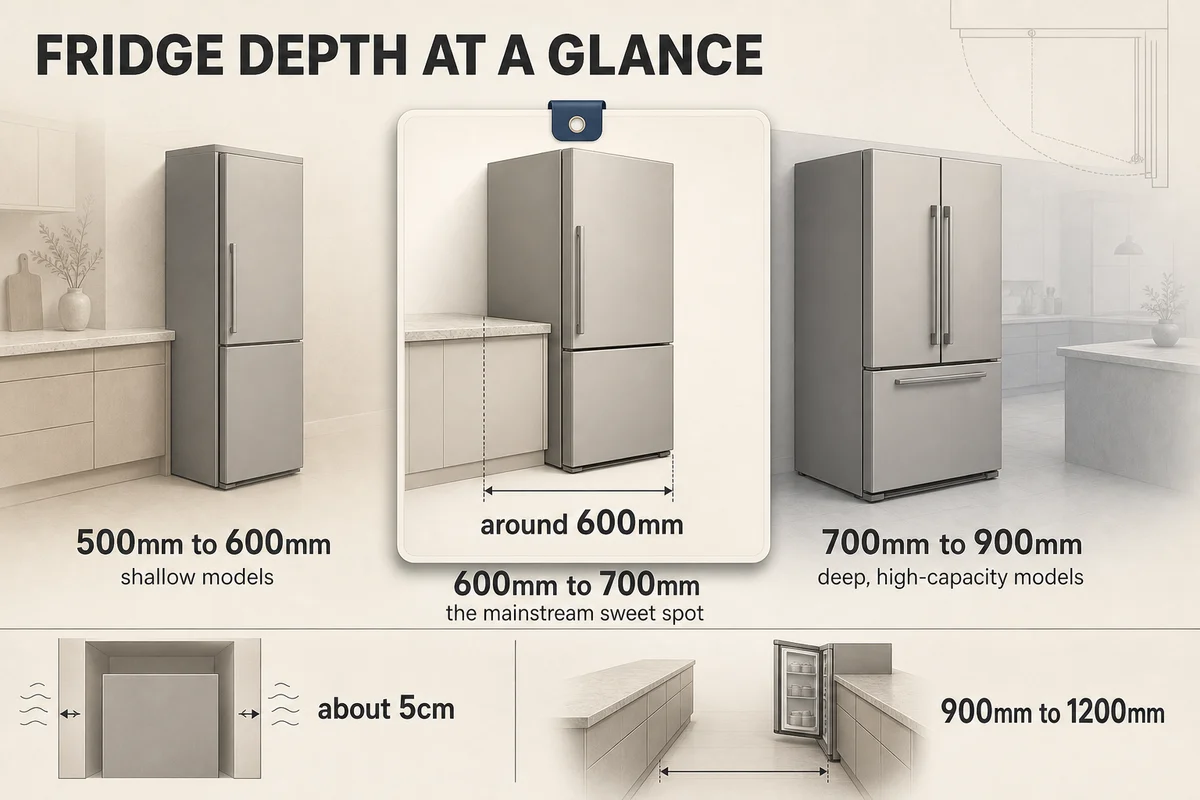
Depth is the measurement from the back of the fridge to the front. For this parameter, it is usually listed in millimetres, and the practical range here is 500mm to 900mm. If a manufacturer gives more than one depth, such as cabinet-only and overall depth with doors, the larger figure is the safer one to use when you are checking fit in your kitchen.
A 500mm-deep fridge is relatively shallow. At the other end, a 900mm-deep model is very deep and will project well beyond standard cabinetry in most homes. That matters because standard kitchen bench depth is often around 600mm, so once a fridge goes much beyond that, it can start to dominate the room visually and physically. Depth also affects how much space you have left for people to pass behind you, open drawers opposite the fridge, or move around an island.
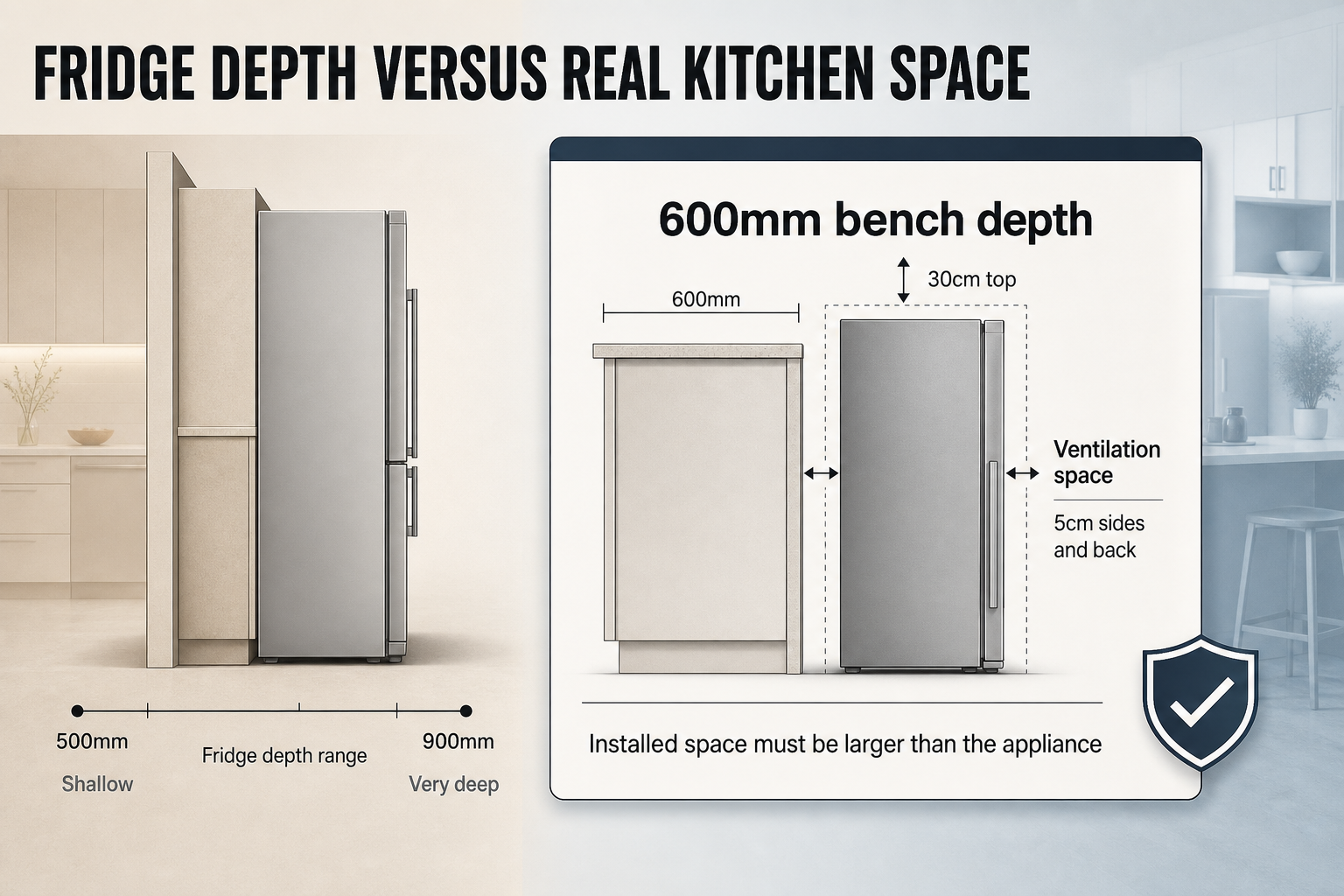
The number on the spec sheet is only part of the story. Consumer NZ advises buyers to think about the fridge dimensions that fit the kitchen and to allow ventilation space on the sides, back and top. For freezers, Consumer NZ gives a rule of thumb of about 5cm on the sides and back and 30cm on top unless the manufacturer says otherwise, and the same principle applies to refrigeration appliances generally: the installed space must be larger than the appliance itself. (consumer.org.nz)
Typical Ranges
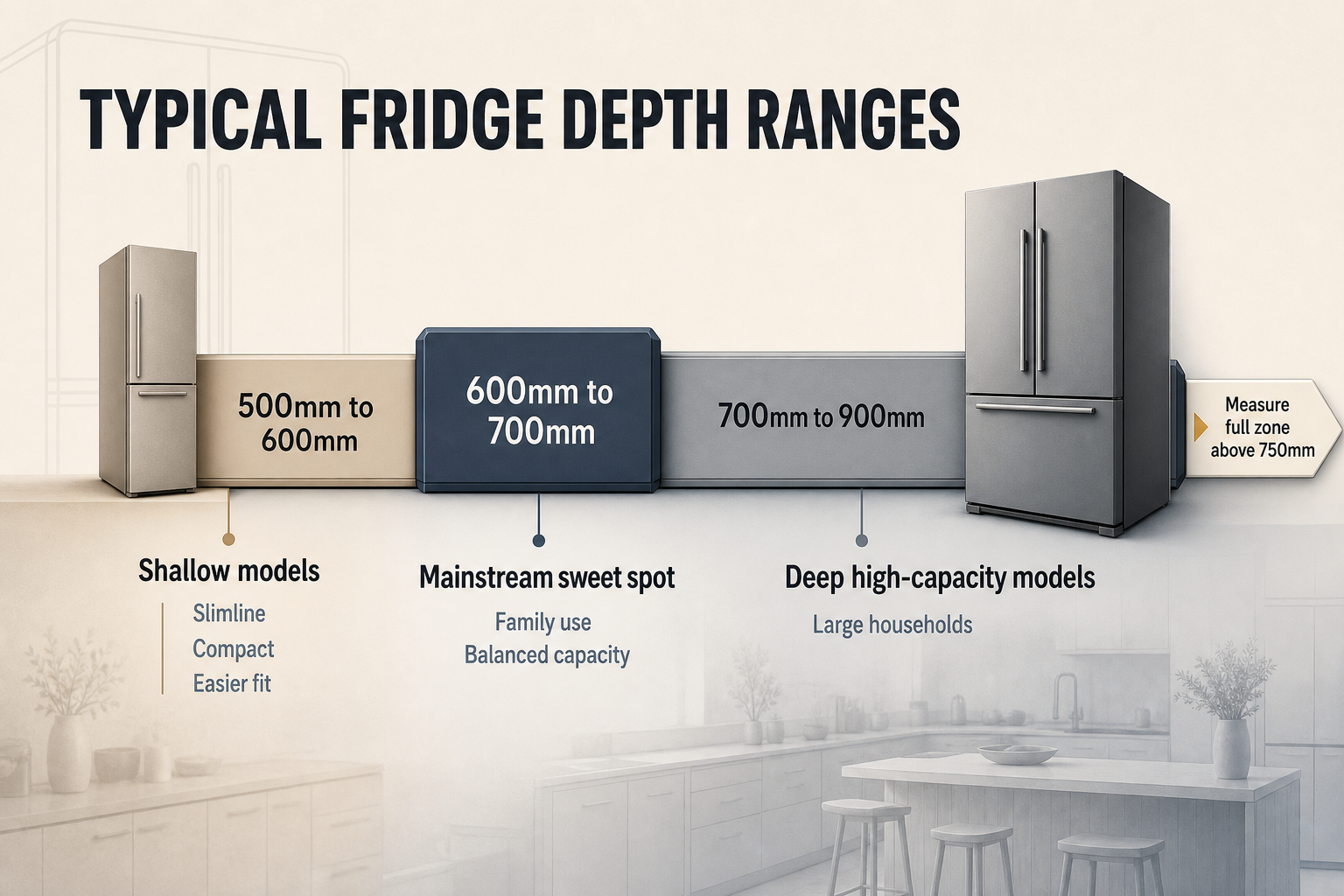
500mm to 600mm: shallow models
This is the shallow end of the range, common in slimline fridges, compact apartment models, some integrated units, and smaller bottom-mount or top-mount designs. A fridge in this band is easier to fit into tighter kitchens and is less likely to protrude far past surrounding cabinetry.
For a small household, a rental, or a townhouse kitchen where every millimetre matters, this depth can make daily use much easier. You are less likely to clip the fridge corner while carrying groceries, and you usually keep better walking space between the fridge and the opposite bench. The trade-off is internal volume. A shallow fridge often needs to be taller or wider to make up the same litres.
600mm to 700mm: the mainstream sweet spot
This is where many standard family fridges sit. It is deep enough to offer useful storage without becoming awkward in most kitchens. If your cabinetry is around 600mm deep, a fridge in the low to mid-600mm range will still project a bit once doors and handles are included, but not excessively.
For many New Zealand buyers, this is the most practical range. It suits typical family use, weekly supermarket shops, and kitchens where you want decent capacity without a full American-style footprint. If you are replacing an older Fisher & Paykel, Samsung, LG or Haier family fridge, this is often the zone you will be comparing.
700mm to 900mm: deep, high-capacity models
This range is common in larger French-door, side-by-side and high-capacity family refrigerators. These models can be excellent if you have a big household, entertain often, or want wide shelves for platters, bulk groceries and large containers.
The downside is space consumption. In a narrow galley kitchen or a home with an island, a deep fridge can reduce usable clearance fast. It may also need more thought around door swing, because the deeper body and thicker doors can make nearby walls, pantry panels or drawers harder to work around. If you are considering anything above about 750mm deep, measure the full zone around the appliance, not just the cavity.
Use-Case Guidance
Compact homes and apartment kitchens
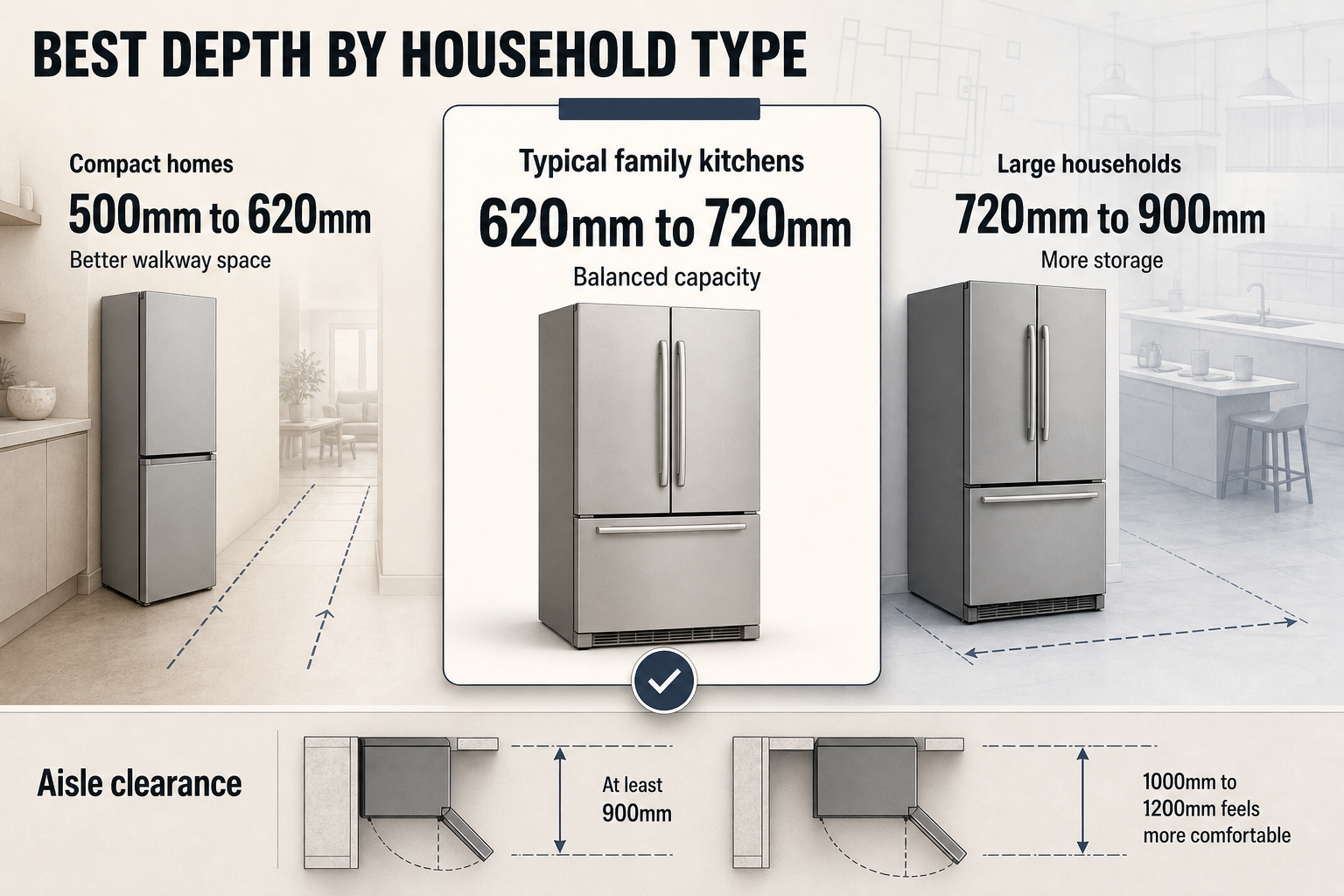
If you live in an apartment or a smaller terrace house, aim for roughly 500mm to 620mm depth where possible. That usually gives you a better chance of preserving walkway space and keeping the fridge from jutting well past the bench line. In a one-cook kitchen, that can make the room feel noticeably less cramped.
This is also a smart range if the fridge sits near an entry path or opposite an island. A shallower model helps if you are opening the fridge while someone else is unloading groceries or making lunch. You may give up some storage, but you gain easier day-to-day movement.
Typical family kitchens
For many family homes, 620mm to 720mm is the sensible middle ground. That usually gives enough volume for a weekly shop, school lunches and leftovers without making the kitchen awkward. If you have two or three children, this range often balances usable capacity with a footprint that still suits a standard kitchen layout.
Look closely at shelf design as well as depth. A well-designed 680mm-deep fridge can be more practical than a poorly designed 750mm model if the shallower one has better drawers, door bins and shelf spacing.
Large households and entertainers
If you have a big family, buy in bulk, or regularly store platters and large containers, you may need 720mm to 900mm depth. That extra front-to-back space is useful for pizza boxes, meal prep containers and large supermarket shops.
Make sure your kitchen can handle it. As a practical guide, you want enough clear floor area that the fridge does not choke the passage between benches. General kitchen design guidance often uses at least 900mm for aisle clearance, with 1000mm to 1200mm feeling more comfortable in busy kitchens. A deep fridge can eat into that quickly once doors are open. (livingetc.com)
Built-in look versus freestanding reality
Many people want a fridge to sit flush with cabinetry, but a true flush fit is harder than it looks. Even if the cabinet depth is 600mm, the fridge may still need extra rear or top air space, and the doors often need room to open past the cabinet line. Consumer NZ recommends checking installation guides and manufacturer information sheets before buying, rather than relying on a showroom impression. (consumer.org.nz)
NZ-Specific Factors
Electricity running cost matters in New Zealand, because a fridge runs all day, every day. EECA says Energy Rating Labels let you compare how much energy similar appliances use and what they cost to run, and fridge and freezer labels show annual energy consumption in kWh as well as a star rating. Bigger and deeper fridges are not automatically inefficient, but more size usually means more space to cool, so compare the label carefully among similar models. (eeca.govt.nz)
Ventilation matters more than many buyers expect. Consumer NZ advises allowing ventilation space around the appliance, and that is especially important if your fridge is pushed into a tight alcove or cabinetry tower. Poor airflow can make the appliance work harder, which can increase electricity use and may shorten its life. (consumer.org.nz)
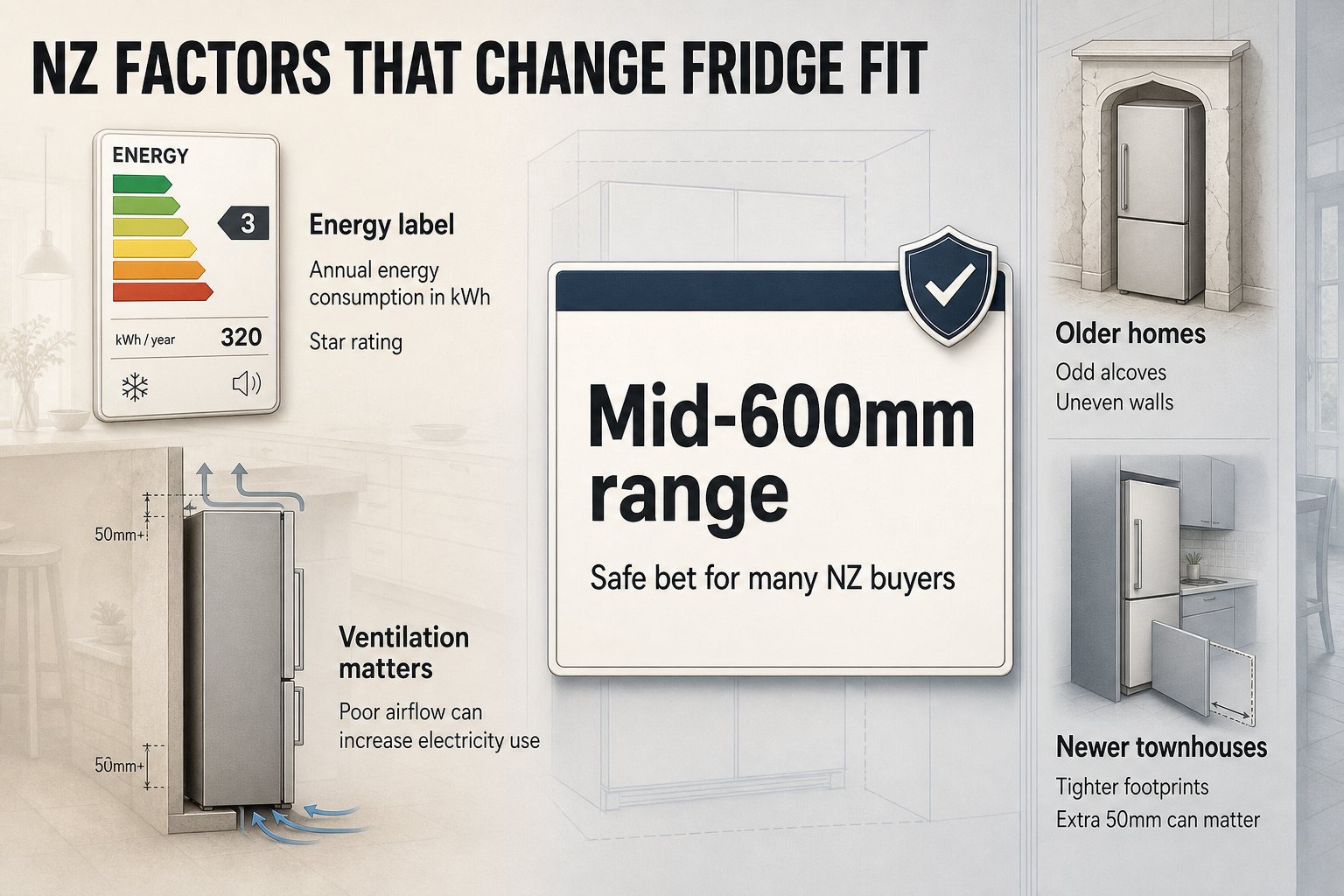
New Zealand homes also vary a lot in age and layout. Older villas and bungalows may have generous kitchen floor area but odd alcoves, skirtings or uneven walls. Newer townhouses often have tighter kitchen footprints, where even an extra 50mm of fridge depth can affect how drawers open or how easily two people can pass each other. Measure from the wall to the furthest point the fridge will occupy, then add the clearance the manufacturer requires.
If you are choosing between two similar fridges, depth is often the tie-breaker that decides whether the appliance feels neatly integrated or annoyingly oversized. For many NZ buyers, a model around the mid-600mm range is the safe bet. Go shallower if your kitchen is tight, and only go into the 700mm-plus range if you genuinely need the capacity and have measured the space around it properly.
You may also be interested in these independent articles
Sources
© 2026 pyfoi. All rights reserved.