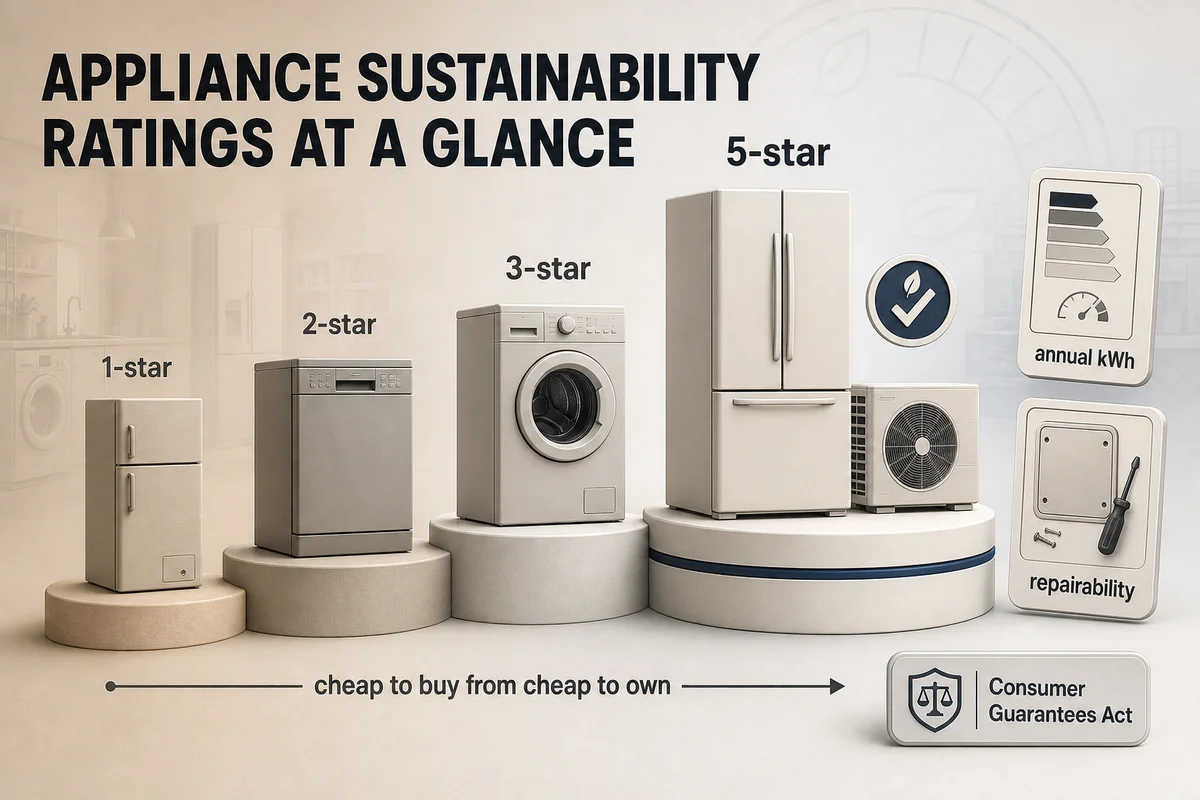

How to Read an Appliance Sustainability Rating
Learn what an appliance sustainability rating really means in New Zealand, from energy labels to repairability, lifespan and long-term costs.
A sustainability rating is a quick way to judge how responsible an appliance is over its full life, not just how well it works on day one. For New Zealand buyers, that matters because the real cost of an appliance includes power use, repairability, lifespan, spare parts, and how soon it ends up in landfill.
What Goes Into the Rating
A 5-star sustainability score usually points to an appliance that is efficient to run, built to last longer, and easier to repair if something fails. A 1-star score usually suggests the opposite: higher running costs, shorter expected life, poor access to parts, or a design that makes repairs difficult or uneconomic. That does not mean a low-rated product is unusable, but it does mean you should look harder at the long-term trade-offs.
In practice, sustainability is broader than the familiar energy label. In New Zealand, the official Energy Rating Label helps you compare the efficiency of certain appliances such as fridges, freezers, dishwashers, clothes washers, dryers, TVs, monitors, and heat pumps. The label shows a star rating for efficiency and annual energy consumption in kWh, based on standardised testing. EECA administers the label in New Zealand under the trans-Tasman system, so it is one of the most reliable pieces of information you can use at point of sale. (eeca.govt.nz)
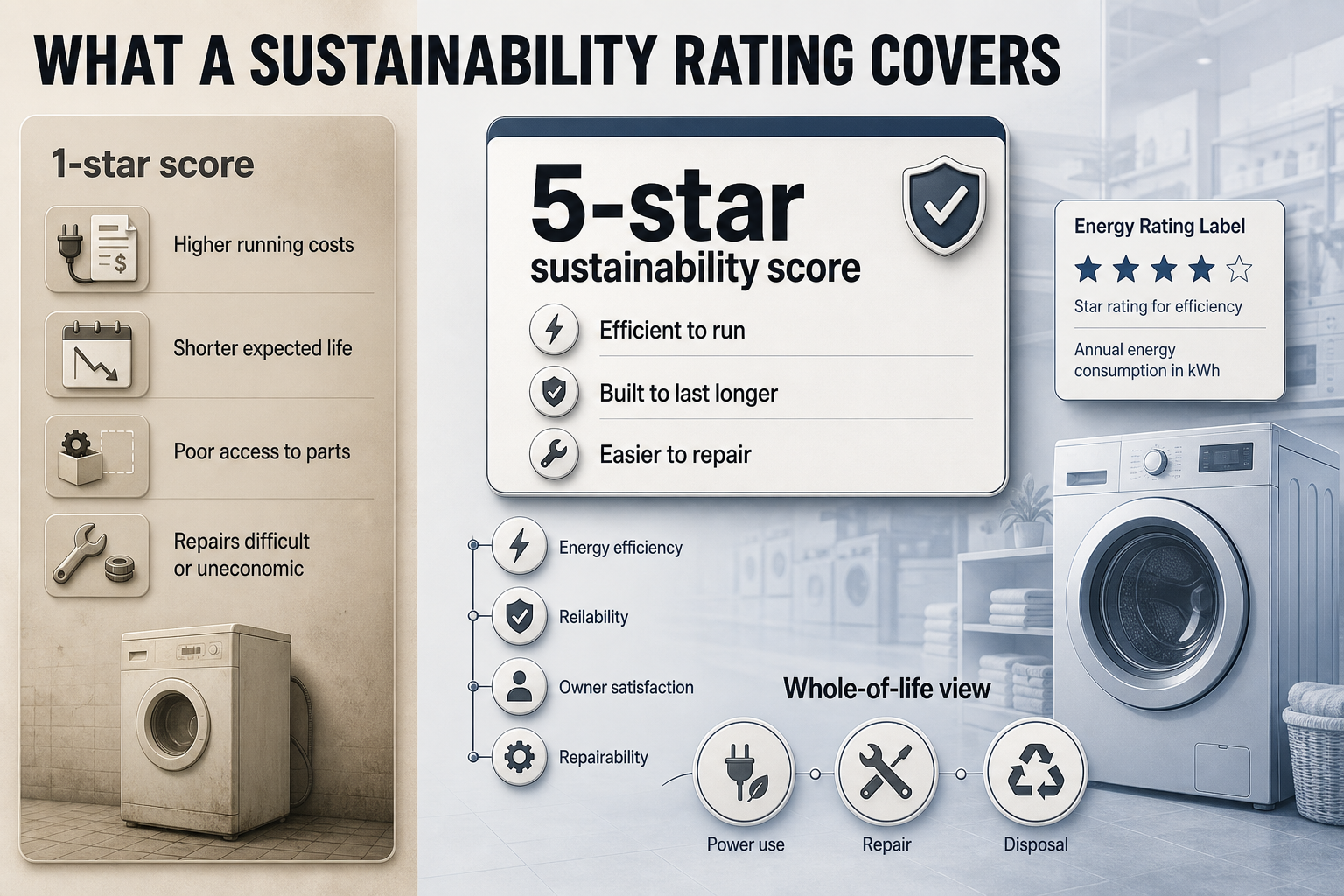
But energy efficiency is only one part of sustainability. Consumer NZ has been pushing harder on product lifetime, and its appliance scoring now includes measures such as reliability, owner satisfaction, and repairability. Consumer NZ has also introduced repairability ratings for some categories, including washing machines, because an appliance that cannot be fixed easily is more likely to be replaced early. (consumer.org.nz)
That distinction is important. Two washing machines can both have good energy numbers, but if one has poor spare-parts support or is costly to dismantle and repair, it may be the less sustainable choice over 10 years. The same logic applies to fridges, dryers, dishwashers, and heat pumps. A proper sustainability view looks at the whole life of the product, from power use to repair to disposal.
What to Look For
Start with the official energy information, because it is standardised and easy to compare. If you are looking at two similar fridges or dishwashers, do not stop at the stars alone. Check the annual kWh figure as well, because the label is designed for comparison within similar product types and sizes. A larger appliance can sometimes show a respectable star score while still using more electricity overall than a smaller alternative. (eeca.govt.nz)
Next, ask how long the appliance is expected to last and whether common faults are repairable. Consumer Protection says the Consumer Guarantees Act requires products to be durable and last a reasonable length of time, and that expectation can go well beyond the written manufacturer warranty. Consumer Protection also advises buyers to check whether a device is repairable before replacing it, noting that well-known brands are often easier to fix. (consumerprotection.govt.nz)
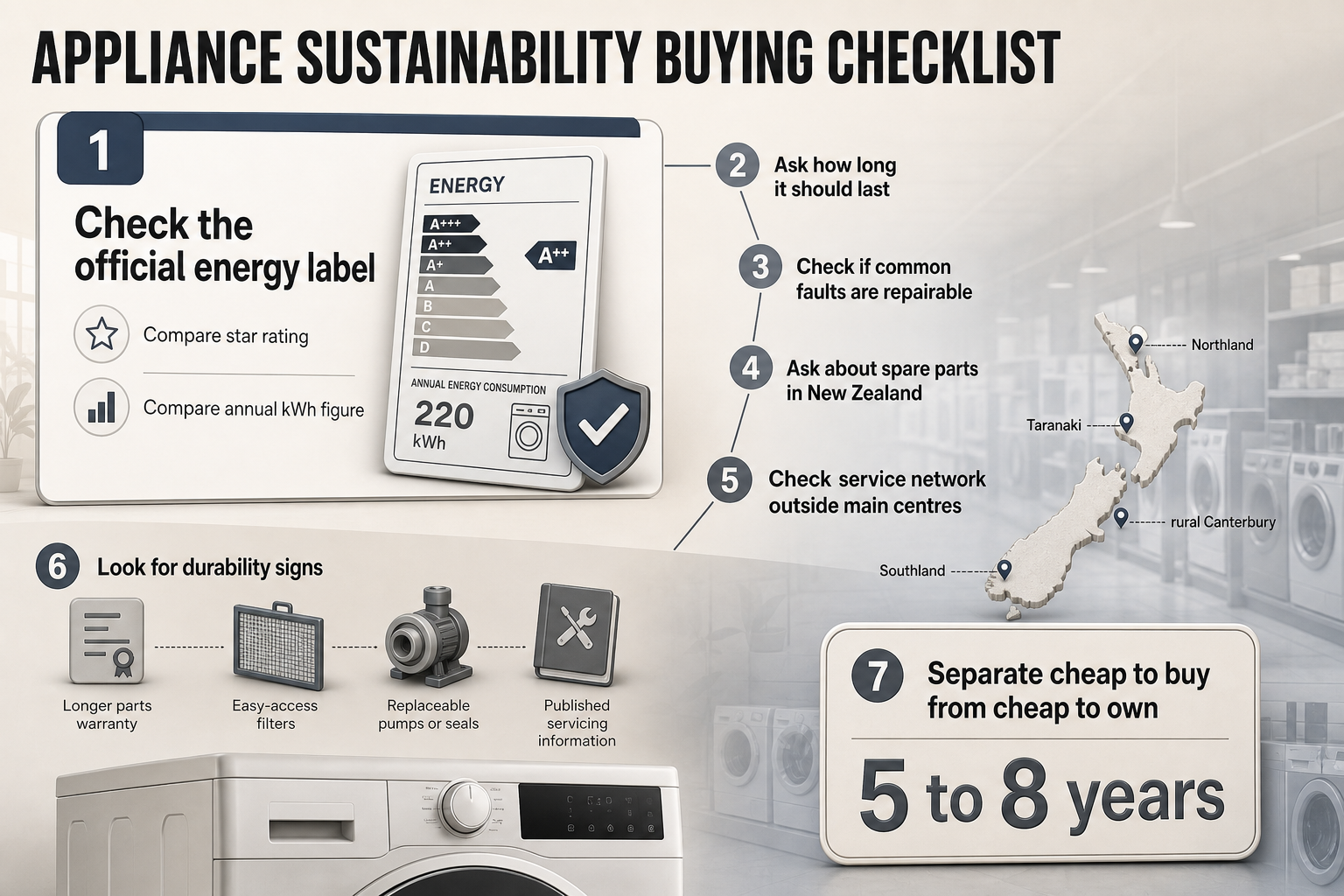
That makes repair support one of the smartest questions you can ask in-store. Ask whether spare parts are stocked in New Zealand, how long they are likely to remain available, and whether the brand has an established service network outside the main centres. If you live in Northland, Taranaki, Southland, or rural Canterbury, a brand with only limited urban service support may be less sustainable in real life than its brochure suggests.
You should also look for signs of durability rather than relying only on marketing language. A longer parts warranty, easy-access filters, replaceable pumps or seals, and published servicing information are all good signs. If independent reviews mention frequent electronic failures, control-board faults, or high repair costs, treat a high sustainability claim with caution. This is especially relevant for appliances with expensive electronics such as heat pumps, induction cooktops, and premium front-load washers.
A useful rule is to separate cheap to buy from cheap to own. A bargain dryer that uses more power and is not worth repairing may cost you more over five to eight years than a mid-priced model with lower energy use and better parts support. Consumer NZ’s life expectancy guidance also reinforces that buyers should expect a reasonable service life from household appliances, and that faults arising over time should still be repairable rather than automatically forcing replacement. (consumer.org.nz)
NZ Context
New Zealand gives you some protections that matter when judging sustainability. The Consumer Guarantees Act says goods must be of acceptable quality, and that includes durability. If an appliance fails earlier than a reasonable person would expect, your rights may extend beyond the manufacturer’s warranty. That is a big deal for expensive whiteware and heat pumps, where the sustainable outcome is often repair rather than replacement. (consumerprotection.govt.nz)
Electricity prices also make efficiency more than an environmental issue. A fridge, freezer, heat pump, or dryer runs often enough that a modest difference in annual kWh use can add up over the years. For many Kiwi households, especially where winter heating loads are high or power bills are already stretched, a more efficient appliance can reduce both emissions and running costs. EECA’s guidance is useful here because it explains that the label is designed to show both comparative efficiency and annual energy use. (eeca.govt.nz)
Climate and housing stock matter too. In colder parts of the South Island, a heat pump’s label and zone-specific performance are more relevant than a simple headline star count, because winter efficiency affects both comfort and bills. Consumer NZ notes that the newer Zoned Energy Rating Label for heat pumps gives information tailored more closely to New Zealand conditions than the older trans-Tasman approach. (consumer.org.nz)
Sustainability also has a waste angle in New Zealand. Consumer NZ has repeatedly argued that poor repairability leads to appliances being dumped too early, and has called for clearer repairability information at the point of sale. That means a sustainability rating is most useful when it reflects not just energy use, but whether the product can realistically stay in service for years with normal maintenance and sensible repairs. (consumer.org.nz)
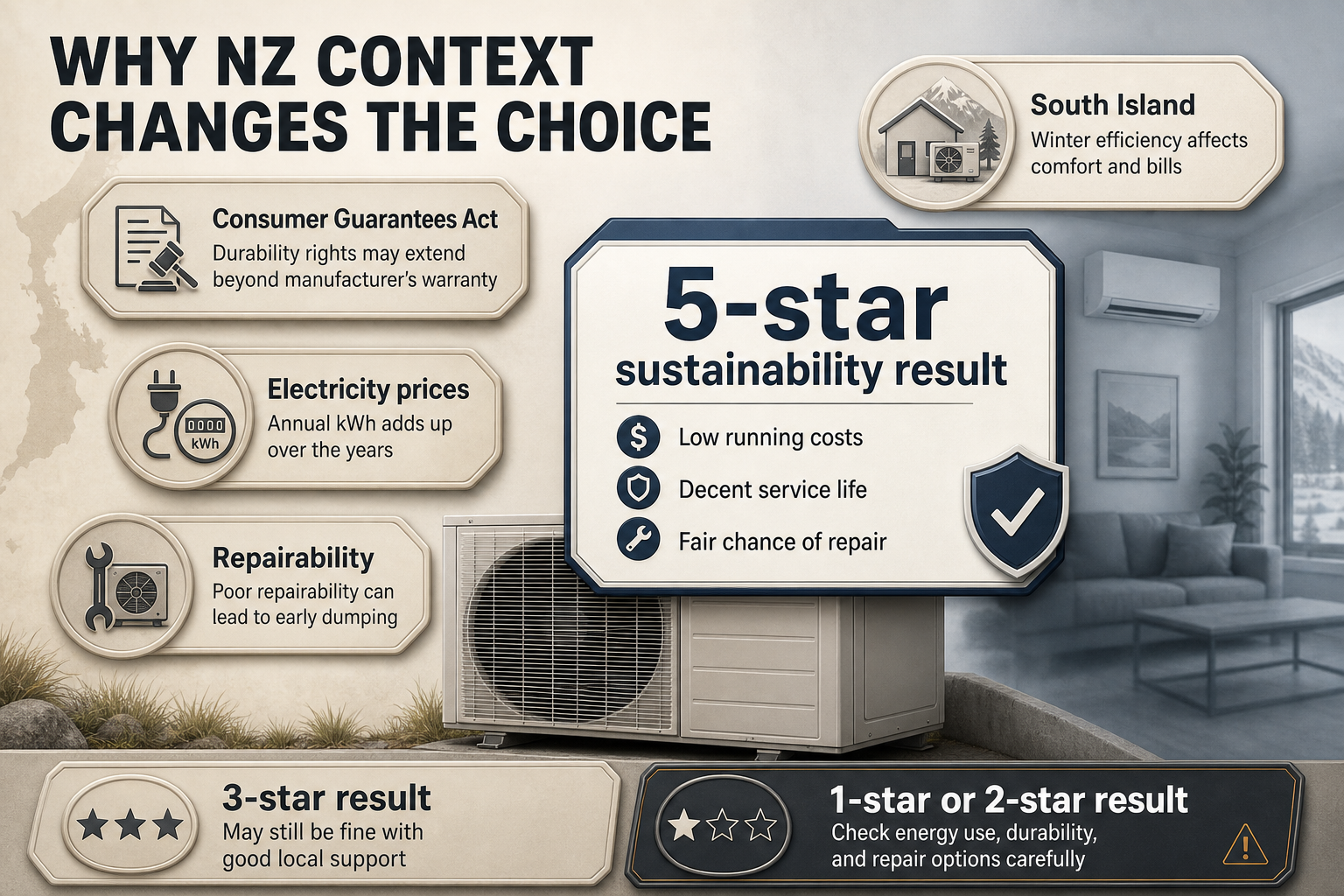
For buyers, the practical takeaway is simple. A 5-star sustainability result should mean low running costs, a decent service life, and a fair chance of repair if something goes wrong. A 3-star result may still be fine if the purchase price is right and the brand has good local support. A 1-star or 2-star result is a warning to check energy use, durability, and repair options very carefully before you commit.
You may also be interested in these independent articles
Sources
- [1]EECA: How to use Energy Rating Labels and star ratings
- [2]Consumer Protection: Product life, maintenance and care
- [3]Consumer Protection: Consumer Guarantees Act
- [4]Consumer Protection: Warranties
- [5]Consumer NZ: Washing machine repairability
- [6]Consumer NZ: How long should an appliance last?
- [7]Consumer NZ: About product lifetime scoring
- [8]Consumer NZ: Energy Rating Labels explained
© 2026 pyfoi. All rights reserved.