
What a Fridge Water Dispenser Rating Really Means
Learn what a refrigerator water dispenser rating really means in NZ, from plumbed vs non-plumbed setups to energy labels, before you buy.
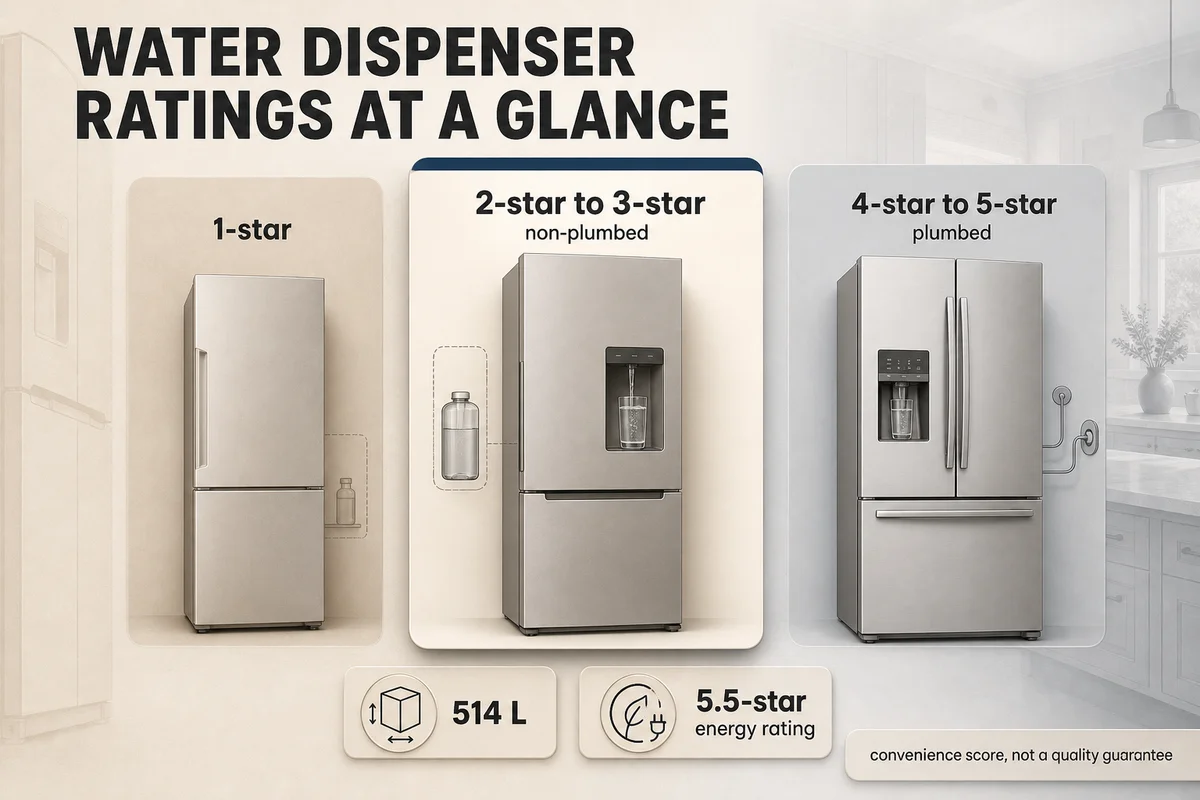
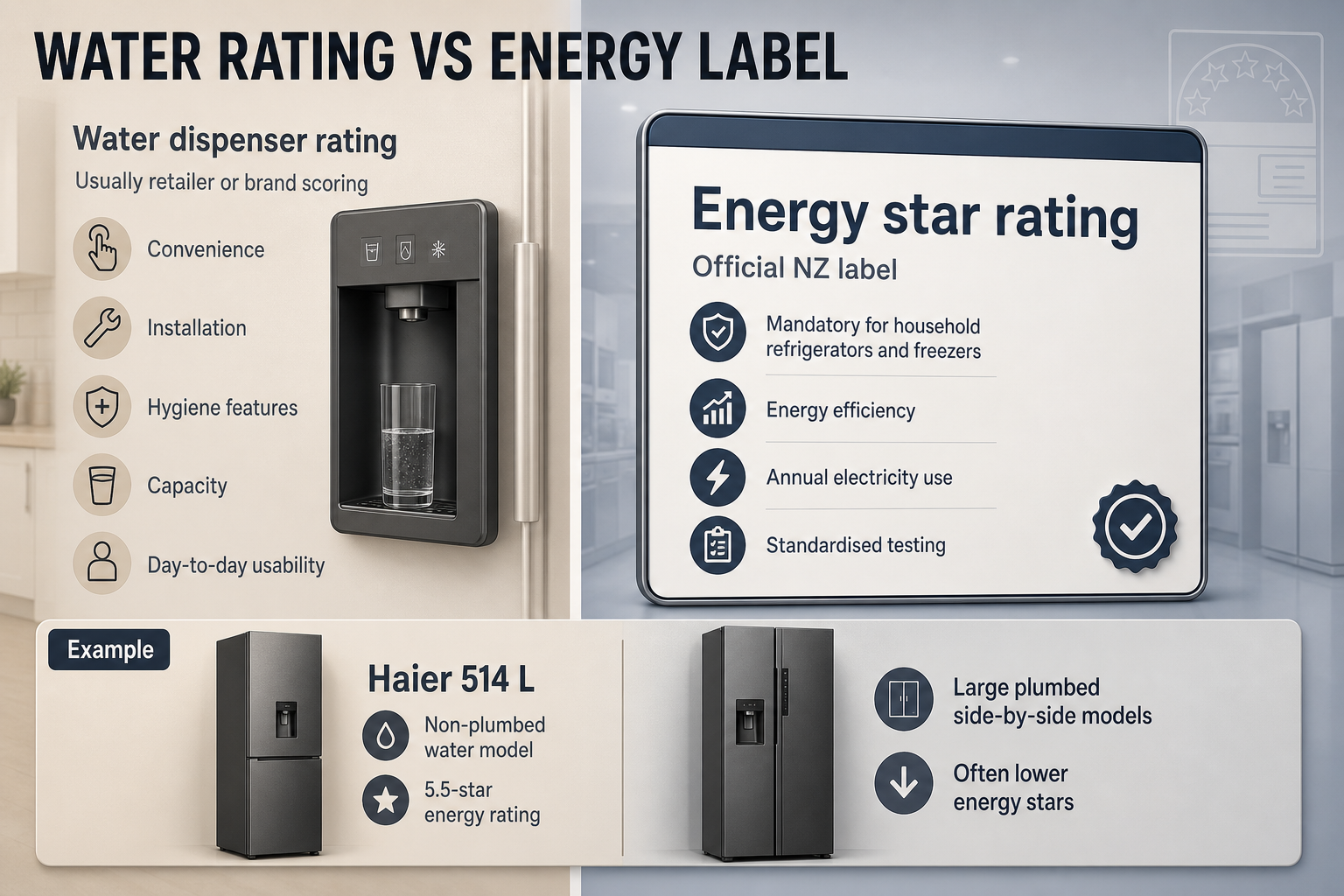
A refrigerator water dispenser rating is not an official New Zealand star label like the energy label on the front of a fridge. In practice, it is usually a retailer or brand scoring system that tries to summarise how good the water dispensing setup is, based on convenience, installation, hygiene features, capacity and day-to-day usability. For NZ buyers, that matters because a water dispenser can be genuinely useful, but it can also add cost, take up space and create extra maintenance.
What Goes Into the Rating
A low water dispenser rating on a refrigerator usually means the fridge has no dispenser at all, or has a very basic setup that adds convenience but not much else. At the other end, a high rating usually goes to fridges with a well-designed dispenser that is easy to use, easy to keep clean and well matched to the size and style of the appliance.
At the bottom end, think of a 1-star setup as either no water dispenser or a dispenser that feels like an afterthought. That might mean a small manual tank, awkward refilling, slow flow, no filtration, or a design that steals too much usable shelf space. These models can still suit some homes, especially if you rarely use chilled water and would rather save money up front.
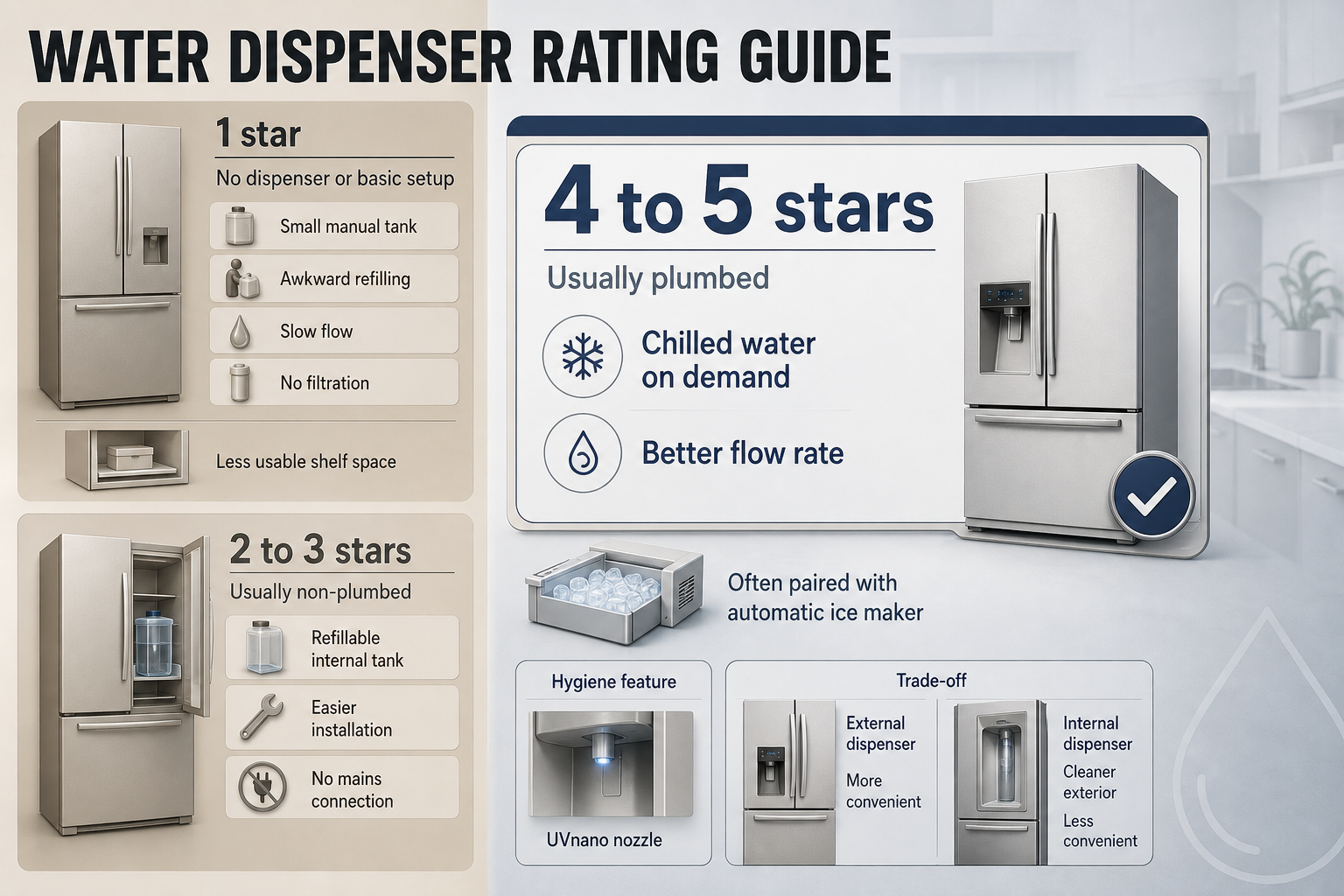
A 2-star to 3-star setup is often where non-plumbed dispensers sit. These use a refillable internal tank rather than a permanent water connection. They are popular because they are simpler to install and suit homes where plumbing to the fridge cavity is difficult or expensive. Haier sells NZ models with an easy-to-refill non-plumbed dispenser, and Samsung support material for non-plumbed refrigerators shows that these models use a water tank rather than a mains connection. (haier.co.nz)
A 4-star to 5-star setup usually means a plumbed dispenser, often paired with an automatic ice maker, better flow rate and more polished design. LG and Westinghouse both sell plumbed refrigerator models in this category, while Fisher & Paykel offers premium integrated refrigerators with internal water dispensers and ice makers. These higher-end systems are generally rated better because they provide chilled water on demand without refilling a tank, and they are often built into larger premium fridge formats. (lg.com)
Hygiene features can also lift a rating. Some premium LG models sold in New Zealand include UVnano on the water dispenser nozzle, which is designed to help keep the outlet cleaner. Features like this do not change the cooling performance of the fridge itself, but they can improve the ownership experience if your household uses the dispenser every day. (lg.com)
A good rating should also reflect how much compromise the dispenser creates. Some internal tanks reduce usable fridge space. Some door dispensers add thickness to the door or reduce door bin flexibility. On integrated premium models, brands sometimes move the dispenser inside the cabinet to preserve a clean exterior, which suits design-led kitchens but may be less convenient than an external dispenser. Fisher & Paykel’s integrated ice and water models are a good example of this trade-off. (fisherpaykel.com)
What to Look For
Start by checking whether the refrigerator water dispenser is plumbed or non-plumbed. This is the biggest practical difference. A plumbed dispenser connects to your household water supply and gives continuous access to chilled water, but it needs suitable plumbing behind or near the fridge. A non-plumbed dispenser uses a refillable tank, so installation is easier, but you need to top it up yourself. NZ and Australian brand listings from LG, Haier, Samsung and Westinghouse show both types are common in the market. (lg.com)
Then look at where the dispenser sits. External door dispensers are the most convenient for busy families because you can fill a glass without opening the fridge. Internal dispensers look tidier and can suit integrated kitchens, but they are slower to use. If your household grabs water all day, the convenience gap is bigger than many buyers expect.
Check whether filtration is built in and what maintenance it needs. Some plumbed systems use replaceable filters, which can improve taste depending on your local water supply, but they add ongoing cost. You should also check whether the brand has readily available replacement filters and service support in New Zealand. A water feature is only as good as the support behind it.
Flow rate and bottle clearance matter more than showroom impressions. A dispenser can look smart but still be annoying if it only fits short glasses or pours slowly. If you use reusable bottles, sports bottles or large jugs, measure them and compare that with the dispenser recess before you buy.
You should also ask how the dispenser affects fridge capacity and layout. A non-plumbed tank inside the door or cabinet takes up room that could otherwise hold food. In a compact bottom-mount fridge, that trade-off can be noticeable. In a 500 L or 600 L family fridge, it is usually easier to absorb.
Do not confuse a water dispenser rating with the official energy star rating. In New Zealand, household refrigerators must display an Energy Rating Label, and that label shows energy efficiency and annual electricity use under standardised testing. EECA says the label is mandatory for household refrigerators and freezers sold here, and the trans-Tasman Energy Rating system also notes that fridges must meet minimum energy performance standards. (eeca.govt.nz)
That distinction matters because a fridge can have an excellent water dispenser but only average energy efficiency, or the reverse. For example, Haier’s 514 L non-plumbed water model is listed with a 5.5-star energy rating, while some large plumbed side-by-side models from LG sit much lower on energy stars because they are bigger and have more features. The water system is only one part of the buying decision. (haier.co.nz)
NZ Context
New Zealand homes vary a lot in kitchen layout, and that affects whether a high water dispenser rating is actually useful. In a new build or renovated kitchen, plumbing a fridge cavity may be straightforward. In an older home, villa or rental, adding a water line can be awkward and expensive, which makes a non-plumbed dispenser more appealing even if it scores lower for convenience.
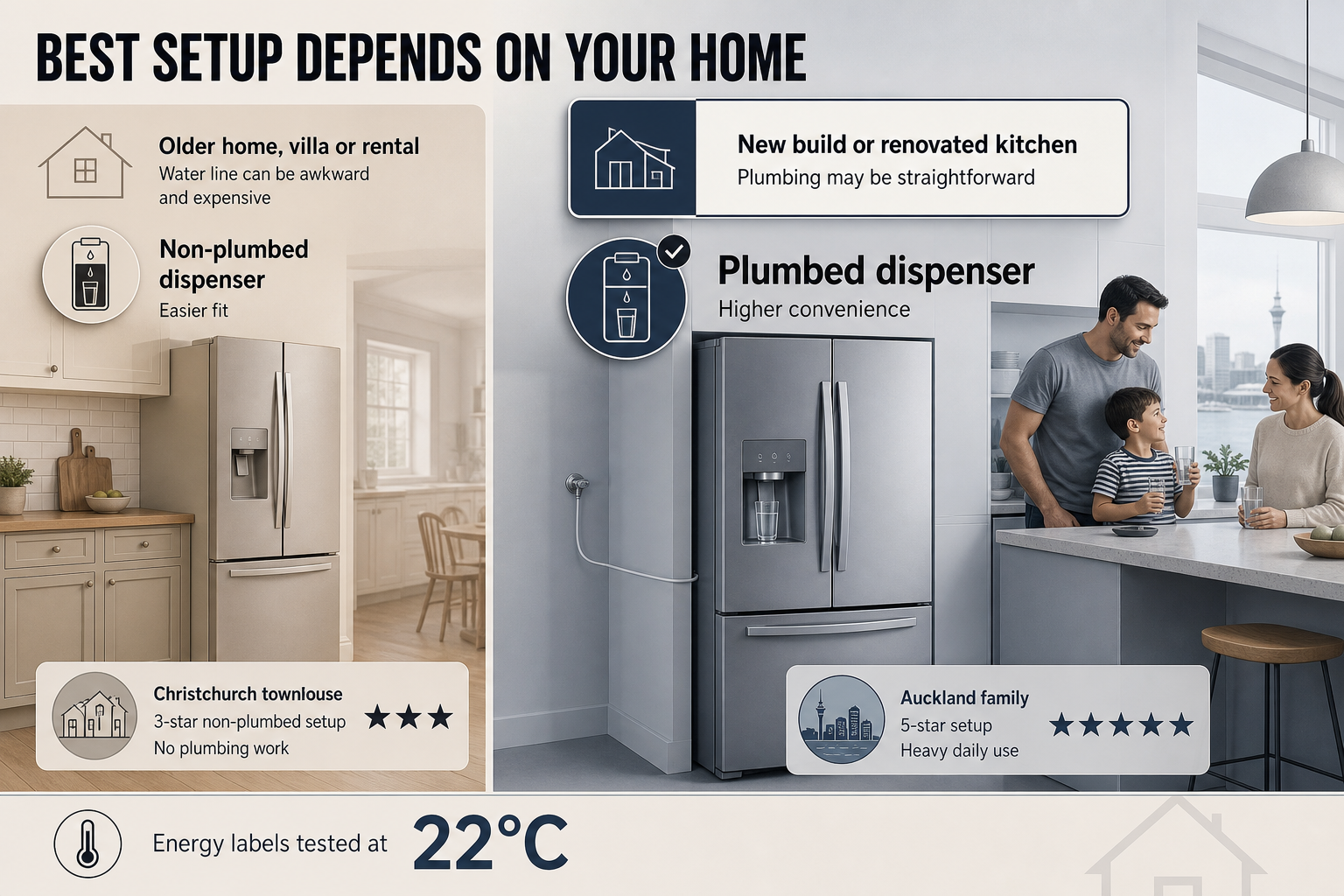
Running costs matter too. Fridges run all year, so energy efficiency deserves at least as much attention as water convenience. EECA notes that refrigerator energy labels are based on standardised testing at an ambient temperature of 22°C, which helps you compare models on a consistent basis. In warmer kitchens, garages or sun-exposed open-plan spaces, real-world electricity use can be higher. (eeca.govt.nz)
You should also think about service and consumer protection. In New Zealand, your rights do not stop when the manufacturer’s written warranty ends. Consumer Protection says the Consumer Guarantees Act applies to household goods sold by businesses in New Zealand, and that your rights can last longer than a manufacturer warranty if the product is not of acceptable quality or does not last a reasonable time. That is especially relevant for water dispensers, filters, valves and ice makers, which add complexity compared with a plain fridge. (consumerprotection.govt.nz)
A smart way to read a water dispenser rating, then, is as a convenience score rather than a quality guarantee. A 5-star dispenser setup may be brilliant for a busy family in Auckland with a plumbed kitchen cavity and heavy daily use. A 3-star non-plumbed setup may be the better buy for a Christchurch townhouse, a rental, or anyone who wants chilled water without paying for plumbing work or premium French-door pricing. The best rating is the one that fits how you actually live.
You may also be interested in these independent articles
Sources
- [1]EECA: How to use Energy Rating Labels and star ratings
- [2]EECA: Fridges and Freezers
- [3]Energy Rating: Fridges and freezers
- [4]Consumer Protection NZ: Consumer Guarantees Act
- [5]Consumer Protection NZ: Warranties
- [6]LG New Zealand: 637L French Door Fridge - Plumbed
- [7]Haier New Zealand: 514L 500 Series Refrigerator Bottom Freezer, Water, Non-plumbed
- [8]Fisher & Paykel New Zealand: 92cm Series 11 Integrated Refrigerator Freezer, Ice & Water
© 2026 pyfoi. All rights reserved.