
What Smart Home Ratings on Appliances Mean
Smart home ratings on appliances can mislead NZ buyers. Learn what stars really measure, from app control and Matter to privacy and offline use.
A smart home rating on an appliance is meant to tell you how well it fits into a connected home. It sounds simple, but the stars usually bundle together several things at once: app control, voice assistant support, automation, energy features, and how easily the appliance works with other devices. For New Zealand buyers, that matters because a flashy app is not much use if the product is awkward on local Wi-Fi, lacks long-term support, or becomes a headache after one software update.
What Goes Into the Rating
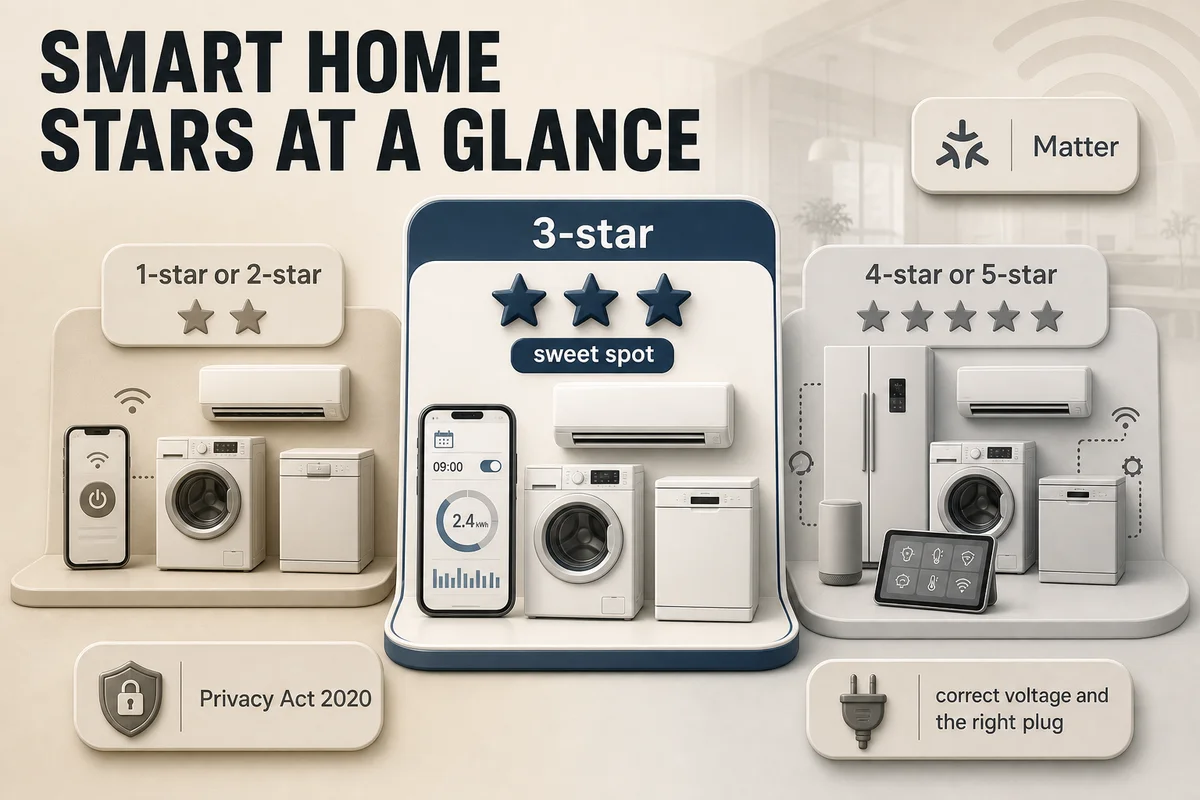
A smart home rating is not a regulated New Zealand standard in the way an electrical compliance mark is. In practice, retailers and review sites usually calculate it from a mix of features rather than one official test. That means you should treat the stars as a shortcut, not a final verdict. A 5-star smart appliance is usually one that does more than simple remote on-off control. It tends to offer reliable app setup, scheduling, notifications, voice assistant integration, and some level of interoperability with wider ecosystems such as Google Home, Apple Home, Alexa, or Matter-enabled platforms. Matter is the industry standard designed to improve cross-brand compatibility, and newer versions have expanded support for more device categories and energy management features. (csa-iot.org)
At the low end, a 1-star or 2-star appliance often has only basic connected features. That might mean an app that mirrors the controls already on the front panel, with little else. You may get remote start, a timer, or a maintenance alert, but no useful automation and no support for broader smart home routines. These products can still suit you if you just want to switch on a heat pump before getting home or check whether the washing machine has finished.
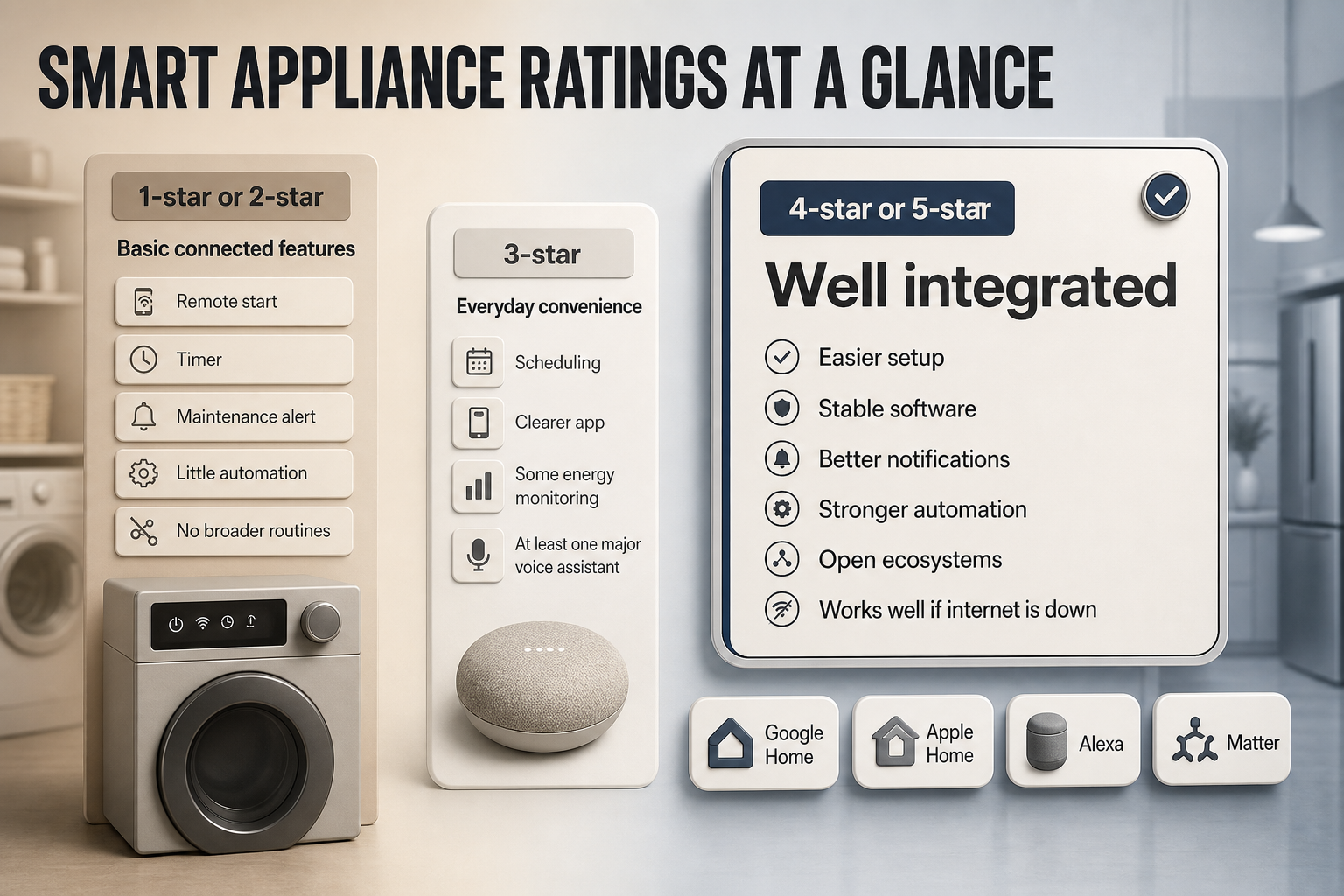
A mid-range 3-star appliance usually adds better everyday convenience. Expect scheduling, a clearer app, some energy monitoring, and support for at least one major voice assistant. This is often the sweet spot for most households. You get genuine convenience without paying a premium for features you may never use.
A 4-star or 5-star appliance should feel well integrated rather than merely connected. That means easier setup, stable software, better notifications, stronger automation options, and support for open ecosystems instead of locking you into one brand. The best examples also keep working well as a normal appliance even if your internet is down. That point is easy to miss, but it matters. A dishwasher that washes brilliantly is still a good dishwasher. A dishwasher that needs an app for basic settings is not especially smart.
What to Look For
The first question is whether the appliance is smart in a useful way for your life. A connected dehumidifier in a damp Wellington flat can be genuinely handy if you can schedule it around power prices or humidity levels. A smart oven may be useful if you like remote pre-heating and recipe integration. But a connected kettle or toaster often adds cost faster than value. Do not assume more stars automatically mean a better buy.
Look closely at compatibility. If you already use Google Home, Apple Home, or Alexa, check whether the appliance supports your system directly. If it supports Matter, that is a good sign for future flexibility because Matter is intended to reduce the usual brand silos. Still, “works with” claims vary in depth. One appliance may allow full control, while another only supports on-off commands. (csa-iot.org)
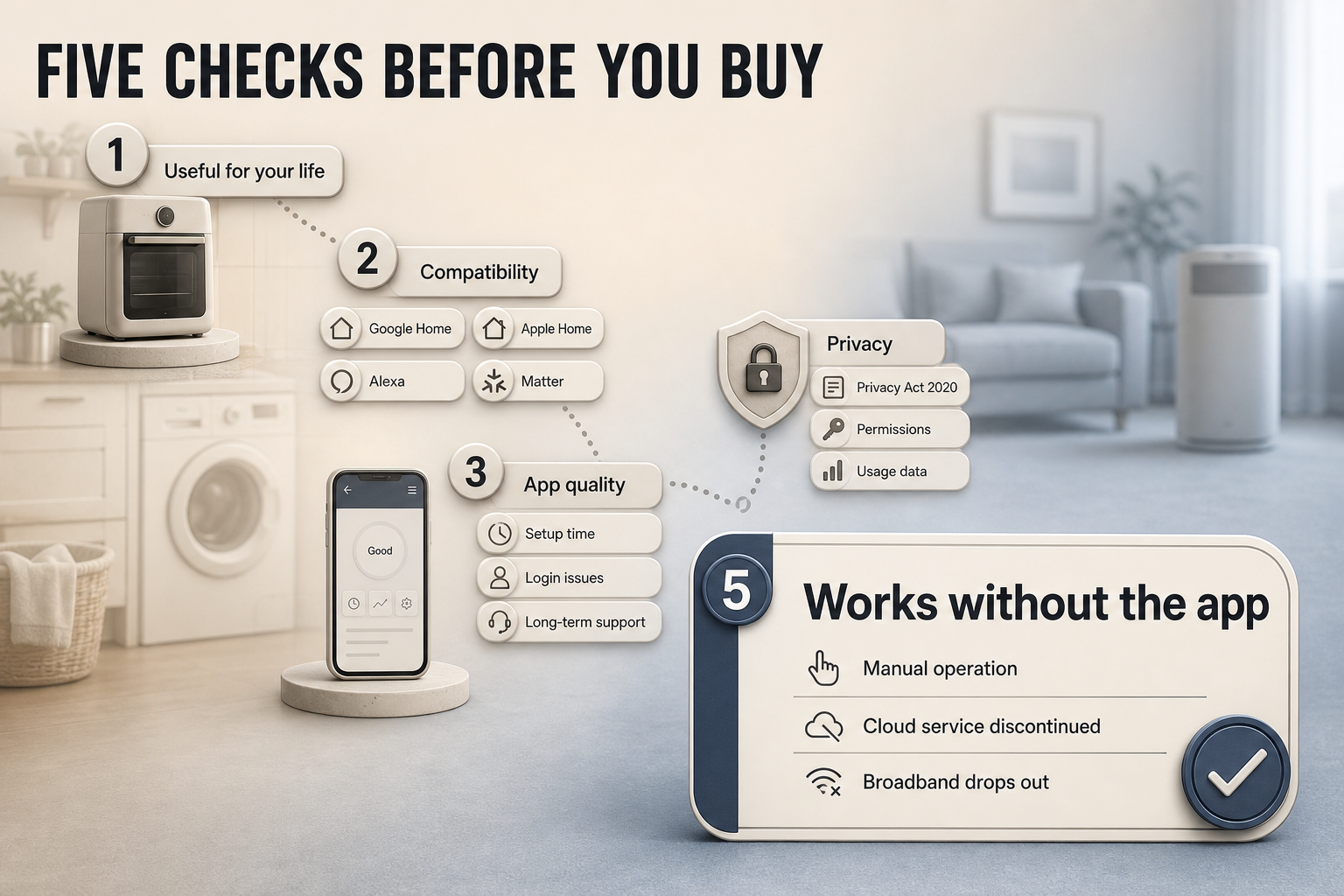
App quality matters more than the star graphic on the product page. Read reviews that mention setup time, login issues, and whether the app still works well after a year or two. Smart appliances depend on software support. If the maker has a weak record for updates, the rating can age badly. This is especially important for appliances that collect usage data or connect to cloud services. CERT NZ advises keeping devices patched and being careful about the software and apps installed on connected devices, because outdated or poorly managed devices can create security risks. (cert.govt.nz)
Privacy deserves the same attention as convenience. Smart appliances can collect data about when you are home, how often you cook, wash, heat, or cool rooms, and sometimes where the device is installed. In New Zealand, the Office of the Privacy Commissioner regulates compliance with the Privacy Act 2020, and good privacy practice includes being open about why information is collected and protecting it properly. If an appliance app asks for more permissions than seem necessary, that is a warning sign. (privacy.org.nz)
You should also check whether the appliance remains usable without the app. This is a big separator between average and excellent smart products. If your broadband drops out in rural Otago or a cloud service is discontinued, you still need the machine to do its main job. A high smart home rating is only meaningful if the “smart” layer adds convenience without creating dependence.
NZ Context
For New Zealand buyers, electrical safety comes first. Any connected appliance still has to be a safe appliance. WorkSafe notes that products sold here should have the correct voltage and the right plug for New Zealand, and the voluntary Regulatory Compliance Mark can be used on products shown to meet applicable electrical safety and electromagnetic requirements for legal sale in New Zealand and Australia. That matters if you are tempted by a parallel import from overseas because a bargain smart appliance with the wrong plug, voltage assumptions, or unsupported app region can quickly become a poor buy. (worksafe.govt.nz)
Warranty and after-sales support matter more with smart appliances than with basic ones. If the connected features fail, the hardware may still work, but part of what you paid for has gone missing. Under the Consumer Guarantees Act, goods supplied to consumers must be of acceptable quality, and MBIE notes that the Act includes a guarantee that goods are safe. In plain terms, if a retailer promoted app control, voice integration, or energy monitoring as part of the product, those features should work as a reasonable buyer would expect. (mbie.govt.nz)
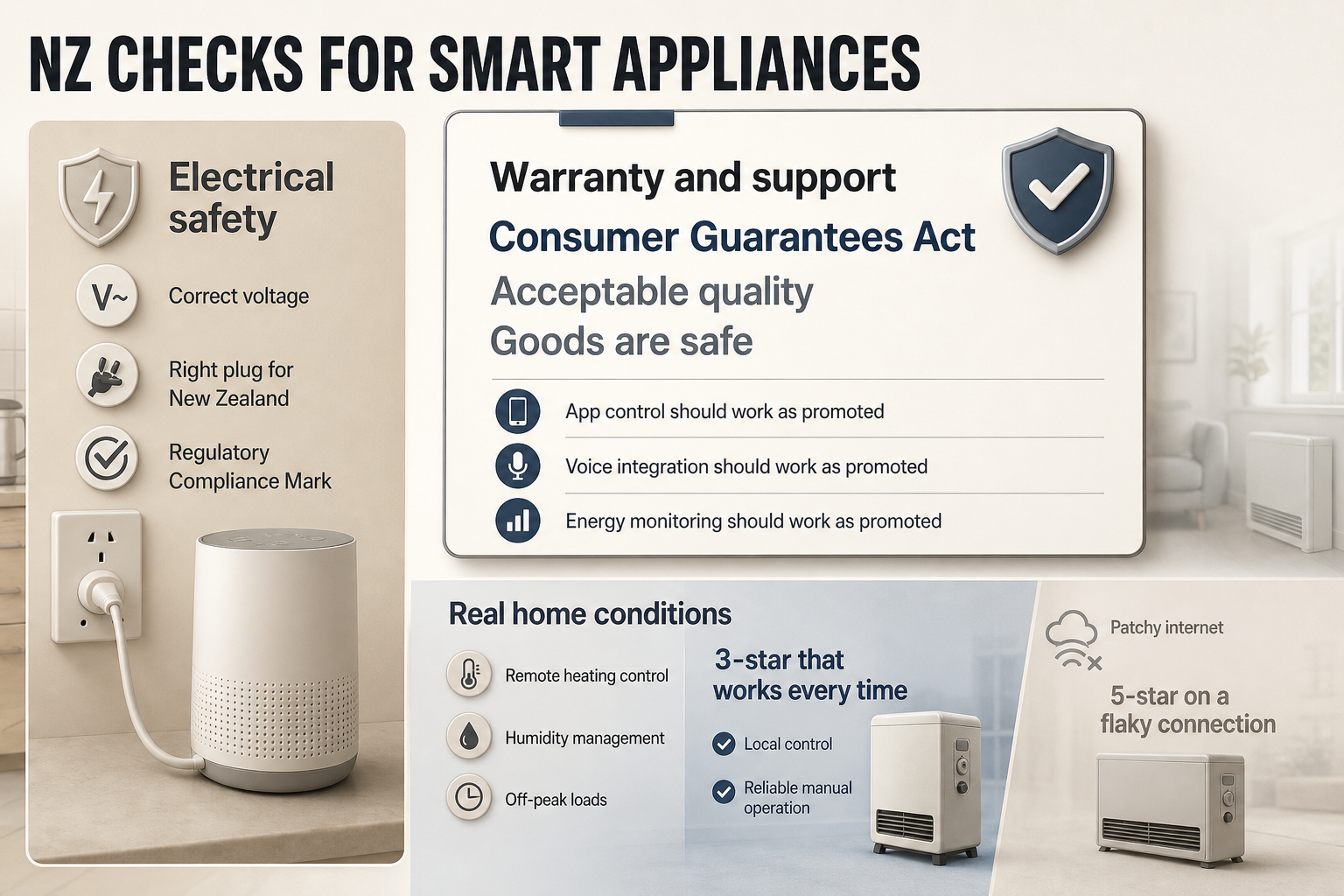
New Zealand homes also shape which smart features matter most. In colder southern regions, remote heating control and humidity management can be genuinely useful. In Auckland apartments, smart appliances that help you run loads off-peak may be more appealing than complex multi-room automation. In rural areas, patchy internet can make cloud-heavy products frustrating, so local control and reliable manual operation deserve extra weight. You are often better off with a 3-star appliance that works every time than a 5-star one that depends on a flaky connection.
Safety recalls are another local factor. MBIE has highlighted recalled household products such as bathroom heaters, which is a reminder that connected features do not replace the basics of product safety and support. WorkSafe also advises checking appliances for damage, using the correct plug and voltage, and having faulty products repaired by qualified people. If a smart appliance includes lithium-ion batteries, battery safety guidance also applies. (mbie.govt.nz)
The best way to read a smart home rating, then, is as a guide to convenience rather than a badge of quality on its own. A higher score should mean better integration, easier control, stronger compatibility, and more useful automation. For a New Zealand household, though, the real test is simpler: does it suit your power, your internet, your privacy expectations, and your day-to-day routine, and will it still be a good appliance if the “smart” part is not perfect?
You may also be interested in these independent articles
Sources
- [1]WorkSafe New Zealand: Electrical equipment and appliances
- [2]WorkSafe New Zealand: Electrical safety compliance
- [3]WorkSafe New Zealand: Standards and testing
- [4]WorkSafe New Zealand: Safe use of lithium-ion batteries and battery products
- [5]MBIE: Status quo - current government interventions
- [6]MBIE: Consumer Protection quarterly reports
- [7]Office of the Privacy Commissioner: What is good privacy practice?
- [8]Office of the Privacy Commissioner: Security and Internal Access Controls
- [9]CERT NZ: Implementation advice for patching
- [10]Connectivity Standards Alliance: Matter 1.5 Introduces Cameras, Closures, and Enhanced Energy Management Capabilities
© 2026 pyfoi. All rights reserved.